Arabic, spoken by at least 400 million people, uses a 28-letter script written right to left and often omits short vowels. Modern Standard Arabic serves official roles while 25+ dialects are spoken regionally. Centuries of trade, scholarship and cultural contact have led to hundreds of Arabic loanwords in English and other languages — examples include algebra (al-jabr), carat (qirat), giraffe (zarafa) and tariff (taʿrīf). These loanwords show how languages adapt sounds and meanings as they travel across cultures.
From A for Algebra to T for Tariffs: How Arabic Shaped English Vocabulary

(Al Jazeera)
Arabic is one of the world's most widely spoken languages, with at least 400 million speakers — roughly 200 million native speakers and 200–250 million non-native users. Modern Standard Arabic (MSA) functions as the formal register for government, law and education, while more than 25 regional dialects are spoken across the Middle East and North Africa.
Why December 18 Matters
Each year on December 18 the United Nations observes World Arabic Language Day, recognising Arabic as “the pillar of the cultural diversity of humanity.” The date marks the 1973 UN General Assembly decision to adopt Arabic as one of its six official languages.
(Al Jazeera)
How Arabic Reached Other Languages
As the largest member of the Semitic language family, Arabic has influenced many societies and languages for centuries. Linguists attribute the spread of Arabic-origin vocabulary to sustained contact through trade, scholarship, religion and cultural exchange. English, Spanish, French, Turkish and many other languages borrowed hundreds — sometimes thousands — of terms from Arabic, often adapting them to local sounds and spelling systems.
Natural Borrowing
Muntasir Al Hamad, a linguist and professor of Arabic at Qatar University, describes this process as a “natural phenomenon” and notes that languages have exchanged vocabulary for centuries. According to Al Hamad, Arabic contributed words across everyday speech, science, technology and administration.
(Al Jazeera)
Alphabets, Script and Perceived Difficulty
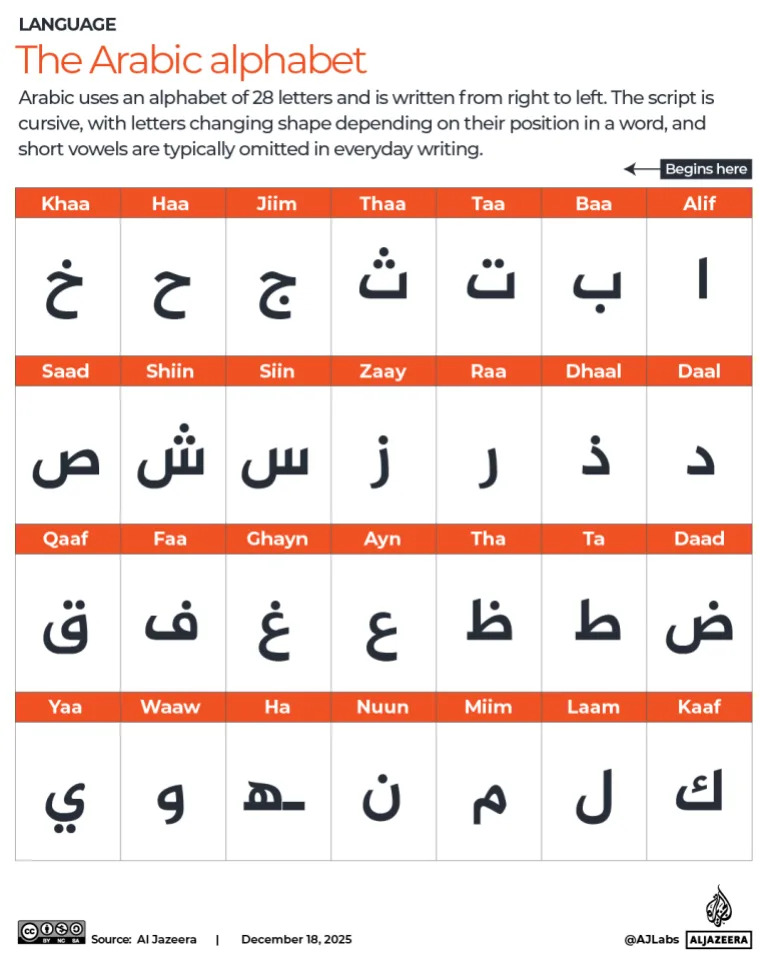
Arabic uses a 28-letter alphabet written from right to left. The script is cursive: letters change shape depending on their position, and short vowels are often omitted in everyday writing. These features — along with a large, nuanced vocabulary — sometimes make learners perceive Arabic as particularly difficult.
“Arabic is simply a language with systems that differ from English or many European languages,” Al Hamad says. He adds that the script looks familiar to speakers of Urdu and Farsi, and that Turkish speakers often find Arabic vocabulary easier to memorise because Turkish has absorbed many Arabic words.
Words That Traveled
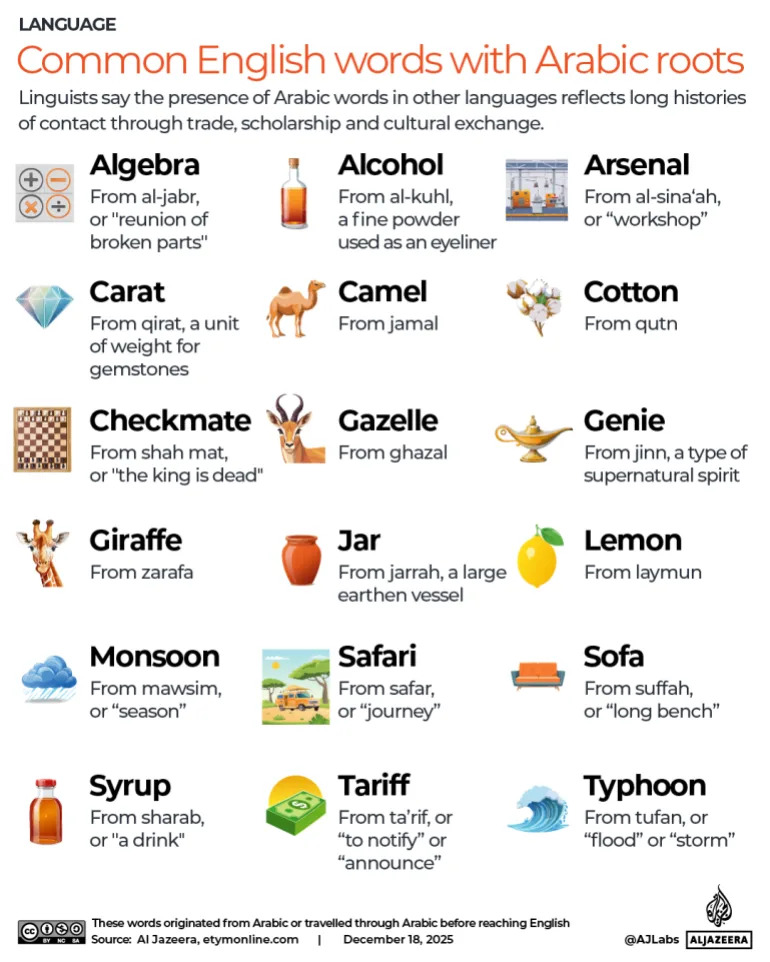
Many scientific and everyday terms entered European languages through Arabic, and some were transformed considerably in sound and spelling along the way:
- Algebra — From Arabic al-jabr ("restoration" or "reunion"). The term appears in the title of a 9th-century treatise by the Baghdad-based scholar Muhammad ibn Musa al-Khwarizmi; his name is also the root of the word “algorithm.”
- Carat — From Arabic qirat, a unit for weighing gemstones. Unfamiliar consonants were adapted into forms more natural to European tongues (q → c/g/k).
- Giraffe — Traces back to Arabic zarafa, later reshaped by European phonetics.
- Tariff — From Arabic taʿrīf ("to notify" or "to announce"), often entering English via Romance languages and through contact with Turkish, which historically borrowed heavily from Arabic.
Mutual Exchange Over Centuries
Borrowing was rarely one-way. During medieval trade networks and the later colonial era, English both absorbed words from Arabic and contributed terms back to Arabic. The result is a rich, mutual linguistic legacy that still appears in everyday speech, specialist vocabulary and technical terms.
Why It Matters
Understanding these word histories reveals how languages adapt unfamiliar sounds and concepts, and it highlights centuries of cultural and intellectual exchange. Far from being merely academic, these connections shape the words we use daily — from mathematics to commerce and beyond.
Help us improve.