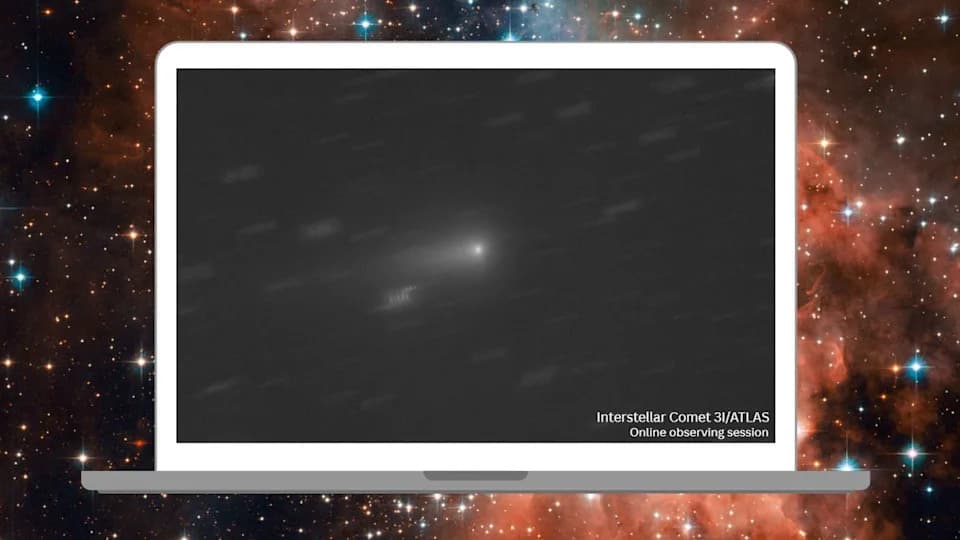
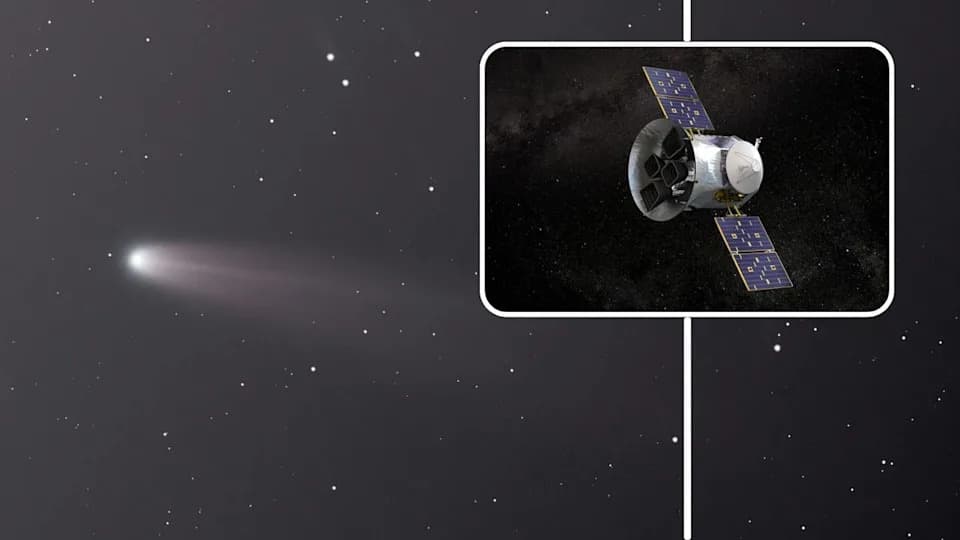
Tune in tonight (Jan. 22) at 6:30 p.m. EST (23:30 GMT) for a free livestream from the Virtual Telescope Project showing interstellar comet 3I/ATLAS at opposition. The comet is expected to be faint (about magnitude +13.2 per COBS) and will require large telescopes to see. Discovered on July 1, 2025 by the NASA-funded ATLAS survey, 3I/ATLAS is the third confirmed interstellar visitor and will pass roughly 33.4 million miles (53.7 million km) from Jupiter in March before continuing out of the solar system.
Watch Interstellar Comet 3I/ATLAS Race Out of the Solar System — Free Livestream Tonight (Jan. 22)
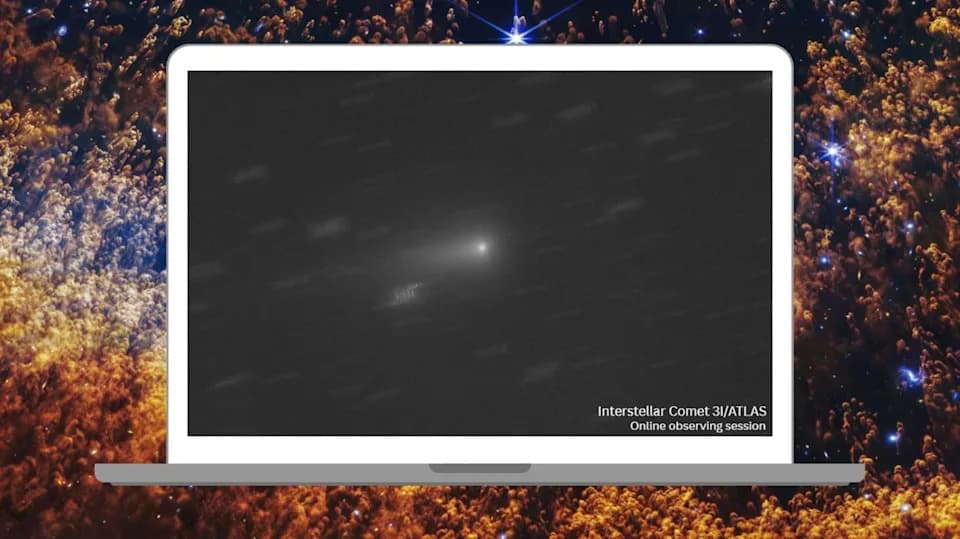
Credit: Gianluca Masi, Virtual Telescope Project. Background image: Image: NASA, ESA, CSA, STScI; Image Processing: Alyssa Pagan (STScI). Created by Anthony Wood in Canva.
Tune in tonight (Jan. 22) to watch live views of interstellar comet 3I/ATLAS at opposition as it heads outbound from the solar system. The Virtual Telescope Project will broadcast real-time images from its robotic telescopes in Manciano, Italy.
Livestream Details: The stream is scheduled to begin at 6:30 p.m. EST (23:30 GMT). Observers should be aware that ground-based observations can be disrupted by clouds or poor seeing; weather forced the cancellation of an earlier stream on Jan. 16.
What 'Opposition' Means: Opposition occurs when an object appears opposite the Sun in Earth's sky. At opposition, solar system objects are typically best illuminated from our perspective and can appear at their brightest — similar to how a full Moon is fully lit.
Brightness (Magnitude): Astronomers use "magnitude" to express apparent brightness. Lower numbers are brighter: bright stars are near +1, the full Moon is about -13, and the Sun is roughly -27. Comet 3I/ATLAS is predicted to be relatively faint at around magnitude +13.2 at opposition, according to the Comet Observation Database (COBS) maintained by Crni Vrh Observatory in Slovenia. At that level it will be invisible to the naked eye and will require large amateur or professional telescopes to detect.
Discovery and Interstellar Status: Astronomers discovered 3I/ATLAS on July 1, 2025, while analyzing data from the NASA-funded Asteroid Terrestrial-impact Last Alert System (ATLAS). Rapid orbit determinations showed the object is on an unbound trajectory — making it only the third confirmed interstellar visitor to our system after 1I/ʻOumuamua and 2I/Borisov.
Recent and Upcoming Trajectory Events: The comet passed closest to the Sun (perihelion) on Oct. 31, 2025, then disappeared for several weeks near the glare of a bright star. It made its closest approach to Earth on Dec. 19, 2025. In March it is expected to make a distant flyby of Jupiter, passing roughly 33.4 million miles (53.7 million km) from the planet, before continuing on a one-way path out of the solar system.
How To Watch: For the livestream, visit the Virtual Telescope Project's website or its social channels at the scheduled time. If you plan to try observing the comet yourself, prepare a large-aperture telescope and check local sky conditions in advance.
Note: All times and predicted brightness come from organisers and the Comet Observation Database (COBS). Actual visibility may vary with observing conditions and refined brightness estimates.
Help us improve.