
An astronaut photo taken Jan. 26, 2022, shows Yellowstone Lake almost entirely covered by deep snow, rendering it a stark white void from orbit. The lake sits at 7,733 ft (2,357 m), spans about 20 miles (32 km) at its widest point and reaches 410 ft (125 m) deep. Beneath the ice, powerful hydrothermal vents—some measured at about 345°F (174°C)—keep the water warmer and sustain North America’s largest cutthroat trout population. The vents are fueled by a magma body roughly 2.6 miles (3.8 km) below, inside a caldera formed about 640,000 years ago.
Deep Snow Turns Yellowstone Lake Into a Stark White Void — Earth From Space

Yellowstone Lake transforms into a featureless white void during the winter months, when snow and ice cover its surface. | Credit: NASA/ISS program
An astronaut aboard the International Space Station captured a striking image on Jan. 26, 2022, showing Yellowstone Lake nearly buried beneath a thick blanket of snow. From orbit the lake appears as a smooth, colorless expanse, interrupted only by a few island tops poking through the white surface.
Where: Yellowstone National Park, Wyoming (44.46284445, -110.3628428)
What you’re seeing: Yellowstone Lake, the largest high-elevation lake in North America, sits at 7,733 feet (2,357 m) above sea level. It spans roughly 20 miles (32 km) at its widest and reaches a maximum depth of about 410 feet (125 m), according to the National Park Service.
Each winter the lake freezes, typically in late December or January, producing an ice sheet that can range from a few inches to nearly 2 feet (0.6 m) thick. Snow accumulates on top of that ice and by March can reach depths of roughly 3.5 feet (1.1 m), NASA’s Earth Observatory reports. The ice and snow usually clear by late May or early June.
Despite rising atmospheric temperatures, Yellowstone Lake’s surface ice and seasonal snow cover have remained unusually resilient compared with other high-altitude lakes — a notable outlier in studies of climate impacts on alpine and subalpine water bodies.
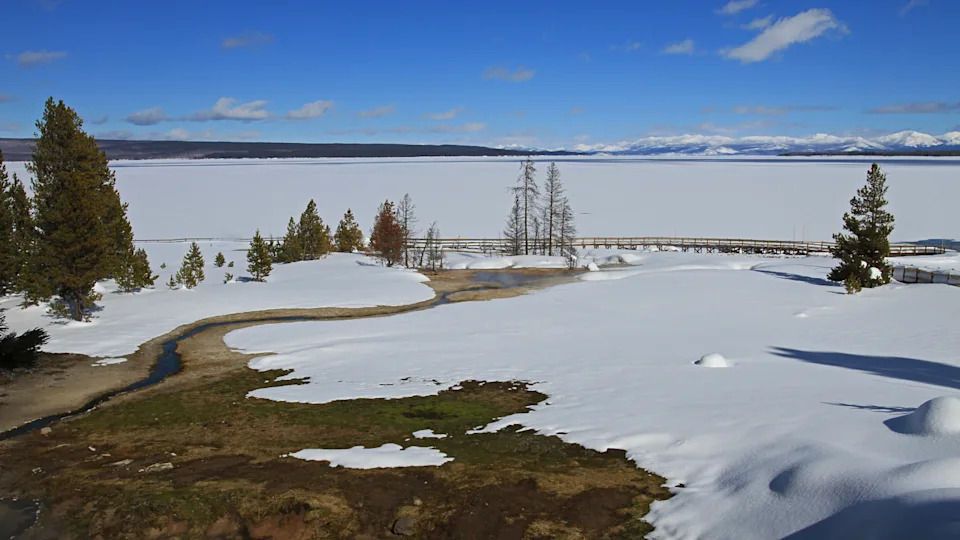
The snow covering Yellowstone Lake can reach up to 3.5 feet (1.1 m) deep. This photo of the lake was taken in February 2014. | Credit: Smith Collection/Gado/Getty Images
Not just cold — heat below: While the frozen surface looks barren, the lake’s floor hosts numerous hydrothermal vents. These vents release heat that helps maintain milder water temperatures beneath the ice and supports aquatic life through the long winter season, including Yellowstone’s large population of cutthroat trout (Oncorhynchus clarkii) — the largest cutthroat population in North America, per the National Park Service.
One vent near Stevenson Island has been measured releasing water at about 345°F (174°C) — hotter than Old Faithful and every other known surface geyser or hot spring in the park. The high temperatures are possible because the weight of the overlying lake water increases pressure, allowing water to remain liquid at temperatures above the normal surface boiling point. The U.S. Geological Survey notes these are the hottest hydrothermal vents recorded in any lake worldwide.
The hydrothermal system is driven by a large magma body roughly 2.6 miles (3.8 km) beneath the park. That magma, together with past massive eruptions, shaped the landscape: a colossal eruption about 640,000 years ago created the approximately 1,500-square-mile (3,900 km²) caldera that now holds Yellowstone Lake, and a later eruption about 130,000 years ago excavated the doorknob-shaped West Thumb area visible in the astronaut photo.
Context and caution: The presence of a large shallow magma body is why Yellowstone remains volcanically active and closely monitored by scientists. While the region is often described in popular accounts as a potential “supervolcano,” experts emphasize that any future major eruption would be detected well in advance through seismicity, ground deformation, gas emissions and other signs — and that such events occur on geological timescales, not human ones.
This image provides a vivid contrast: a frozen, monochrome surface that conceals intense geologic heat and biological activity beneath. It’s a reminder of how dynamic Earth processes can be, even under a seemingly lifeless winter skin.


