
The study in Nature Geosciences finds fast‑changing submesoscale eddies — “underwater storms” up to ~6 miles wide — intensify melting beneath Pine Island and Thwaites ice shelves and accounted for about 20% of observed melt over nine months. These eddies pull warm deep water upward, creating a positive feedback that can amplify melting. While experts praise the insight, they stress that more in‑situ data are needed because much of the analysis depends on models.
Underwater ‘Storms’ Are Eating the Doomsday Glacier — Short‑Lived Eddies May Accelerate Sea‑Level Rise
10:59 PM, 12/10/2025

Thwaites Glacier in Antarctica, known as the Doomsday Glacier, is experiencing melting from churning underwater "storms." - Jeremy Harbeck/NASA
Swirling, short-lived underwater “storms” — called submesoscale eddies — are intensifying melting beneath the floating ice shelves of Pine Island and Thwaites glaciers, new research shows. The finding raises fresh concerns about how quickly Antarctic ice could contribute to global sea‑level rise.
What The Study Found
The study, published in Nature Geosciences, is the first systematic look at how ocean processes operating on hours-to-days timescales — rather than months or years — affect ice-shelf melt. Combining computer models with in‑situ ocean measurements, the authors report that short‑lived, weather‑like ocean features were responsible for roughly 20% of the melt observed at the two glaciers during a nine‑month period.
How These “Underwater Storms” Work
Submesoscale eddies are fast-changing swirls of water that form where warm and cold water masses meet. In the open ocean they can stretch up to about 6 miles across. Once generated, these eddies can rush beneath ice shelves and, trapped between an uneven ice base and the seafloor, stir warmer deep water upward. That warm water accelerates melting where it contacts vulnerable ice.
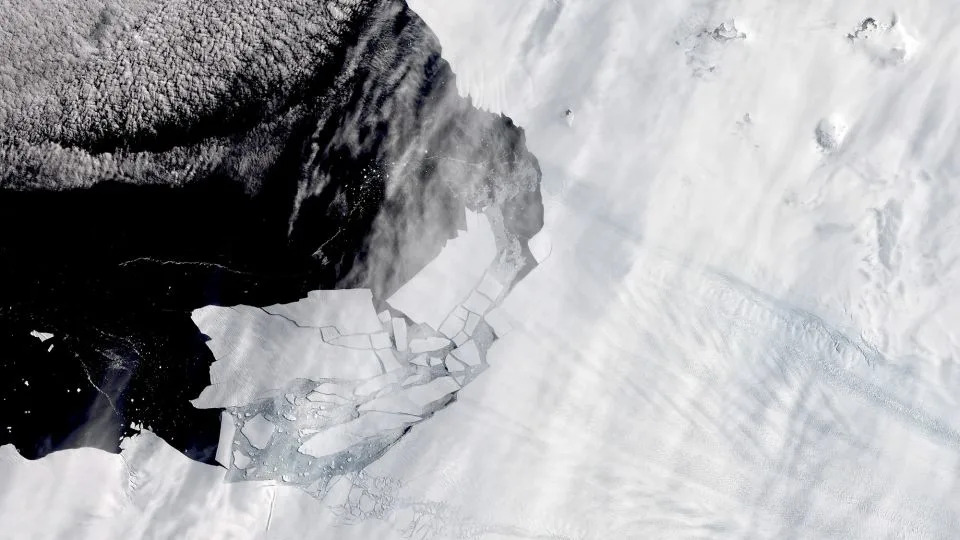
Icebergs detach from the Pine Island Glacier in Antarctica, one of the continent's fastest-retreating glaciers, February 11, 2020. - Lauren Dauphin/NASA Earth Observatory/Reuters
“We are looking at the ocean on very short ‘weather‑like’ timescales, which is unusual for Antarctic studies,” said Yoshihiro Nakayama, a co-author and assistant professor at Dartmouth College.
Worrying Feedbacks
The researchers describe a positive feedback: meltwater from the ice shelves freshens and cools the upper ocean, which then mixes with warmer, saltier water beneath and generates more turbulence — driving yet more melting. Co-author Lia Siegelman of Scripps Institution of Oceanography warns this loop could strengthen in a warming climate.
The Stakes
Ice shelves act as a buttress that slows the flow of inland ice into the sea. Thwaites Glacier alone contains enough ice to raise global sea levels by more than 2 feet. If Thwaites’ ice‑shelf support fails and triggers broader instability in the West Antarctic Ice Sheet, long‑term sea‑level rise on the order of ~10 feet is a conceivable, though longer‑term, risk.
Uncertainties And Next Steps
Scientists not involved in the study welcomed the new perspective but urged caution. Antarctic ice‑shelf environments are extremely difficult to observe, so models play a large role in current results. As NYU’s David Holland noted, more direct, real‑world measurements are essential to verify the models and better quantify how common and powerful these eddies are over seasons and years.
Why This Matters: The study highlights that ocean “weather” on short timescales matters for ice loss. Improving observations of fine‑scale ocean dynamics beneath ice shelves is now a critical frontier for predicting future sea‑level rise.
Similar Articles

Glaciers' Hidden Heartbeat: NASA Study Finds Seasonal 'Pulse' That Intensifies With Warming
NASA JPL researchers Chad Greene and Alex Gardner used 2014–2022 optical and radar satellite data to show that glaciers world...

Under‑ice 'Storms' Pull Warm Water Under Antarctica — Could Accelerate Ice Loss
Researchers have found intense, storm‑like vortices beneath West Antarctic ice shelves that lift warm deep water against ice,...

Scientists Probe Hektoria Glacier’s Unprecedented 16‑Mile Retreat — Experts Debate Cause
Researchers are probing an unusually swift retreat of the Hektoria Glacier, which lost about 16 miles of ice between January ...

Antarctic Alert: Glacier the Size of Philadelphia Lost Half Its Ice in Two Months
The Hektoria Glacier on the Antarctic Peninsula lost roughly half its mass in two months, researchers report in Nature Geosci...

Scientists Warn: Nature Is Sending Alarming Signals — Climate Disruption Is Escalating
Scientists warn that a suite of environmental signals — from near year‑round wildfires and stronger hurricanes to melting gla...

How Climate Change Can Trigger Earthquakes, Rift Formation and Increased Magma — Evidence from Lake Turkana
New research shows that climate-driven changes in water and ice loads can alter seismicity, rifting and magma production. A s...

Is a New Ice Age Possible? Scientists Warn Atlantic 'Conveyor' (AMOC) May Be Near Collapse
Scientists warn that the Atlantic Meridional Overturning Circulation (AMOC)—the ocean current that carries warm water north—i...

Human‑Driven Warming Could Paradoxically Push Earth Toward a Far‑Future Ice Age
New research in Science shows that human‑driven warming could amplify marine biological feedbacks—especially larger algal blo...

Warmer Atlantic Waters Invade Arctic Fjords — Sediment Cores Reveal Shifts in Carbon Storage
Scientists analyzing sediment cores from an Arctic fjord found that warmer Atlantic waters are increasingly influencing fjord...

Study: European Summers Could Lengthen By Up To 42 Days By 2100
The study reconstructs 10,000 years of climate from European lake sediments to quantify how Arctic amplification affects seas...

Unexpected Nitrogen Fixation Found Beneath Melting Arctic Sea Ice — Could Fuel Algae and Boost Carbon Uptake
Study: University of Copenhagen researchers discovered active nitrogen fixation beneath melting Arctic sea ice, challenging p...

New Sponge Study Suggests 1.5°C Climate Threshold May Already Be Past — But Experts Urge Caution
A University of Western Australia team used Sr/Ca ratios in long-lived Caribbean sclerosponges to reconstruct sea temperature...

James Hansen: AMOC Could Reach a 'Point of No Return' in 20–30 Years, New Study Warns
James Hansen, who warned Congress of global overheating in 1988, now helps lead a new international paper that finds the Atla...

Marine Species Are Racing Poleward — Climate Change Is Rewriting Ocean Ecosystems
Researchers at the University of the Sunshine Coast report that marine species are shifting poleward at an average of 59 km p...

Groundwater Pumping Shifted Earth's Rotational Pole by 31.5 Inches — What That Means
Summary: A Geophysical Research Letters study finds that groundwater extraction from 1993–2010 redistributed about 2,150 giga...