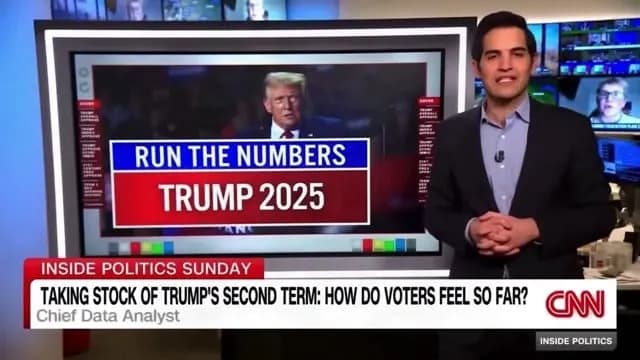
President Trump’s approval ratings have slipped to a DDHQ average of 42 percent approval and 55 percent disapproval, down from roughly 46/51 a month earlier. Polls from Fox News, Reuters/Ipsos and Marquette show particular weakness on the economy, tariffs and among independent voters, even as he scores better on border security and some international issues. Analysts cite inflation, tariff effects and controversial ICE enforcement actions as drivers of the decline and say refocusing on affordability and targeted policy changes could help reverse the trend.
Trump’s Approval Slides as Voters Point to Inflation, Tariffs and Immigration Concerns
President Trump’s approval ratings have dipped in recent weeks as he nears the end of the first year of his second term, according to multiple national surveys. A Decision Desk HQ (DDHQ) rolling average now places his approval at 42 percent and his disapproval at 55 percent, down from roughly 46/51 about a month earlier.
Poll results and trends
Recent polls show consistent weakness on pocketbook issues and with independent voters even as the president maintains stronger ratings on certain security and foreign-policy items. A Fox News survey found just 38 percent of respondents approved of the way Trump handled the economy (including 25 percent of independents), 35 percent approved of his handling of tariffs and 34 percent approved of his handling of health care; the same poll put his approval on border security at 53 percent and overall approval at 41 percent.
A Reuters/Ipsos survey earlier this month recorded overall approval at 38 percent, while a Marquette Law School poll put him at 43 percent and showed slippage among independents. Marquette’s results showed strong support for an Israel-Hamas ceasefire (67 percent) and border security (54 percent), but low marks on handling a government shutdown (25 percent), disclosures related to Jeffrey Epstein (26 percent), the economy (36 percent), tariffs (37 percent) and immigration (45 percent).
Why voters are shifting
Analysts point to several factors behind the decline: concerns about inflation and the cost of living, the economic impact of tariff policy, and controversy surrounding recent ICE enforcement actions. "It’s the economy and especially inflation," said Todd Belt, director of the political management program at George Washington University’s Graduate School of Political Management. "People elected Trump to solve that issue ... and I think people’s patience is wearing off."
Some experts note tariffs have raised costs for businesses and consumers, although the administration has removed duties on certain food items such as beef, coffee and bananas. Treasury Secretary Scott Bessent disputed that tariffs are the main driver of inflation, pointing instead to price pressures in the services sector and trade negotiations that may be easing food-price pressures from Latin American suppliers.
Meanwhile, enforcement raids by U.S. Immigration and Customs Enforcement have drawn criticism for their tactics and perceived effects on Hispanic and Latino communities. An ICE spokesperson said the agency conducts targeted enforcement against individuals in the U.S. illegally "NOT based on their skin color, race, or ethnicity." Surveys suggest independents and many Latino voters disapprove of current enforcement approaches: a University of California, Berkeley survey of California voters found 45 percent of independents opposed federal actions aimed at reducing illegal entry, and Pew Research Center data showed 65 percent of Latino respondents disapproved of the administration’s immigration approach and 71 percent felt the administration was doing too much on deportations.
Political context and the president’s response
The president has pushed back on the polling, posting on his social platform that he has achieved "THE HIGHEST POLL NUMBERS OF MY POLITICAL CAREER" and touting tariff revenue and foreign investment generated by his policies. White House spokesperson Abigail Jackson said polls show broad public support for the administration’s priorities and highlighted actions the White House says demonstrate progress on border security, inflation and workers’ interests.
Experts caution that presidents have limited direct control over many economic forces — including interest-rate policy set by the Federal Reserve — but say political choices, messaging and measurable wins on affordability remain central to repairing public confidence. "He has to refocus on ... the economy and affordability," said Lee Miringoff, director of the Marist Institute for Public Opinion. "He’s going to have to put more points on the board that reflect the agenda voters expected."
Data snapshot
Key recent measures include: DDHQ rolling average — 42% approve / 55% disapprove; Fox News — 41% overall approval with weak economy scores; Reuters/Ipsos — 38% approval; Marquette — 43% approval with strong support on ceasefire and border security but weak ratings on the economy and tariffs. The U.S. Bureau of Labor Statistics’ consumer price index has been reported at about 3 percent since September.
While these polls suggest challenges for the administration, analysts note public opinion can shift quickly in response to events and policy changes. Observers recommend clearer messaging, targeted policy adjustments on tariffs and actions that deliver tangible relief on living costs to help reverse the downward trend.
Help us improve.