The Democratic Party began 2025 recovering from last November’s loss, but recent trends suggest a rebound: Trump’s approval has fallen, divisions in his coalition have widened, and Democrats scored key local victories. Polling shows Democrats with a modest edge, and six national figures have seen their profiles shift this year. Governors Gavin Newsom and J.B. Pritzker and Rep. Alexandria Ocasio-Cortez have gained ground, while Kamala Harris, Pete Buttigieg, and Gretchen Whitmer face mixed prospects.
Six Democrats Rising — and Fading — in 2025
The Democratic Party began 2025 reeling after President Trump reclaimed the White House, but recent developments suggest the party is gradually regaining momentum. Mr. Trump’s approval ratings, already uneven, have slipped further — with particularly weak marks on inflation and the cost of living — while divisions in his coalition, amplified by tensions over the Jeffrey Epstein files, have created political openings for Democrats.
Electoral victories have bolstered Democratic morale: Zohran Mamdani won the New York City mayoralty, and Rep. Mikie Sherrill (D-N.J.) and former Rep. Abigail Spanberger (D-Va.) captured gubernatorial contests in their states. Polling averages from Decision Desk HQ show Democrats roughly five points ahead heading into the midterms, and speculation about the 2028 field has already begun to shape how national figures position themselves.
Below are six Democrats whose national profiles have risen or dimmed during 2025, and what those shifts mean for their political prospects.
Gavin Newsom — Rising
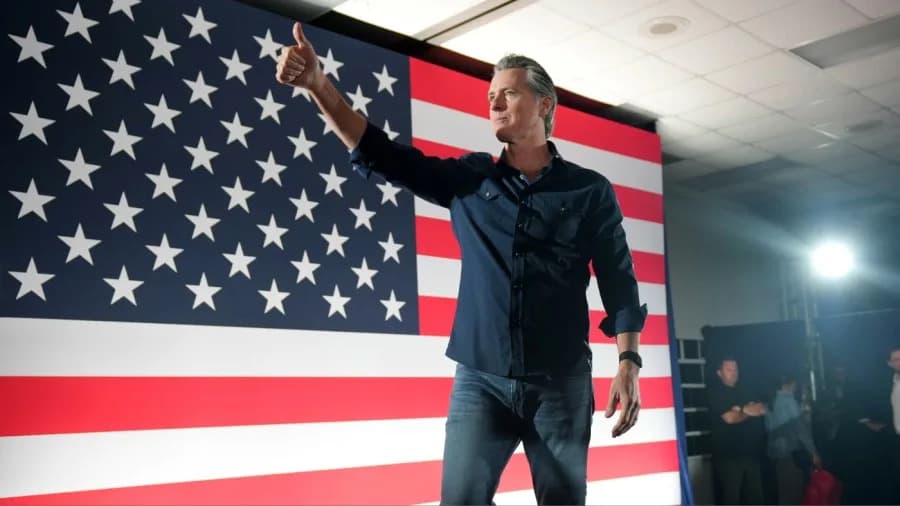
California Governor Gavin Newsom enjoyed perhaps the strongest year among potential 2028 contenders. After an early, controversial podcast effort that drew criticism from the left, he pivoted to a more confrontational public posture toward Trump — mixing sharp social-media mockery with substantive policy moves. Most notably, Newsom led the successful Proposition 50 ballot initiative to redraw California’s congressional map, a move projected to net Democrats several additional House seats. That combination of media savvy and tangible political wins has elevated his standing as an early front-runner.
Alexandria Ocasio-Cortez (AOC) — Rising
AOC strengthened her national profile by drawing large crowds at progressive rallies alongside Sen. Bernie Sanders and by endorsing Zohran Mamdani in his successful mayoral bid. Mamdani’s primary and general-election victories over Andrew Cuomo energized the left and bolstered the argument that voters may be open to bolder progressive policies. Critics note New York City’s electorate is uniquely left-leaning, but Mamdani’s success nonetheless makes a serious AOC presidential bid feel more plausible.
J.B. Pritzker — Rising
Illinois Governor J.B. Pritzker gained national attention without actively campaigning for it after the Trump administration’s deployment of the National Guard to Chicago. Pritzker publicly suggested invoking the 25th Amendment and later leveled a profane on-stage attack on the former president, raising his visibility. Whether Democratic primary voters will embrace a billionaire candidate remains an open question, but Pritzker is a higher-profile figure now than he was at the start of the year.
Kamala Harris — Mixed
Former Vice President Kamala Harris remains a possible 2028 contender but faces significant hurdles. Her 2020 bid ended early, and she initially kept a low profile after last year’s defeat. Harris’s memoir, "107 Days," sold well in its first week and generated renewed attention, but the book tour also revived difficult memories for some Democrats, including questions tied to President Biden’s debate performance and the circumstances of the 2024 campaign. Harris’s tendency to try to appeal broadly — sometimes to the point of pleasing no one — continues to shape perceptions of her electability.
Pete Buttigieg — Cooling
Pete Buttigieg remains a respected communicator with a record of strong primary performance in 2020, but his profile cooled somewhat in 2025. Observers question whether his polished rhetorical skills mask a lack of policy clarity and note that his absence from elected office reduces his daily visibility compared with governors and sitting members of Congress.
Gretchen Whitmer — Dimmed
Michigan Governor Gretchen Whitmer was briefly viewed as a top-tier 2028 prospect: a two-term governor from an upper-Midwest swing state who can spar with Trump. This year she adopted a lower-key approach, focusing on governing rather than headline-grabbing fights. That restraint contributed to one notable misstep — a widely circulated April photograph of Whitmer covering her face with a binder in the Oval Office while Trump signed executive orders — an image that lingered in political coverage. She has also reportedly expressed private ambivalence about a presidential run.
What it means: the Democratic bench looks fluid heading into the midterms and the long run toward 2028. Governors who deliver tangible results and figures who can mobilize progressive energy both have pathways forward. Meanwhile, those who fail to translate visibility into clear policy advantages or who avoid sustained engagement risk losing momentum.
By Niall Stanage
Help us improve.