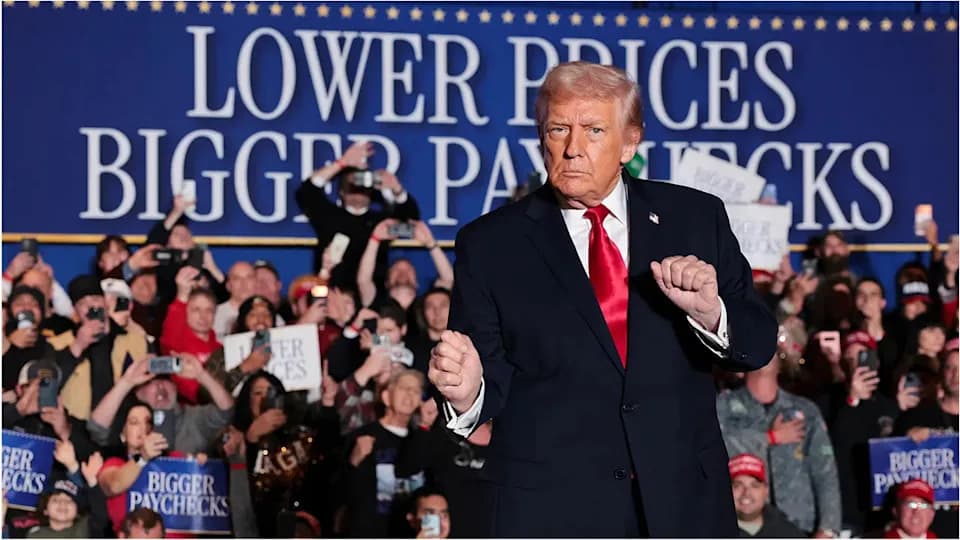
Republican officials warn the 2026 midterms could cost their party the House and shrink the Senate majority unless they address voter concerns about the economy and rising health care costs. Recent off-year defeats and polling — including President Trump's approval near 41.9% and a Democratic lead on the generic ballot — have heightened GOP anxiety. Ongoing redistricting battles, legal appeals and the rise of progressive challengers add uncertainty to an already competitive map.
GOP Alarm Grows: 2026 Midterms Could Cost House and Trim Senate Majority
Republican lawmakers are increasingly alarmed that the 2026 midterm elections could deliver heavy losses for the party — potentially costing Republicans control of the House and trimming their Senate majority by two or three seats.
Off-year results served as a wake-up call
GOP senators described the Nov. 4 off-year results in New Jersey, Virginia and other states as a wake-up call, urging Republican leaders — including former President Donald Trump — to address voter concerns about a slowing economy and persistent price pressures.
Vulnerabilities: health care and the economy
Republicans acknowledge that rising health insurance premiums and broader health care costs are major vulnerabilities heading into 2026. Party officials worry those pocketbook issues, emphasized by Democrats as a top campaign theme, could depress GOP standing with swing voters.
"If we are where we are today in the beginning of the second quarter [of 2026], then I think we're in for a really rough time in November," warned retiring Sen. Thom Tillis (R-N.C.). "We have plenty of time to address it. But if we don't get health care policy right, if we don't get some of the cost policies right, we're going to have major headwinds next year."
Polling and political headwinds
Polling averages from Decision Desk HQ show President Trump's approval slipping to about 41.9 percent, with disapproval around 55.7 percent. The same averages put Democrats ahead on the generic congressional ballot, roughly 46.8 percent to 41.4 percent — an unsettling sign for Republicans heading into a midterm year.
Redistricting fights add uncertainty
Redistricting remains unsettled in several states, complicating GOP hopes that new maps would produce pickup opportunities. Texas, for example, faces an ongoing legal fight over a Republican-leaning map that is currently the subject of appeals. At the same time, Democrats are projected to pick up several blue-leaning seats in states such as California and Utah, narrowing the net advantage Republicans had hoped for.
House outlook: many see losses as likely
Some Republican strategists privately predict the party will lose the House. The narrow 219-213 majority leaves little room for error: even a modest swing could flip control. Both parties disagree on the size of the competitive map — Republicans argue the battlefield remains small, while Democrats say there could be as many as 60 competitive races.
Key dynamics include retirements (such as Rep. Don Bacon in Nebraska's 2nd District) and districts Democrats must defend that Trump won in 2024. The rise of progressive challengers in places like California's 22nd and Colorado's 8th also complicates Democratic efforts to present a unified front.
Senate map: pick-up opportunities on both sides
Republicans currently hold a roughly 53-47 advantage in the Senate. Lawmakers on both sides acknowledge several competitive contests next year — including North Carolina, Maine, and Ohio — that could shift control. Losing three GOP seats would produce a 50-50 split, with the vice president holding the tiebreaking vote; Democrats would need additional gains beyond that to win a working majority.
Other vulnerable or competitive contests cited by strategists include Iowa, Texas, Alaska, Georgia, and Michigan, where retirements, primary dynamics and strong challengers make outcomes uncertain.
What party leaders are saying
Republicans point to the potential political liabilities of Democrats' left flank and to the party's favorable pockets of redistricting as reasons they can still defend majorities. Democrats highlight energized turnout at town halls and the enthusiasm of progressive voters as reasons they could expand the competitive map and make gains.
With nearly a year until the midterms, both parties are preparing for a protracted fight over maps, messaging and turnout as they jockey for advantage in a volatile political environment.
Help us improve.