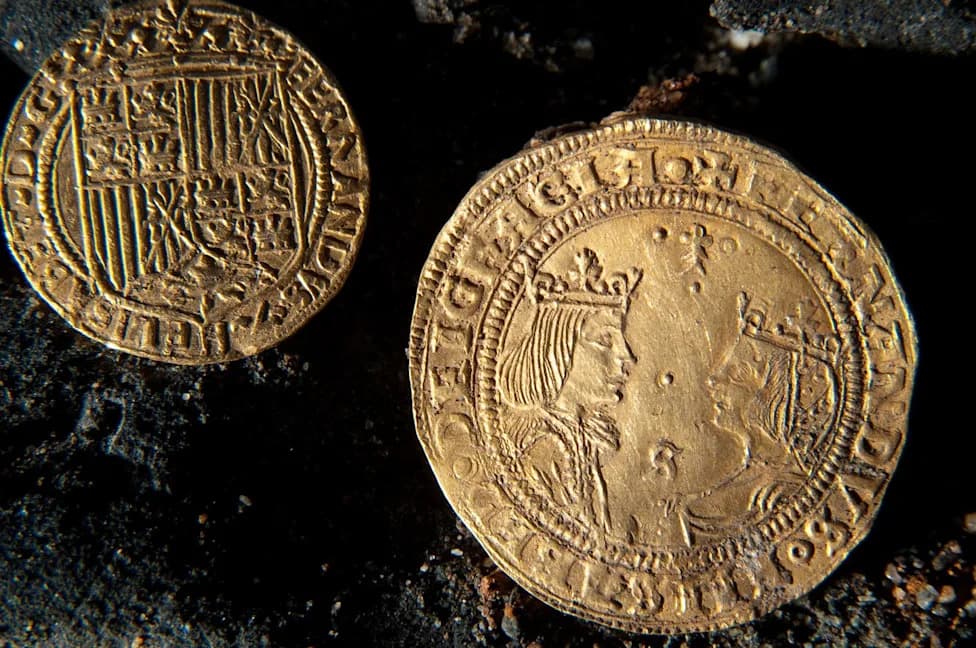
Colombian teams have retrieved a cannon, three coins and a porcelain cup from the wreck of the Spanish galleon San José, which sank in 1708 and is believed to contain vast caches of coins, emeralds and other valuables. The finds will be conserved in a dedicated laboratory as part of a government-authorized scientific investigation. The wreck—located in 2015 and lying nearly 2,000 feet deep—remains the subject of international legal disputes, and its coordinates are being kept secret to prevent looting.
Colombian Teams Recover First Artifacts from Legendary Galleon San José Believed to Hold Billions

Colombian scientists have recovered a cannon, three gold coins and a porcelain cup from the wreck of the Spanish galleon San José, which sank in 1708 off Colombia's Caribbean coast after an attack by an English fleet. The items were the first objects retrieved as part of a government-authorized scientific expedition to study the wreck and investigate the cause of the sinking.
The wreck, first located by Colombian researchers in 2015, lies at nearly 2,000 feet (about 600 meters) below the surface. Its exact coordinates remain a state secret to deter looting. Officials say the operation is research-focused rather than intended to confiscate any treasure.
Often called the "holy grail of shipwrecks," the San José is believed to contain millions of gold and silver coins, emeralds and other valuables from Spanish colonial shipments—cargo that could be worth billions if fully recovered. Colombia is involved in legal disputes with multiple parties claiming rights to the wreck, including a U.S. salvage group, Sea Search Armada, which seeks arbitration and has asserted entitlement to a large share of the find, and other claimants such as Spain and Indigenous Qhara Qhara communities asserting historical claims.
Researchers earlier this year examined intricately struck gold coins recovered near the site and confirmed they match coins historically associated with the San José: designs include castles, lions and crosses on one face and the "Crowned Pillars of Hercules" over ocean waves on the reverse, according to a study published in the journal Antiquity.
In 2024, remotely operated vehicles (ROVs) surveyed the site and documented numerous artifacts including an anchor, jugs, glass bottles, cast-iron cannons, porcelain fragments, pottery and objects that appear to be gold. The newly recovered cannon, coins and cup will undergo conservation in a laboratory established specifically for the expedition.
"This historic event demonstrates the strengthening of the Colombian State's technical, professional and technological capabilities to protect and promote underwater cultural heritage, as part of Colombian identity and history," said Yannai Kadamani Fonrodona, Minister of Cultures, Arts and Knowledge.
Investigators have also collected sediment samples from inside the wreck to help determine the circumstances of the sinking. British and Spanish archival accounts differ on whether the ship exploded during battle or sank by other means; the new scientific study aims to clarify these questions.
In May 2024 Colombia declared the site a protected archaeological area. Authorities stress that recoveries will be carried out under archaeological and conservation standards, with recovered items conserved and studied before any decisions about ownership or disposition are made.
Help us improve.