This article examines public reactions to merit-based, color-blind admissions when those rules are said to produce campuses that are mostly white or mostly Asian. An experiment embedded in two national surveys of 1,059 U.S. adults found modest concern among white Republicans (28% worried about mostly Asian campuses; 21% about mostly white), stronger concern among Black respondents (nearly half worried about mostly Asian; 58% about mostly white), and a sharp asymmetry among white Democrats (53% vs. 26%). The findings suggest race-neutral rules shift contention to who benefits rather than removing race from the debate.
Do Americans Worry Schools Will Become ‘Too White’ — Or ‘Too Asian’? A National Survey Experiment

How Americans react to merit-based admissions depends on who is perceived to benefit. A national survey experiment explores whether people are more likely to object if strict, color-blind admissions produce campuses that are mostly white or mostly Asian.
Background
The debate was reignited after Bo French, a Republican candidate in Texas, posted a photo of South Asian students celebrating a University of Texas at Austin football win and complained they were displacing supposedly "more deserving" white, non-immigrant applicants. The episode sparked national discussion because UT-Austin relies heavily on merit-based, colorblind admissions rules (including automatic admission by class rank), yet Asian students now make up nearly a quarter of the undergraduate body while representing roughly 7% of Texas's population.
The Survey Experiment
To measure public reactions, the author embedded an experiment in two national surveys of 1,059 U.S. adults, conducted for Florida State University's Institute for Governance and Civics. Respondents read that some people support strict reliance on grades and test scores, while others worry such rules reduce diversity. Participants were then randomly assigned one of two prompts: that merit-based admissions could lead to campuses that were either mostly white or mostly Asian. Because assignment was random, differences in responses reflect reactions to which group was named as the likely beneficiary.
Key Findings
Three patterns stand out:
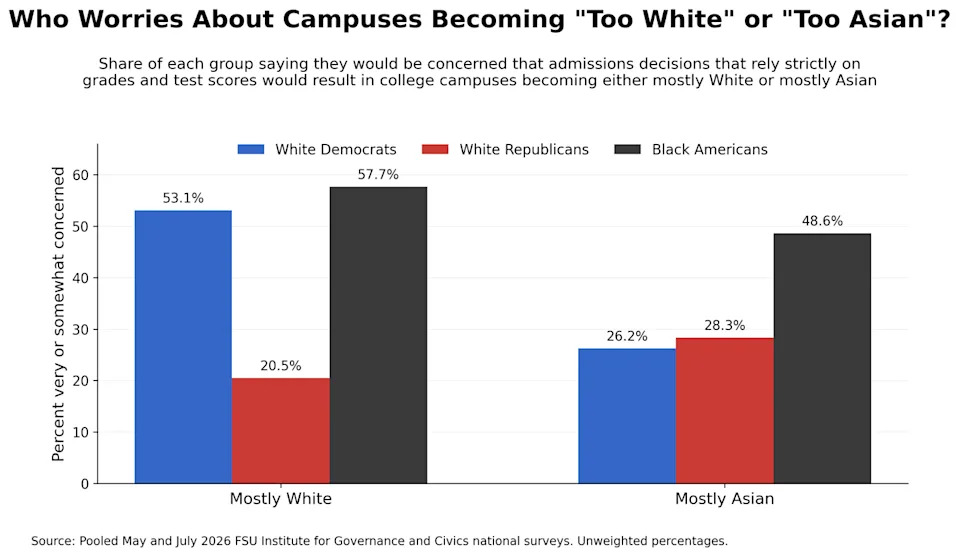
1. Most white Republicans expressed only modest concern about either outcome: 28% said they'd be worried if merit rules produced a mostly Asian campus, and 21% said they'd be concerned about a mostly white campus.
2. Black respondents showed stronger concern overall: nearly half were worried about a mostly Asian campus, and 58% were concerned about a mostly white outcome — signaling sensitivity to racial concentration regardless of which group benefits.
3. White Democrats displayed the largest asymmetry: 53% were concerned when the outcome favored white students, but only 26% objected when the same policy was said to favor Asian students.
Real-World Context
These perceptions contrast with the empirical patterns driving the debate. In New York City's specialized high schools, for example, white students received about 17% of offers from an exam-based specialized high school while constituting roughly 16% of the public-school population. Asian students received more than half of those offers while representing about 19% of the system — an overrepresentation that highlights the policy concern is often about Asian academic success rather than white majorities.
At the national level, the U.S. Supreme Court's Students for Fair Admissions decisions have sharply limited universities' ability to consider race explicitly in admissions, heightening attention on race-neutral but academically selective systems (like exam schools and merit-based quotas) and the distributional effects they produce.
Conclusion
Race-neutral admissions rules do not remove race from educational politics; they tend to shift the fight from whether race should be considered to which groups benefit from ostensibly neutral rules. So far, most white Republicans appear relatively indifferent to whether meritocratic outcomes favor white or Asian students. Whether that indifference holds as Asian academic success becomes a more salient political issue remains an open question.
Help us improve.