Researchers at Kyoto University and Hiroshima University report the first experimental entangled measurement for three-photon W states using a discrete Fourier transform optical circuit. The single-shot interferometric technique reads out the W state's cyclic shift symmetry and avoids the exponential measurement overhead of quantum tomography. The team reported a Measurement Discrimination Fidelity of 0.871 ± 0.039, exceeding the 66.7% threshold required to confirm three-particle entangled measurement. Future work aims to implement the method on integrated photonic chips for scalable quantum applications.
After 25 Years, Physicists Achieve First One-Shot Measurement of Three-Photon W-State Entanglement

(Albert Yarullin/iStock)
Quantum entanglement remains one of the most striking differences between the microscopic quantum world and our everyday experience. When elementary particles such as electrons or photons become entangled, they share a single quantum description: the full system exists in superposition and individual particles have no definite states until a measurement is made.
Researchers at Kyoto University and Hiroshima University report a major experimental advance: the first entangled measurement for three-photon W states. Unlike the better-known Greenberger–Horne–Zeilinger (GHZ) states, W states keep usable entanglement even if one particle is lost, but that robustness has made them harder to measure directly.
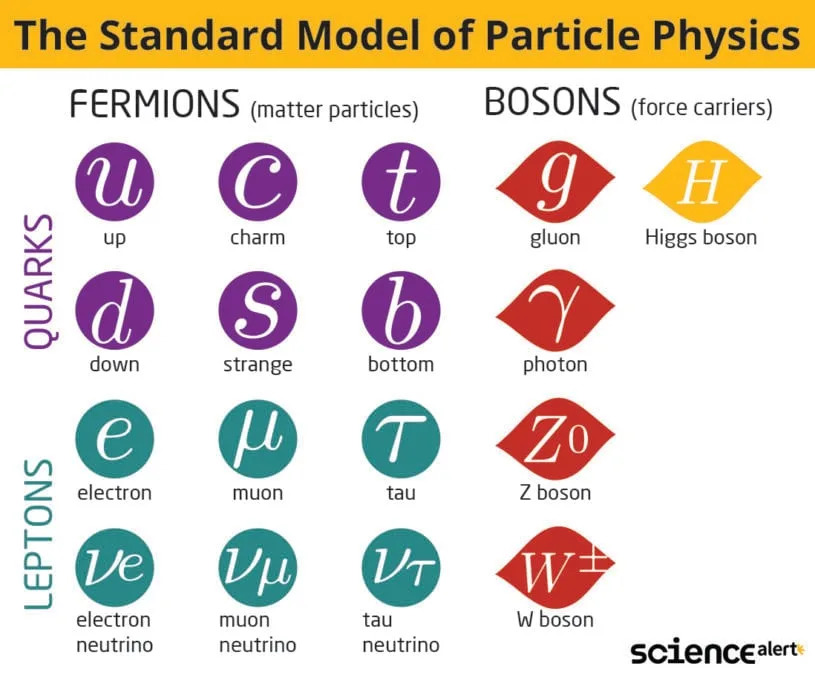
The elementary particles of theStandard Model, which describe our current-best understanding of the Universe's fundamental particles and forces, except gravity.(ScienceAlert)
What the team did
Instead of reconstructing the state via conventional quantum tomography—which requires many identical copies and a number of measurement settings that grows exponentially with particle count—the team implemented a single-shot interferometric measurement. They built an optical circuit based on a discrete Fourier transform (DFT) that acts as an advanced interferometer: three photons of known polarization are injected into different input ports, routed along separate paths, and then recombined so that their interference pattern reveals the joint quantum structure.
Cyclic Shift Symmetry
The measurement targets the W state's cyclic shift symmetry, a structural fingerprint that remains unchanged when the photons are cyclically permuted. By observing how the photons' wave peaks and troughs combine or cancel in the DFT circuit, the experiment discriminates whether the input corresponds to the W-state structure in a single run.
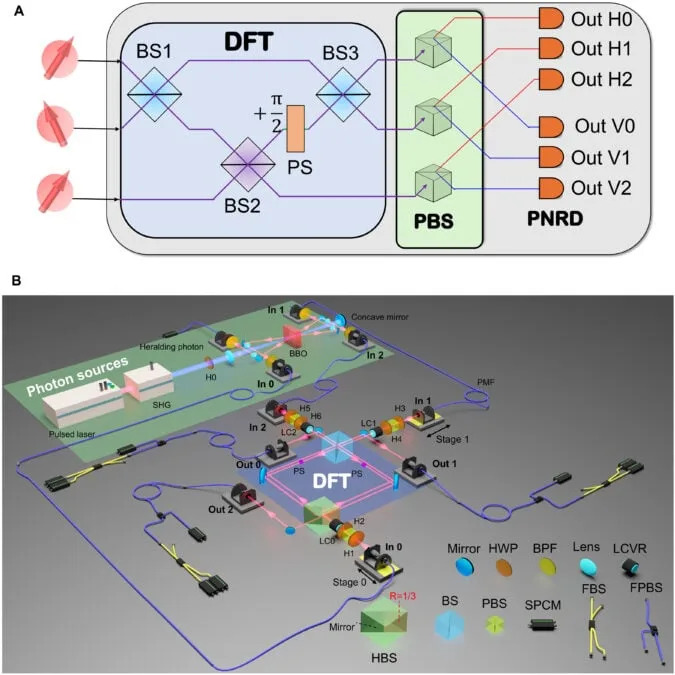
The experimental setup. (Park et al,Sci. Adv., 2025)
More than 25 years after the initial proposal concerning the entangled measurement for GHZ states, we have finally obtained the entangled measurement for the W state as well, with genuine experimental demonstration for 3-photon W states — Shigeki Takeuchi
Results and significance
The experiment achieved an averaged Measurement Discrimination Fidelity (MDF) of 0.871 ± 0.039, meaning the apparatus correctly identified the W-state condition about 87% of the time. This comfortably exceeds the 66.7% (two-thirds) threshold required to demonstrate three-particle entangled measurement, validating the technique.
The shortfall from perfect fidelity is attributed to imperfections in photon preparation and residual errors in the measurement hardware. Despite these limitations, the result is an important milestone: it demonstrates a scalable strategy to perform entangled measurements without the exponential overhead of tomography.
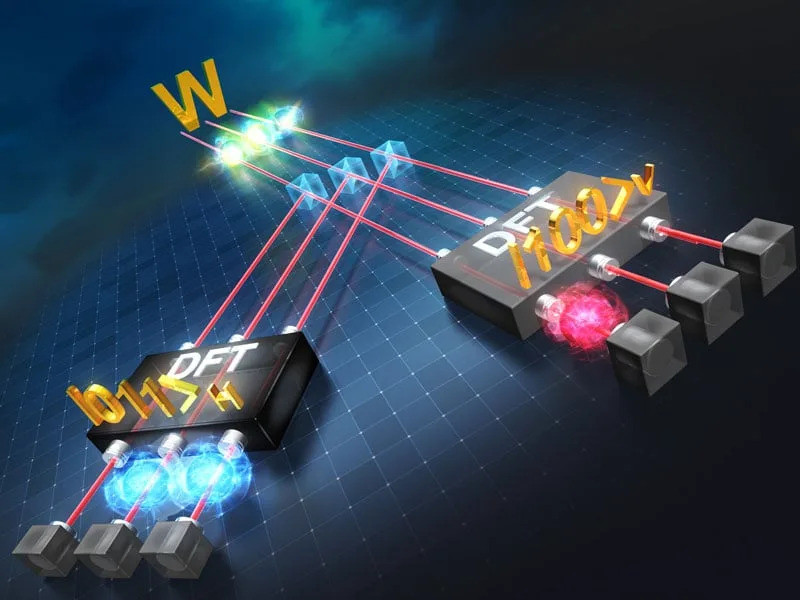
A simplified illustration of the experimental setup. (KyotoU/Takeuchi lab)
Outlook
The researchers plan to develop integrated, on-chip photonic circuits that implement the same DFT interferometric measurements. If integrated devices and other quantum-hardware advances converge, this approach could accelerate photonic quantum computing, communication, and sensing applications—ranging from improved quantum-secure communications to more efficient quantum-assisted discovery workflows in areas such as drug research and materials design.
The work appears in the journal Science Advances and represents a concrete experimental step toward efficient multi-particle entanglement measurement in photonic systems.
Help us improve.