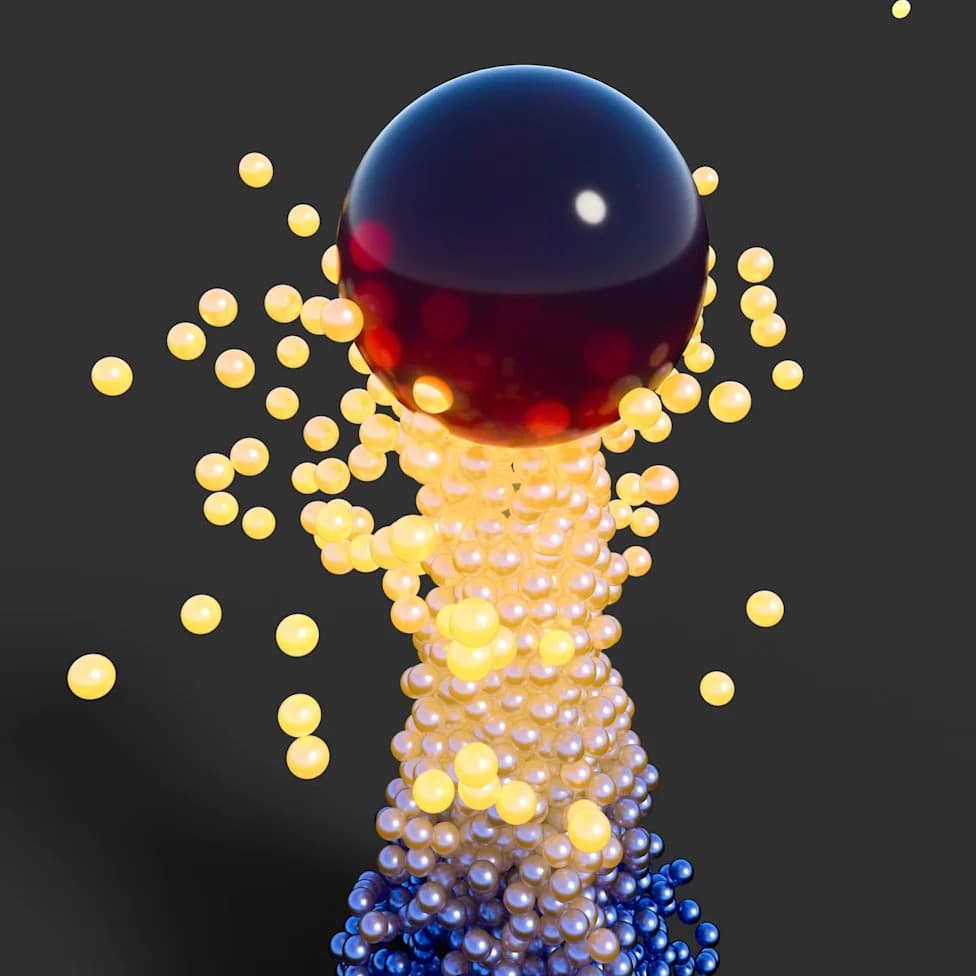
ATLAS at CERN reports strong evidence that two Z bosons from a Higgs decay are quantum entangled, with the data favoring entanglement at 4.7 sigma. The analysis used roughly 400 Higgs → ZZ* → 4-lepton events and reconstructed Z spin correlations from lepton angular distributions. This is the first clear indication of entanglement in elementary-particle qutrits and raises intriguing questions about whether virtual particles can carry entanglement-relevant information.
CERN Sees 'Spooky' Quantum Entanglement Between Z Bosons From Higgs Decays
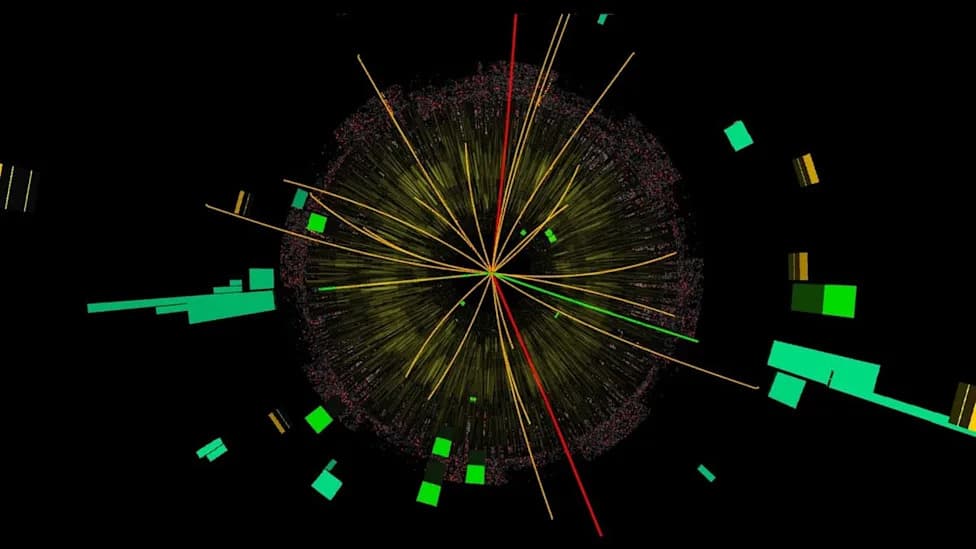
An ATLAS event display showing the tracks left by particles produced in a proton collision. (ATLAS Collaboration/CERN)
Physicists at CERN's ATLAS experiment report strong evidence that a pair of Z bosons produced in Higgs-boson decays are quantum entangled — the same "spooky action at a distance" that so puzzled Einstein. The result extends entanglement observations at the Large Hadron Collider to Z bosons, which behave as three-state quantum systems (qutrits) rather than two-state qubits.
YouTube Thumbnail
What the ATLAS Team Measured
The analysis used the rare decay chain Higgs → ZZ* → 4 leptons (electrons or muons). Because the Higgs has no intrinsic spin, angular-momentum conservation constrains the combined spin states of the two Z bosons, which can produce an entangled joint state. One complication is that a Higgs (≈125 GeV) does not have enough mass to create two on-shell Z bosons (each ≈91 GeV), so at least one Z in these events is virtual (off-shell).
YouTube Thumbnail
Even though Z bosons decay extremely quickly (~3×10-25 s), their decay products retain information about the parent spins. ATLAS reconstructed the relevant angular distributions from about 400 suitable Higgs → ZZ* → 4-lepton events and tested whether those correlations are consistent with an entangled quantum state.

Subscribe to ScienceAlert's free fact-checked newsletter
Significance and Interpretation
The most sensitive statistical test in the analysis favored an entangled state over a separable (non-entangled) hypothesis with a significance of 4.7 sigma — strong evidence but just below the 5-sigma threshold commonly required in particle physics to claim a discovery. The measurement is notable because it is the first robust indication of entanglement involving elementary-particle qutrits (three-level systems).
"The spins of the two Z bosons are extremely entangled, considerably more so than in the top–antitop case that was measured previously," said Juan Antonio Aguilar-Saavedra of the Institute of Theoretical Physics (translated from a Spanish-language video).
Why This Matters
Beyond demonstrating entanglement in a new system, the result touches on conceptual questions about virtual particles. Virtual Z bosons are usually treated as intermediate mathematical objects in quantum-field calculations, but here the virtual participant appears to carry spin correlations that become entangled with its partner — behavior that looks particle-like in an operational sense.
The ATLAS analysis has been published in Physical Review Letters. While philosophical debates about the ontological status of virtual particles continue, this measurement expands the range of elementary systems in which entanglement has been observed and suggests interesting avenues for future study, especially with larger datasets expected from the LHC and the High-Luminosity LHC upgrade.
Help us improve.