New Shoresh analysis: Parents' occupations explain more than twice the variation in 15-year-olds' PISA scores compared with parental education. Using data on 10,336 Hebrew-language test-takers (2012–2022) and adjusting for household factors, researchers found stronger links between fathers' jobs and performance across subjects and between mothers' occupations and reading. The study is associative, not causal, and authors call for education policies to promote equal opportunity.
Parents' Jobs Predict Teens' PISA Scores More Than Their Education, Study Finds
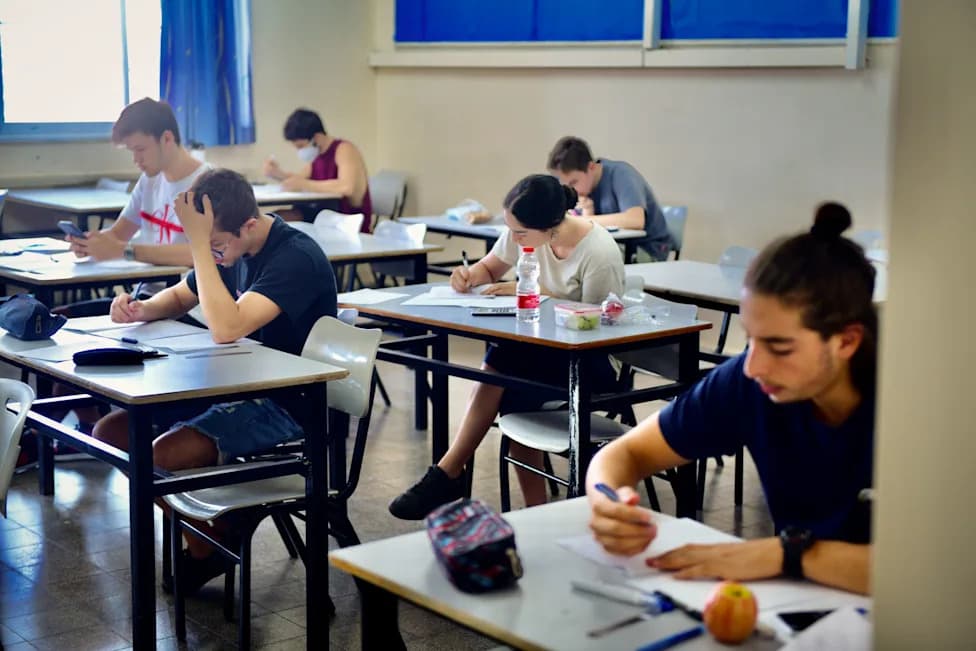
Keshet high school students take their mathematics matriculation examination (Bagrut), in Tel Aviv, June 29, 2020. (photo credit: AVSHALOM SASSONI/FLASH90)
A new analysis from the Shoresh Institution for Socioeconomic Research finds that a parent's occupation explains more than twice the variation in 15-year-olds' PISA scores compared with parental education. The study used Hebrew-language PISA test data from 2012, 2015, 2018 and 2022 and controlled for a range of household background factors.
Study and Methods
The paper, by Ariela Savin, Prof. Ayal Kimhi and Prof. Dan Ben-David, analyzed results for 10,336 students (age 15) whose parents were both employed and who took the Hebrew-language PISA tests. Students who took PISA in Arabic were excluded because earlier work identified large inconsistencies between those students' reports of parental education and official Central Bureau of Statistics records.
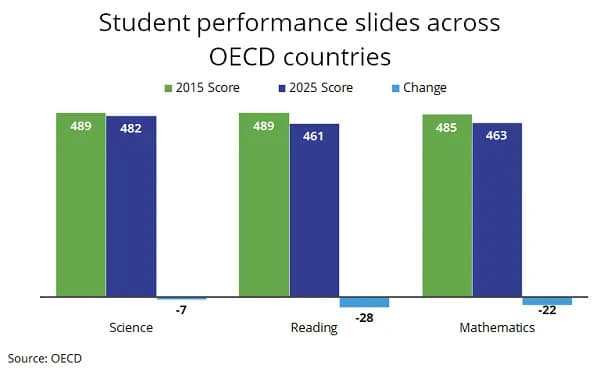
PISA (the Organisation for Economic Co-operation and Development's Programme for International Student Assessment) measures 15-year-old students in reading, mathematics and science. The researchers compared each student's average score across the three subjects with detailed parental-occupation categories. Models controlled for parental education, parents' birthplace and gender, the number of books in the home, computer and internet access and other household items, but did not directly include household income.
Key Findings
The authors report a clear association between parents' occupations and children's average PISA scores. Importantly, they emphasize these are associations, not proof of causation: unmeasured family or job-related factors may explain some of the patterns.

View of an empty classroom at a school in Givatayim, during a teacher's strike, on May 6, 2025. (credit: MIRIAM ALSTER/FLASH90)
- Occupations Explained More Than Twice The Variation — Knowing what parents do for work accounted for over twice the difference in students' scores compared with knowing parents' level of education.
- Fathers' Occupations were linked to children's results across reading, mathematics and science.
- Mothers' Occupations showed the strongest association specifically with reading scores; by contrast, mothers' education was more closely associated with achievement than fathers' education.
To estimate differences across jobs, the researchers grouped occupations whose children produced similar results and used these as reference groups. Because mothers and fathers tend to work in different sectors, they created separate comparison groups for each parent for analytical clarity; these reference groups are not representative of the average Israeli parent or student.
Examples of Occupational Associations (Adjusted Estimates)
- Children of fathers in university teaching, science or research scored an estimated 7.3% higher than the fathers' reference group.
- Children of fathers in technology, information or software scored about 6.8% higher.
- Advanced engineering (fathers): ~5.0% higher; finance/accounting/economics (fathers): ~4.2% higher; health/medicine (fathers): ~3.7% higher.
- Children whose fathers had "general" or "elementary" roles (for example, office management or mail sorting) scored roughly 5.4% higher than the fathers' reference group.
- For mothers, working in technology, information or software was associated with about 6.8% higher student scores compared with the mothers' reference group.
- Two maternal categories were associated with lower scores: early-childhood educators (~4.6% lower) and teaching assistants (~2.2% lower), though the authors caution against assuming causation.
Limitations
The study did not directly account for household income, and the reported percentages are adjusted estimates reflecting differences after controlling for other measured background variables — they are not raw PISA-point increases. The researchers stress that other unmeasured family characteristics or occupational attributes could be driving some associations.
"To understand a student's starting point, it is not enough to know their parents' level of education. Where their parents stand in the labor market is also significantly associated with their achievement," said Prof. Ayal Kimhi.
Implications
The authors argue the findings highlight the role of parents' labour-market positions in shaping children's educational starting points and call for education policies that better promote equal opportunity and intergenerational mobility. They note schools must work to reduce the link between family background and achievement so that students can progress regardless of their parents' occupations.
Authors: Ariela Savin (Shoresh researcher), Prof. Ayal Kimhi (vice president), Prof. Dan Ben-David (president).
Help us improve.