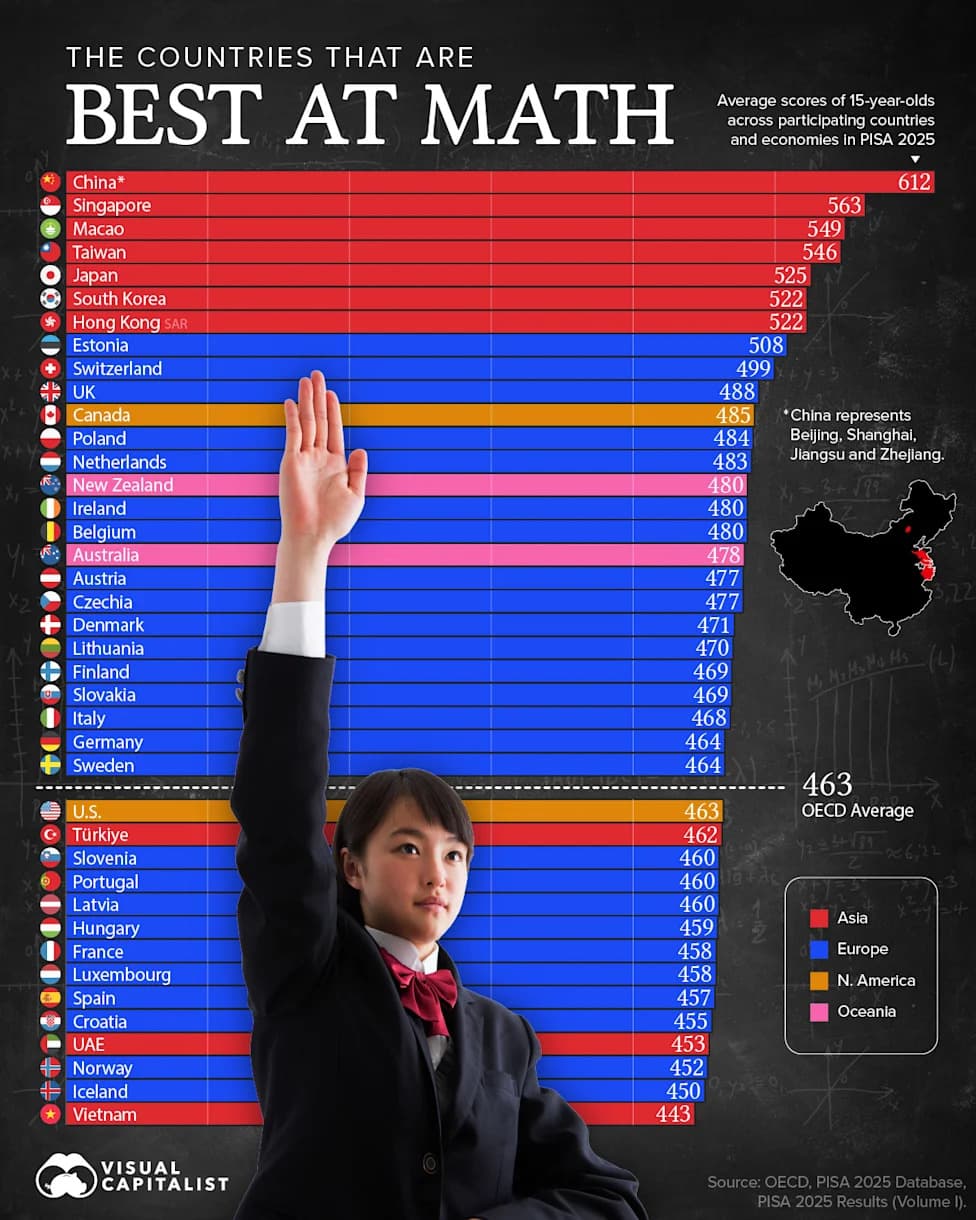
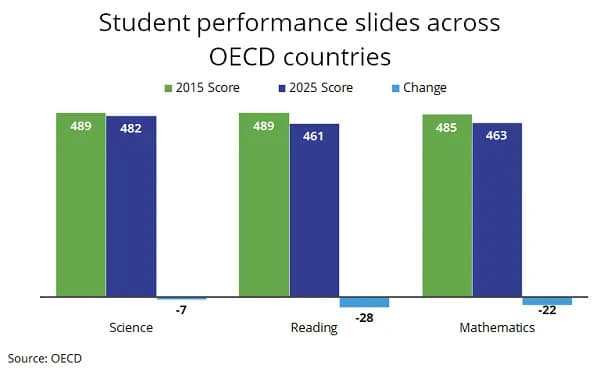
PISA 2025 places China first in science with a score of 597 and highlights Asian systems occupying most top positions. The assessment covered over 760,000 students from 91 countries and evaluates 15-year-olds on explanation, evaluation and real-world use of scientific knowledge. The United States ranks 13th with 502—20 points above the OECD average of 482, which fell to its lowest recorded level. The OECD cautions that small score differences may not be statistically significant and that causes for regional gaps cannot be pinned to a single factor.
PISA 2025: The World’s Best Countries at Science — China Leads, Asian Systems Dominate
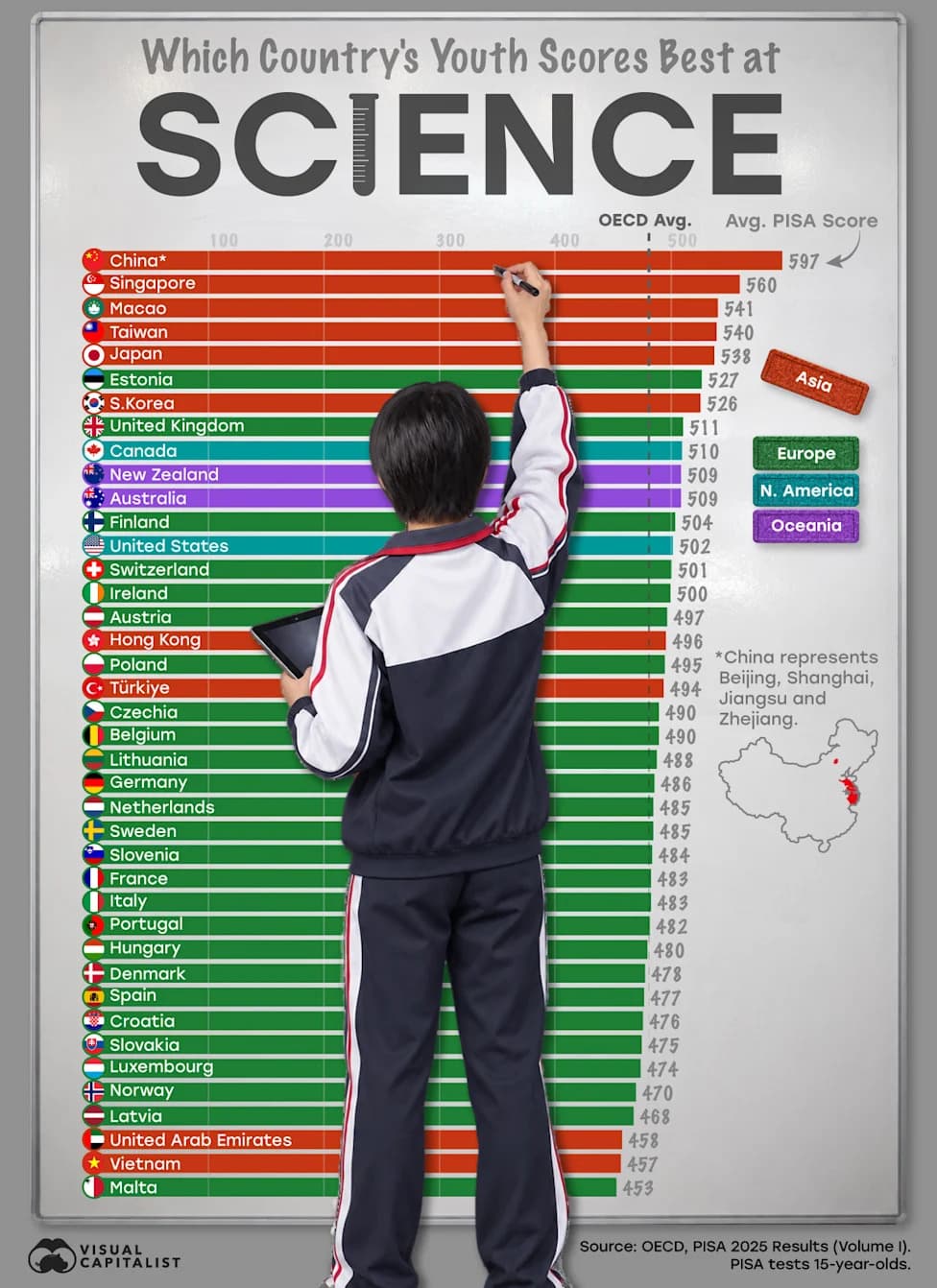
See which countries are best at science based on PISA 2025 scores, with China and Singapore leading the global ranking.
China topped the PISA 2025 science ranking with an average score of 597, followed by Singapore at 560, according to the OECD study published in September 2026. Asian education systems claim six of the seven highest positions in the table, while Estonia is the highest-performing European country.
PISA assesses the skills of 15-year-old students in mathematics, reading and science. The science domain tests not only factual knowledge but also students’ ability to explain scientific phenomena, evaluate investigations and evidence, and apply scientific information to real-world decision-making.
Scope and Sample
More than 760,000 students participated in PISA 2025 across 91 countries and economies, representing roughly 33 million 15-year-olds worldwide. In this ranking, the entry for China represents four participating jurisdictions: Beijing, Shanghai, Jiangsu and Zhejiang.
Top Results
The leading average science scores (PISA 2025) include:
1. China — 597 (Asia)
2. Singapore — 560 (Asia)
3. Macao — 541 (Asia)
4. Taiwan — 540 (Asia)
5. Japan — 538 (Asia)
6. Estonia — 527 (Europe)
7. Korea — 526 (Asia)
The United States ranks 13th with an average science score of 502, which is 20 points above the OECD average of 482. Canada is 9th at 510, and Australia and New Zealand each score 509.
What Helps High Performance
Several high-scoring Asian systems combine strict academic expectations with classroom conditions that support consistent performance. One measurable difference is lower reported digital distraction: in China, Japan and South Korea, fewer than 10% of students said classmates were distracted by digital devices during most or every science lesson, compared with 28% across OECD countries. The OECD also found that schools with clear smartphone rules tended to report lower levels of distraction.
High-performing systems also produce a larger share of students with advanced skills. For example, 26% of Singaporean students reached the top two proficiency levels in science, versus about 7% across OECD countries.
Some East Asian systems combine strong average performance with relatively small links between students’ socioeconomic background and science outcomes, suggesting the results are not driven solely by advantaged cohorts. Outside formal schooling, intensive tutoring and strong academic expectations are common in parts of East Asia; however, PISA does not isolate these outside factors as causal drivers, so the OECD cautions against attributing the regional gap to any single practice.
Regional Patterns and Cautions
Estonia is the top European performer (527), followed by the United Kingdom (511), Finland (504) and Switzerland (501). Many large European countries cluster near the OECD average, including Germany (486), France and Italy (483) and Spain (477).
Statistical note: The OECD warns that small differences in scores between nearby ranks are often not statistically significant, so close positions should not automatically be read as meaningful performance gaps.
Overall, PISA 2025 found that roughly three-quarters of students across OECD countries reached at least baseline proficiency in science. At the same time, the OECD average science score fell to its lowest recorded level in the assessment, continuing a longer-term decline in student performance.
Help us improve.