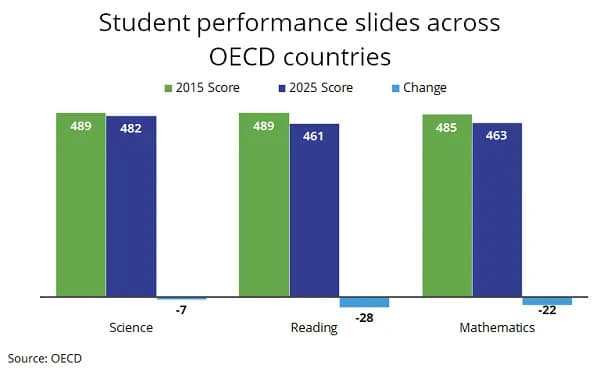
PISA 2025 mathematics results (published Sept 2026) rank China first with a 612 average — nearly 150 points above the OECD mean of 463. Seven of the top 10 performers are Asian jurisdictions; Estonia is the highest-ranked European at eighth. The United States scores 463, matching the OECD average, while Canada places 11th at 485. Across the OECD, average math performance fell by 22 points from 2015 to 2025. PISA also finds that very heavy digital leisure use (>4 hours/day) correlates with lower scores and weaker school belonging.
PISA 2025: China Tops Global Math Rankings — Seven of Top 10 Are Asian Jurisdictions
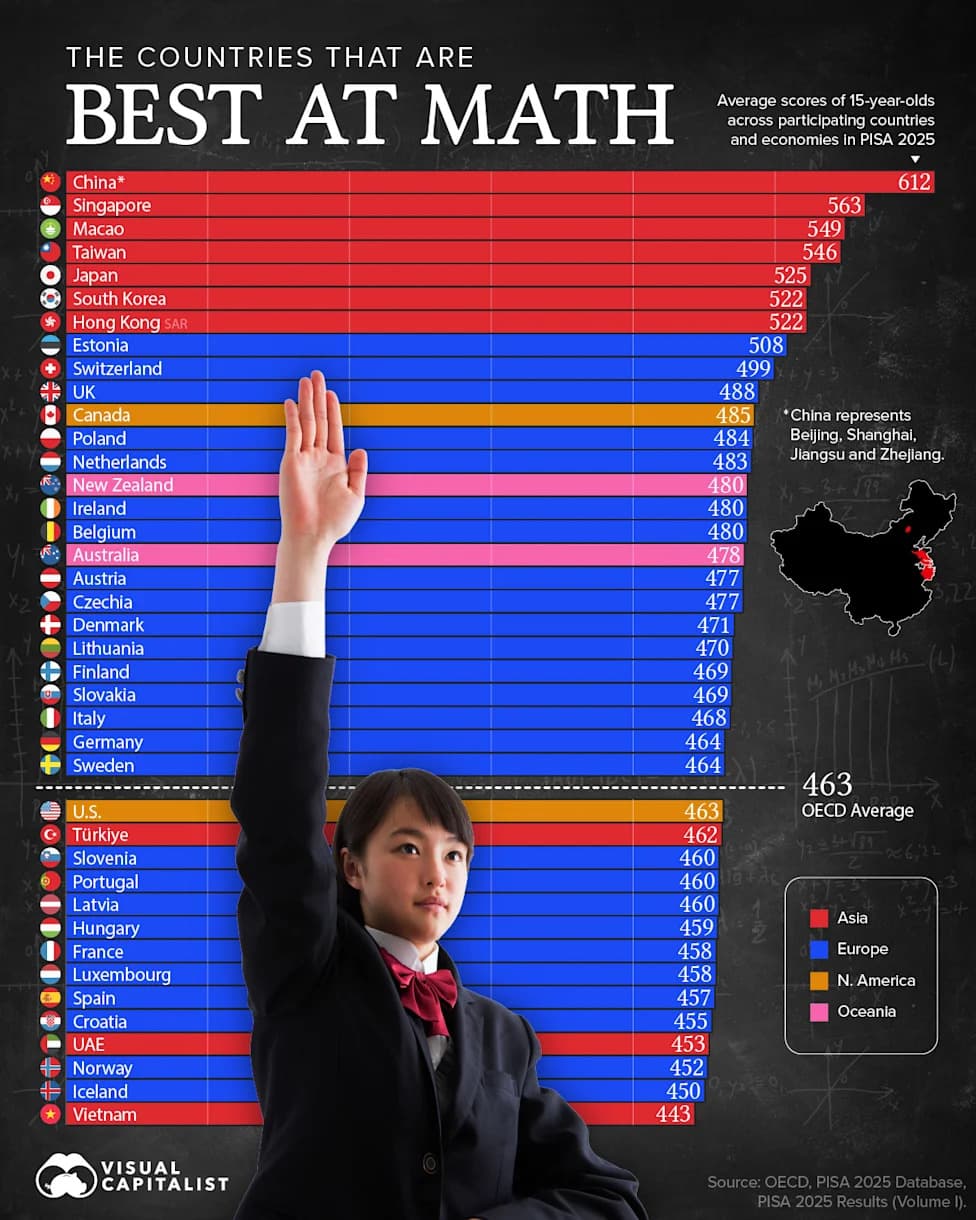
See which countries are best at math based on PISA 2025 scores, with China and Singapore leading the global ranking.
Key finding: The OECD's PISA 2025 mathematics results, published in September 2026, place China first with an average score of 612 — nearly 150 points above the OECD average. The assessment sampled more than 760,000 15-year-olds across 91 countries and economies, representing about 33 million students worldwide.
PISA measures not just procedural knowledge but students' ability to apply mathematical reasoning to real-world problems. In this report, "China" refers to the participating Chinese jurisdictions of Beijing, Shanghai, Jiangsu and Zhejiang. Uzbekistan is excluded from this ranking because a comparable mathematics score was not reported.
Top Performers
Asian education systems occupy seven of the top 10 places. China leads Singapore by 49 points. Macao and Taiwan rank third and fourth, while Japan, Korea and Hong Kong also place among the leaders. Estonia is the top European performer, ranking eighth.
- China — 612
- Singapore — 563
- Macao — 549
- Taiwan — 546
- Japan — 525
- Tied: Korea — 522; Hong Kong — 522
- Estonia — 508
- Switzerland — 499
- United Kingdom — 488
- Canada — 485
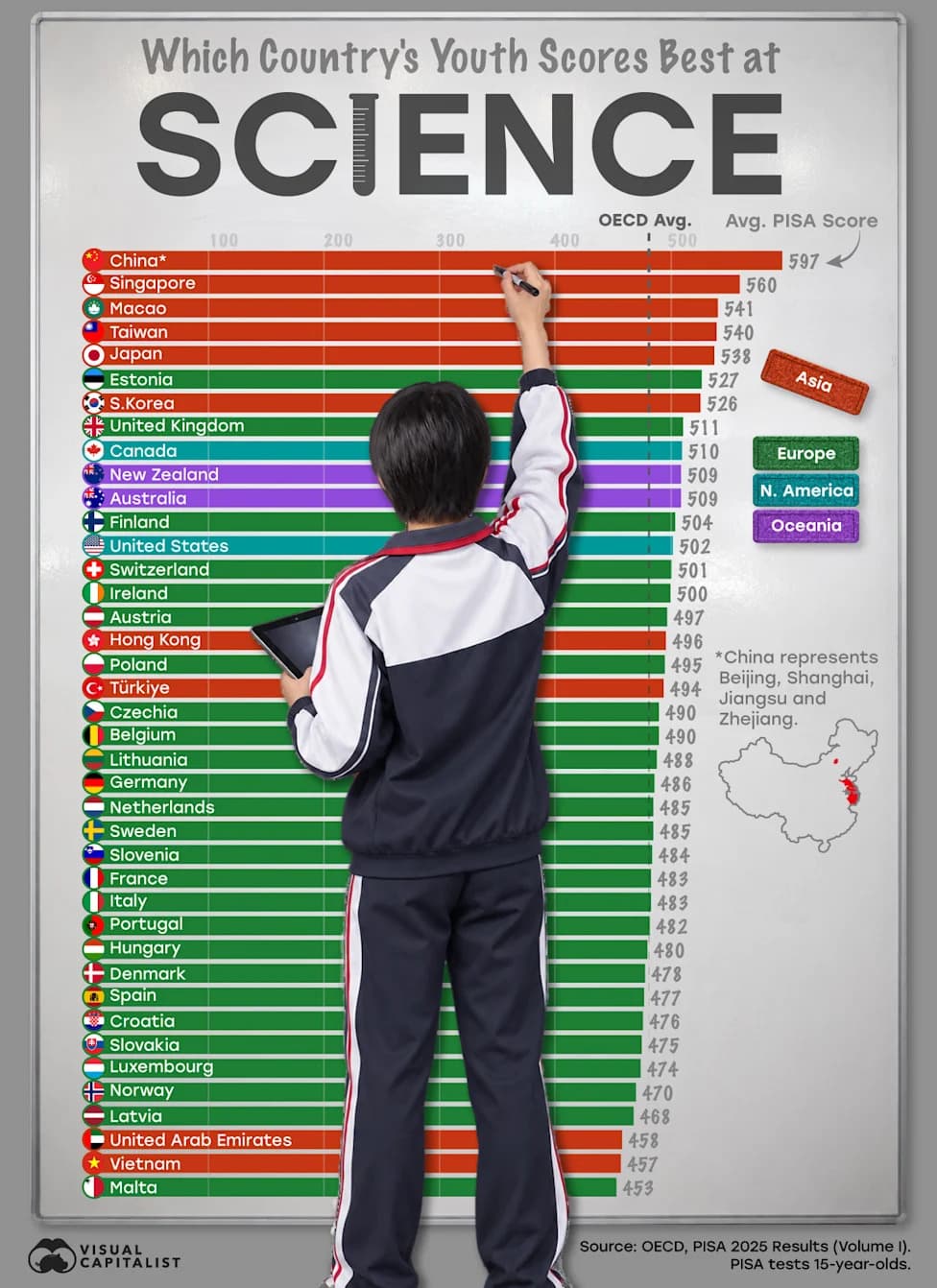
Selected other results: the OECD average is 463 (the United States also scores 463). Canada ranks 11th at 485, 22 points above the OECD average. Australia is 17th (478), New Zealand ties for 14th (480), and several large European economies — including Germany (25th, 464), France (33rd, 458), Spain (35th, 457), and Italy (24th, 468) — sit below the top tier.
Trends and Behavioral Findings
Across OECD countries, average mathematics performance fell by 22 points between 2015 and 2025 — roughly equivalent to just over one year of learning. Similar declines were recorded in many non‑OECD participants.
PISA also identified a link between students' digital leisure time and outcomes: more than four hours per day of digital leisure outside school is associated with lower mathematics scores and a weaker sense of belonging at school. By contrast, moderate digital use was associated with better outcomes than either no use or very high use.
What this means: The 2025 PISA mathematics results highlight stark international differences in performance, notable declines over the past decade in many countries, and behavioral patterns (like heavy digital leisure) that correlate with lower achievement and weaker social connectedness in school.
Help us improve.