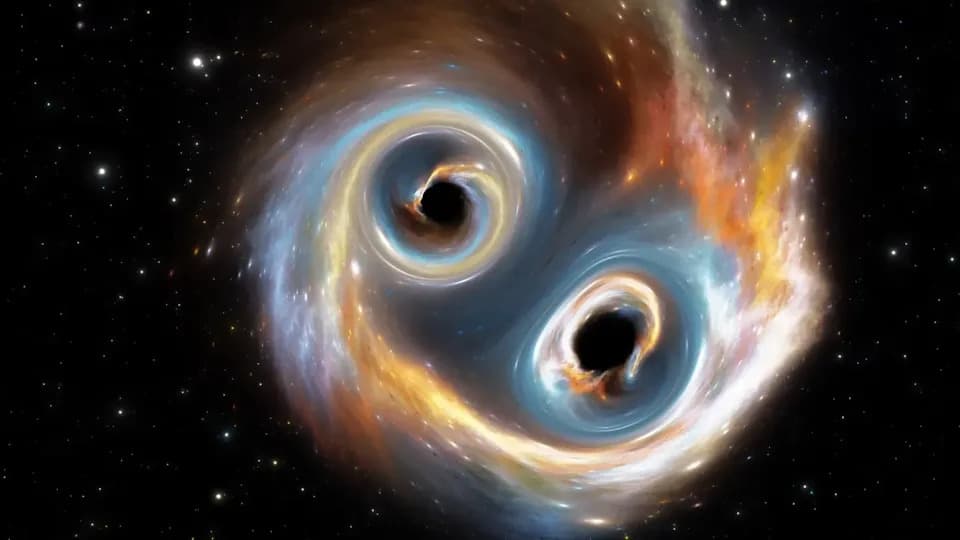
Researchers at the University of Aveiro ran 3D simulations showing that some 'hairy' black holes — black holes surrounded by a self-gravitating scalar field — can evolve in two ways. In the absorption outcome the scalar cloud falls in and the black hole becomes hairless; in the fission outcome the black hole is pushed out of the cloud, leaving a horizonless boson star behind. The effect depends on the compactness of the scalar hair and the scalar potential; the model uses electric charge as a stabilizer, so further work is needed to test astrophysical relevance and possible gravitational-wave signatures.
Black Holes Can Be 'Ejected' From Their Own 'Hair,' Leaving Boson Stars Behind
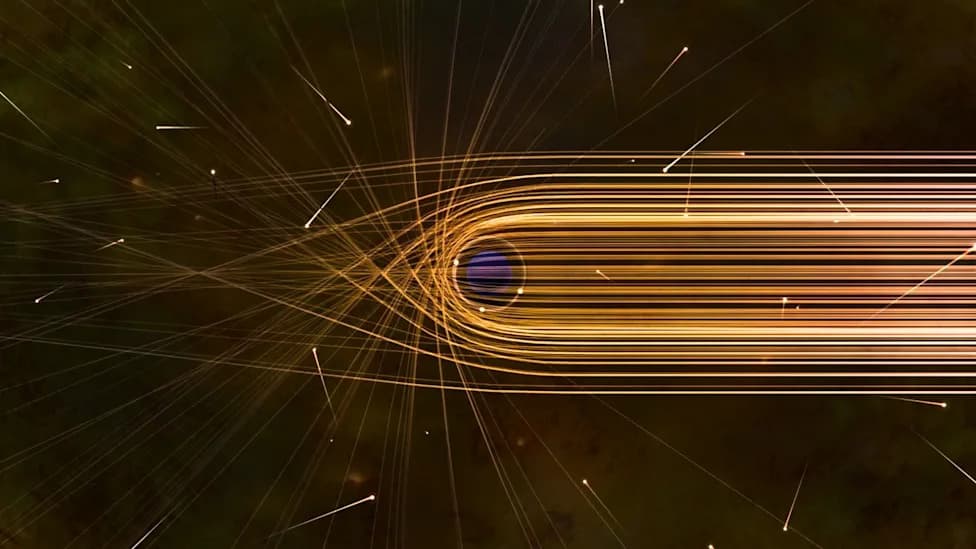
An illustration of photon paths around a black hole. (Nicolle R. Fuller/NSF)
If anything in the Universe seems permanent, it is the black hole — or so their basic physics suggests. These ultra-dense objects pull in matter with such ferocity that almost nothing comes back out. Yet new theoretical work from the University of Aveiro shows a stranger possibility: under certain conditions a black hole can be pushed out of the scalar field that surrounds it, leaving a horizonless boson star behind.
Researchers José Ferreira, Carlos Herdeiro, Eugen Radu and Miguel Zilhão used fully three-dimensional numerical simulations to follow the evolution of so-called 'hairy' black holes — black holes surrounded by a self-gravitating scalar field. Early, symmetry-constrained studies suggested some of these configurations could be long-lived. By allowing asymmetric evolution in their models, the team discovered two distinct end states.
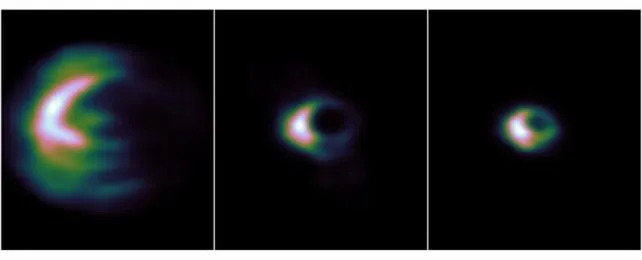
Synthetic images of a nonrotating black hole (left), rotating black hole (center), and boson star (right). (Fromm, Younsi & Olivares/BHAC)
Two Possible Fates: Absorption or Fission
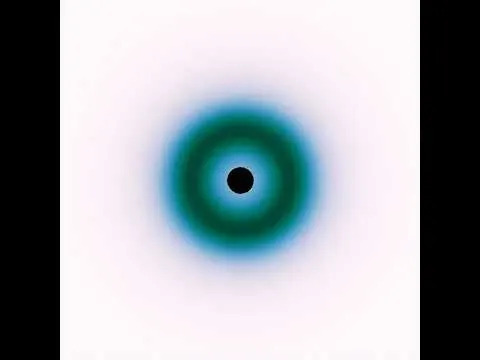
Absorption: In many cases the instability causes the scalar field to collapse into the black hole. The cloud is swallowed and the system relaxes to a conventional, hairless black hole.
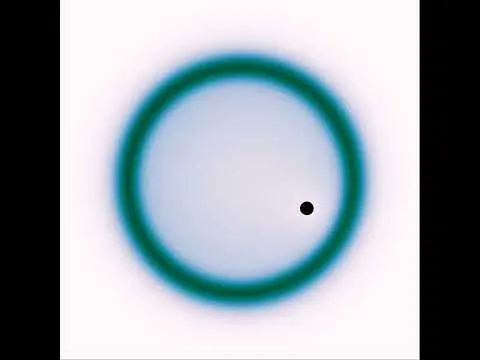
Fission: In the more surprising outcome, the composite system separates. A small perturbation nudges the black hole off-center and it migrates outward until it effectively emerges from the scalar cloud. The scalar field remains bound and settles as a stable, horizonless boson star, while the black hole continues on without its hair.
YouTube Thumbnail
"In one of the scenarios we call 'fission', neither the black hole nor its surrounding scalar structure is destroyed. Instead, the composite object separates into two independently viable objects," the authors told ScienceAlert.
How and Why It Happens
The models studied rely on a resonance that can balance the scalar field against the black-hole horizon, producing an equilibrium. However, when general (non-spherical) perturbations are allowed this equilibrium can be unstable. Which fate occurs depends partly on the compactness of the scalar cloud: more compact hair tends to be reabsorbed, while more extended clouds are prone to fission. The team observed this tendency across at least two different scalar potentials.
It is important to emphasize caveats: the simulations use ordinary electric charge as a stabilizing ingredient, while astrophysical black holes are expected to carry negligible net electric charge. As the authors note, the setup is primarily a toy model intended to reveal a dynamical mechanism that might also operate under other, more realistic conditions — for example, if rotation plays a role analogous to charge.
YouTube Thumbnail
Observational Consequences And Future Work
If an astrophysically plausible version of this instability exists, it could leave observable traces. A violent symmetry-breaking fission event would generate a characteristic gravitational-wave signal very different from familiar mergers, so future work will aim to compute waveforms and assess detectability. The authors describe this as a particularly interesting direction for follow-up studies.
The study has been published in Physical Review D.
Help us improve.