The gravitational-wave event GW231123, detected by LIGO on Nov. 23, 2023, initially appeared to come from an extremely massive black hole merger with component masses near 100 and 130 solar masses and a remnant of ~230 solar masses. A new study argues that gravitational lensing of the waveform could have magnified the signal, making intrinsically smaller black holes appear heavier and reducing the remnant estimate to ~140 solar masses. While this resolves the 'mass gap' tension, the proposed lens — a compact object of roughly 190–850 solar masses or an extended cluster — has not been identified and remains a major open question.
Einstein’s Relativity May Solve an 'Impossible' Black Hole Merger — But It Raises a New Puzzle
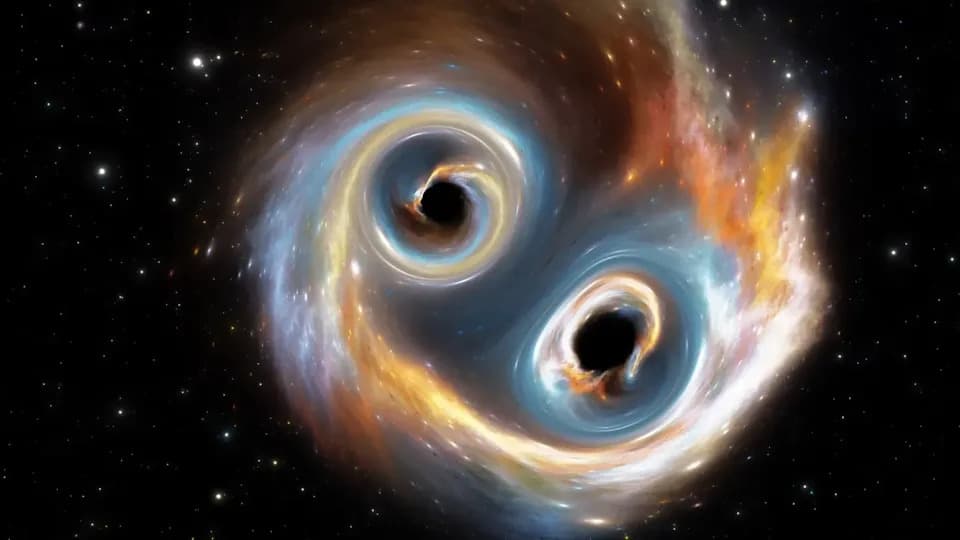
The GW231123 signal, detected in November 2023, was created by the most massive black hole merger seen to date. However, scientists have struggled to explain the size of the colliding singularities. | Credit: Pitris via Getty Images
On Nov. 23, 2023, the Laser Interferometer Gravitational-Wave Observatory (LIGO) recorded a puzzling signal now labeled GW231123. The waveform appeared to come from the most massive black hole merger observed to date, producing a remnant near 230 times the mass of the Sun. Yet the component masses inferred from the raw signal — roughly 100 and 130 solar masses — sit in a poorly understood “mass gap,” and their high spins added further confusion.
How Lensing Could Explain the Anomaly
In a paper published Aug. 25 in The Astrophysical Journal Letters, researchers from the Max Planck Institute for Gravitational Physics propose a different, less exotic explanation: gravitational lensing of the gravitational-wave signal. Just as massive foreground objects can bend and magnify light, they can in principle deflect, amplify, diffract and even split ripples in space-time. If GW231123 were magnified by a foreground lens, the inferred masses and distance would be biased upward.
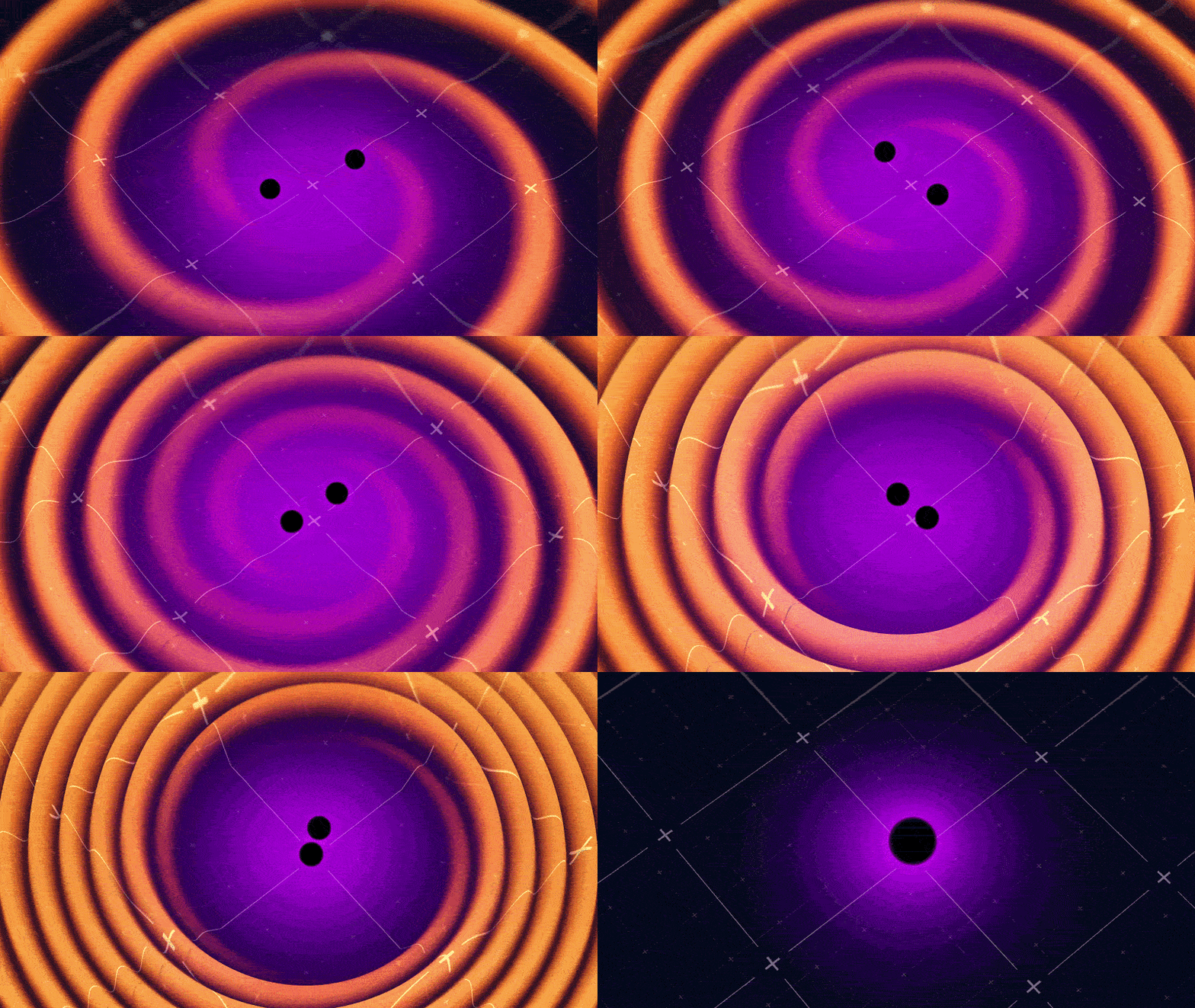
When black holes collide, they send out ripples in the fabric of space-time, dubbed gravitational waves, which can be detected by special observatories on Earth, such as LIGO. | Credit: NASA's Goddard Space Flight Center Conceptual Image Lab
Revised Mass Estimates
The authors show that if the waveform were lensed by a compact object of roughly 190–850 solar masses, or by an extended structure such as a globular cluster, the merged remnant’s apparent mass could fall from ~230 to about ~140 solar masses. That shift would move the progenitor black holes out of the problematic mass gap and remove the need for a rare formation channel that avoids supernovae.
“Like light, gravitational waves can also be deflected, magnified and split into multiple signals,” says Miguel Zumalacárregui, a co-author of the study. “Diffraction and interference effects give us an additional way to identify and study lensed signals.”
Why This Hypothesis Is Exciting — and Unproven
The lensing interpretation is attractive because it resolves the mass-gap tension without invoking unusual stellar physics or population-level changes. It also implies the source could be farther away than originally estimated, which would expand the volume of the universe accessible to LIGO-like detectors if lensing is common.
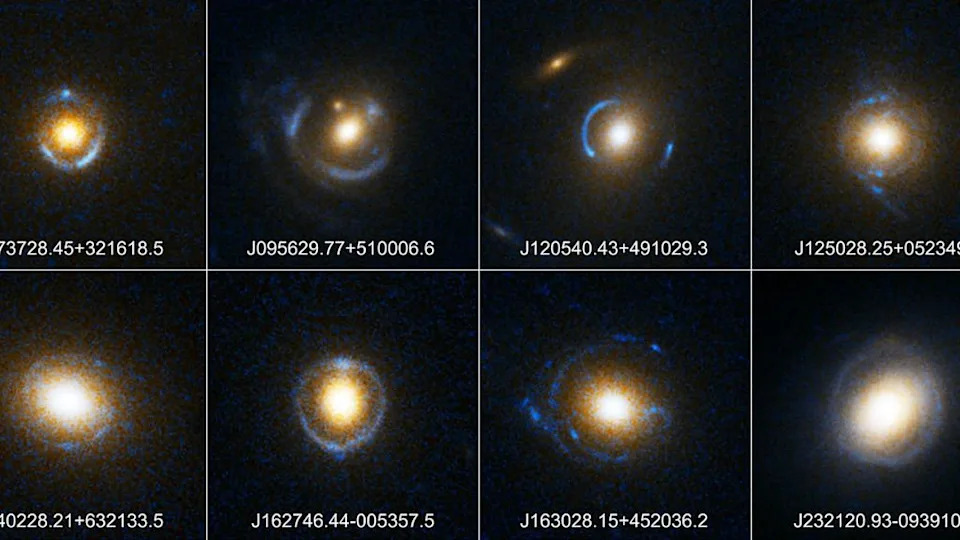
The gravitational lensing of visible light can sometimes create luminous halos, dubbed Einstein rings. In these images, the lensing object is the bright spot at the center of the rings and the warped blue light is from a distant object, located directly behind the "lens." (The blue light has also been magnified, making it appear much brighter than it otherwise would.) | Credit: NASA
However, gravitational-wave lensing has not yet been definitively observed. The study is theoretical: there is no direct electromagnetic signature (no Einstein ring or multiple images) to confirm a lens along GW231123’s line of sight. The parameter space the models favor points to compact lenses of 100–1,000 solar masses — objects that should be rare and are not obviously present between Earth and the event.
New Mysteries and Future Opportunities
If the lens exists, its nature becomes a new, intriguing question. Could isolated intermediate-mass objects form at those masses? Might ensembles of lighter objects, dense star clusters, or exotic dark-matter clumps mimic a compact lens? The authors suggest targeted searches for lensing signatures in gravitational-wave catalogs and follow-up electromagnetic observations of the event’s sky location.
Proving gravitational-wave lensing would be transformational: it would let astronomers study fainter, more distant mergers and could encode diffraction patterns that probe compact objects and dark matter in novel ways.
Credit: Pitris via Getty Images; concept illustration credit: NASA’s Goddard Space Flight Center Conceptual Image Lab
Help us improve.