NYU researchers used a custom random-positioning machine and flow-suppressing algorithms to simulate microgravity and separate it from fluid-induced mechanical stress. After 24 hours there was no detectable DNA damage and genome organization and chromatin motion remained intact, though nuclei enlarged and nucleoli smoothed. Strong fluid flows, in contrast, caused cell elongation and DNA damage. The study refines methods to identify true gravity-driven cellular changes but cannot predict long-term spaceflight effects.
Could Gravity Become a Medicine? NYU Study Finds Human Genome Intact After 24 Hours of Simulated Microgravity
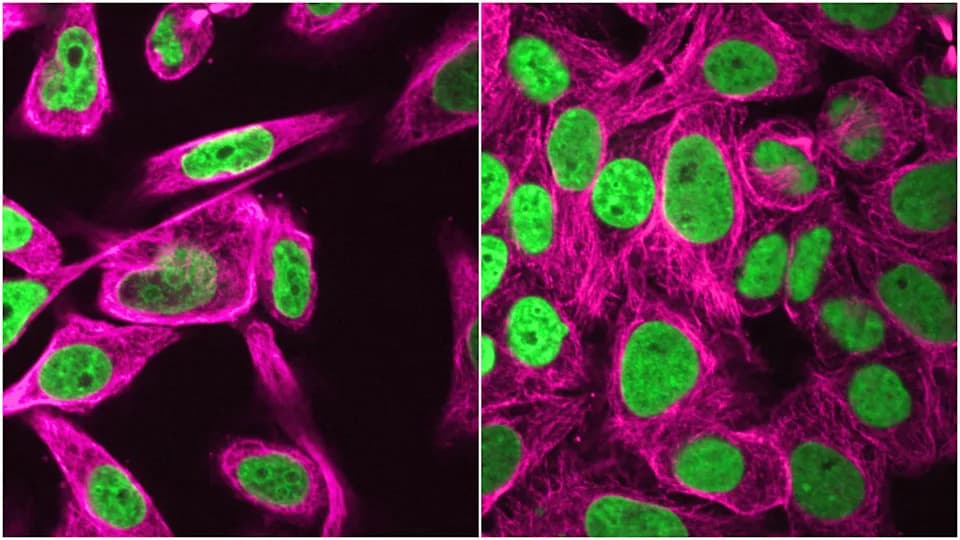
Human cells with fluorescently labeled chromatin (green) and microtubules (magenta) after 24-hour exposure to fluid flows (left) and 24-hour exposure to simulated microgravity. | Credit: Nikitas Kanellakopoulos and Alexandra Zidovska, Department of Physics, New York University
Human cells with fluorescently labeled chromatin (green) and microtubules (magenta) after 24-hour exposure to fluid flows (left) and 24-hour exposure to simulated microgravity.
Credit: Nikitas Kanellakopoulos and Alexandra Zidovska, Department of Physics, New York University
Scientists have probed how the human genome responds to a day of simulated microgravity and found that, over 24 hours, genome organization and chromatin motion remain largely resilient. The experiment — performed at New York University — combined an innovative random-positioning machine with algorithms that minimize fluid currents inside rotating cultures so researchers could separate true microgravity effects from mechanical flow.
What the researchers did
NYU researchers developed a custom random-positioning device that continually changes the orientation of cultured human cells relative to Earth's gravity. They also created software to suppress the fluid flows that commonly arise in rotating cell cultures. This control allowed them to isolate the cellular response to simulated microgravity rather than to shear stress from fluid motion.
Key findings after 24 hours
After a 24-hour exposure to simulated microgravity, the team observed no detectable DNA damage and no disruption of global genome organization or chromatin dynamics. The nuclear envelope — the membrane that separates a cell's genetic material from the cytoplasm — remained intact. Two structural changes were noted: nuclei increased in volume and nucleoli (the ribosome-production centers) became smoother in appearance. By contrast, strong fluid flows elongated cells and produced DNA damage, an important control that helps explain inconsistencies in earlier studies that did not adequately control for flow.
Limitations and context
The experiment was deliberately short-term. The authors caution that longer exposures — such as months-long spaceflights — could produce different effects, especially when combined with space-specific hazards like ionizing radiation. Study senior author Alexandra Zidovska noted that changes might emerge over extended missions or from DNA damage incurred in space.
Why this matters
Beyond basic biology, researchers are increasingly treating gravity as a controllable variable — almost like a drug — to identify doses (intensity, duration, frequency) that preserve astronaut health or aid rehabilitation on Earth. Ongoing and planned studies include NASA-funded "Gravity Dose" experiments at Texas A&M University's human centrifuge to test lunar and Martian gravity, European bed-rest trials BRACE and BRAVE pairing centrifuge-generated gravity with exercise, and the GRACER1 clinical trial assessing artificial gravity plus exercise for rehabilitation after conditions such as stroke and multiple sclerosis.
Bottom line
The NYU study does not define a therapeutic gravity dose, but it improves experimental methods for separating true gravity-driven cellular responses from artifacts caused by fluid flow. These techniques will help researchers identify when short-term cellular resilience to altered gravity gives way during longer journeys away from Earth.
The study was published on Sept. 23 in Science Advances.
Help us improve.