
Drone footage by wildlife cinematographer Carlos Gauna captures multiple great white sharks feeding on a dead dolphin off Southern California. Gauna says the dolphin was already dead and was "disposed of by 4 white sharks" in just over 18 minutes, as the predators tore away large pieces from the carcass. The event highlights the natural role of apex predators and comes amid an unusually shark-heavy season driven in part by warm El Niño waters.
Drone Captures Great White Sharks Feeding on Dead Dolphin Off Southern California Coast
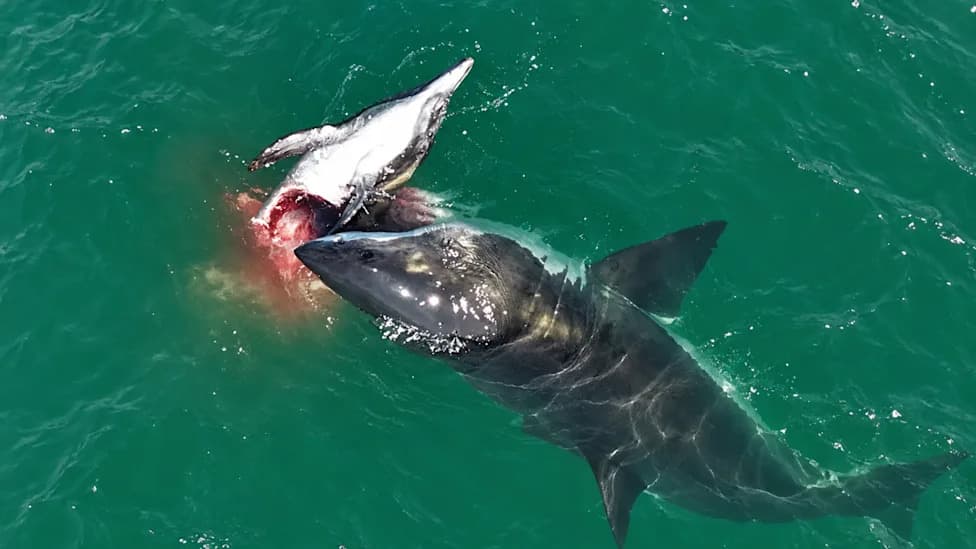
Great White Sharks Rip Apart Dolphin in Brutal SoCal Feeding Frenzy (Video)
Drone footage from wildlife cinematographer Carlos Gauna, known online as The Malibu Artist, shows multiple great white sharks feeding on a dead dolphin off the Southern California coast. Gauna, who has documented white sharks from the air for years, said he recognized the encounter as exceptionally rare and dramatic.
Viewer warning: the video is graphic. Gauna reported the dolphin was already dead when the sharks arrived and said the carcass was "disposed of by 4 white sharks" in just over 18 minutes. From above, the sharks circle the carcass before tearing away large pieces as blood spreads across the water, quickly reducing the animal to unrecognizable remains.
What the Footage Shows
The clip illustrates both active feeding and scavenging behavior. Several of the sharks in the footage appear noticeably larger than the six-to-nine-foot juveniles commonly seen near Southern California beaches, though Gauna and officials provided no official size measurements.
Biological Context
California wildlife officials note a clear dietary difference between juvenile and adult great whites. Adult whites consume a broad range of prey — seals, sea lions, dolphins, larger fish, other sharks and scavenged whale blubber — while juveniles primarily feed on rays and smaller fish.
This year Southern California has seen an abundance of juvenile whites, a pattern researchers attribute in part to unusually warm El Niño conditions that keep younger sharks closer to shore. Director Chris Lowe of the Cal State Long Beach Shark Lab previously warned the region was "gearing up to be a sharky summer" as warmer waters influence shark distribution.
Not About Attacks On People
Gauna's aerial work often captures white sharks moving calmly beneath surfers and swimmers — encounters people rarely notice. This footage, by contrast, shows natural predation and scavenging behavior rather than sharks hunting humans. It is a reminder that apex predators perform ecological roles that can appear violent to human eyes.
"While it's not easy to watch, it is the reality of our natural world, and a necessary event to keep the balance functioning," Gauna wrote.
The footage was originally published by Surfer on Sep 24, 2026.
Help us improve.





















