Argentina is seeing renewed social strain as soup kitchens overflow and barter clubs reappear, with early UCA estimates warning poverty could reach 35% by year-end. INDEC will release official H1 2026 poverty figures on Thursday; UCA currently places the rate near 31%–32%. Rising unemployment, a year-long drop in private-sector jobs and stalled income recovery are testing President Javier Milei's support ahead of a likely 2027 reelection bid.
Poverty Rise Tests Milei Ahead Of 2027 Election — Barter Clubs, Soup Kitchens Signal Growing Strain
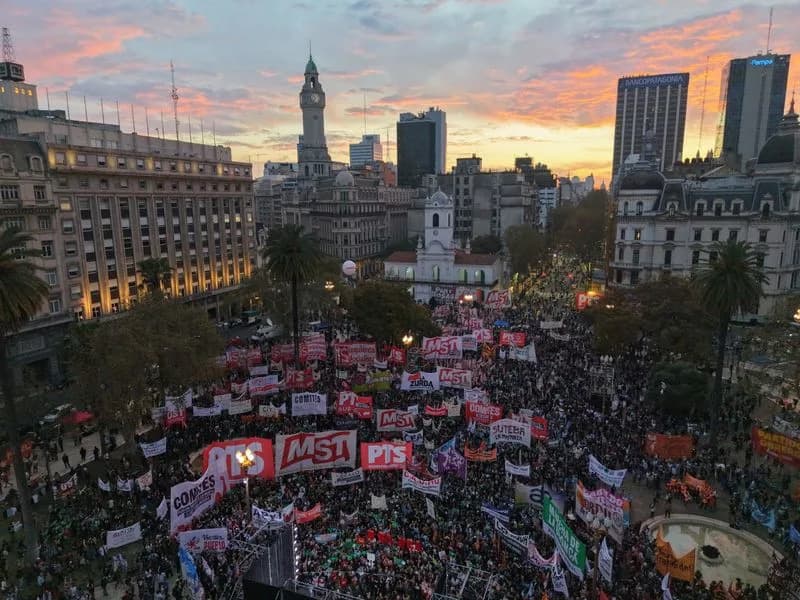
A drone view shows demonstrators during the "march of anger" to protest against the government of Argentine President Javier Milei, in Buenos Aires, Argentina, September 19, 2026. REUTERS/Martin Cossarini
Overflowing soup kitchens, a revival of cash-free barter clubs and families taking short-term loans to buy groceries are underscoring mounting social pressure in Argentina as economists expect official figures this week to show the first rise in poverty since President Javier Milei succeeded in bringing down inflation.
INDEC, Argentina's national statistics agency, is scheduled to publish poverty data for the first half of 2026 on Thursday. Early estimates from the Catholic University of Argentina (UCA) are being treated as a leading indicator: UCA projects the poverty rate could climb to about 35% of the population by year-end, reversing part of the sharp fall to 28% in 2025.
Agustín Salvia, director of the Argentine Social Debt Observatory at UCA, says 'every quarter over the last four quarters, 400,000 to 450,000 people have fallen into poverty' and estimates the current poverty rate at roughly 31%–32%.
Why This Matters
Even if INDEC confirms only a modest uptick, poverty would remain well below the levels seen during Milei's first year in office. But economists warn the social gains driven by lower inflation may be losing momentum, with future progress increasingly dependent on stronger job creation and real wage growth.
'A modest increase in poverty would not undo the large decline seen under Milei, but it would suggest that the easier part of the improvement has run its course,' said Nicholas Watson, Managing Director for Latin America at consultancy Teneo.
Communities Feeling the Strain
Across Buenos Aires outskirts, barter clubs have reappeared as people trade staples like cooking oil, sugar, flour and pasta for clothing and household goods. Aid workers report rising pressure on soup kitchens and community food programs.
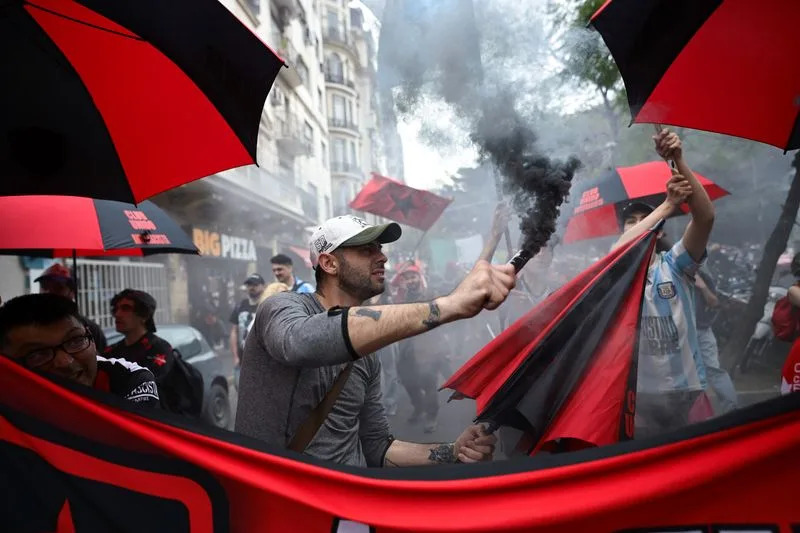
Demonstrators take part in the "march of anger" to protest against the government of Argentine President Javier Milei, in Buenos Aires, Argentina, September 19, 2026. REUTERS/Martin Cossarini
Small business owners also report weaker demand. 'Four years ago I had lines of customers. I used to sell 10 wheelbarrows, now I sell one,' said Gustavo Raúl Pérez, who runs a hardware store in San Fernando north of Buenos Aires. 'I voted for Milei believing he would bring change for the better, but he really disappointed me.'
Labor Market And Politics
Unemployment rose to 7.9% in Q2 2026, up from 7.6% in Q2 2025. Private-sector employment has fallen for 13 consecutive months, and household income recovery has largely stalled. Those trends appear to be eroding Milei's support among lower-income voters—an AtlasIntel survey in September found disapproval in that group near 70% and approval below 30% (lower-income defined as earning up to roughly $650 a month).
The government defends its austerity agenda—cuts to public-sector pay, removal of transport and utility subsidies, and tighter fiscal discipline—saying these moves are necessary to secure macroeconomic stability, balance the budget and attract investment. A government spokesperson told Reuters, 'The president is not going to move one inch from his program. He is not going to loosen his (contractionary) monetary policy to win elections.'
Outlook
If INDEC confirms an upward shift in poverty for H1 2026, it will present a political and social test for Milei ahead of the likely 2027 reelection campaign: slower inflation alone may no longer be sufficient to sustain improvements unless accompanied by stronger job growth and real wage gains.
Reporting by Nicolas Misculin in Buenos Aires; additional reporting by Miguel Lo Bianco. Editing by Lucinda Elliott and Aurora Ellis.
Help us improve.