New polling commissioned by Rep. Pramila Jayapal's Medicare for All PAC finds broad support for a government-run universal health system: 94% of Democrats, 60% of independents, 55% of conservative-leaning battleground voters and 19% of 2024 Trump voters. Experts link cross-party interest to affordability frustrations, while other polls and strategists warn that replacing private insurance remains politically risky. Jayapal aims to build support within the Democratic caucus and pursue a congressional markup as she prepares for a possible future trifecta.
New Poll Finds Medicare for All Garners Support in Conservative Battlegrounds — But Political Hurdles Remain
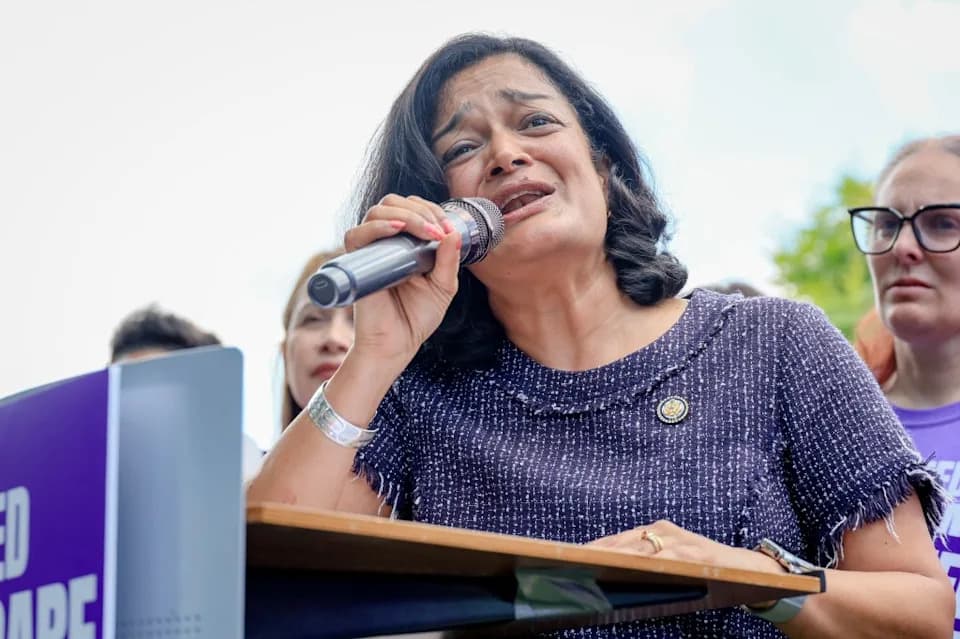
WASHINGTON, DC – MAY 19: Rep. Pramila Jayapal (D-WA) speaks during the SEIU rally where SEIU Members Called on Congress to Fund "Healthcare Not Hate" at the U.S. Capitol in Washington D.C. (Photo by Jemal Countess/Getty Images for The Service Employees International Union (SEIU))
A renewed push for Medicare for All is drawing support beyond progressive lawmakers, with new polling indicating that a government-run universal health system resonates even in some conservative-leaning battleground congressional districts.
The survey, commissioned by Rep. Pramila Jayapal's Medicare for All PAC and conducted by Democratic firm Greenberg Quinlan Rosner Research, reports that 94% of Democrats back a universal, government-run health care system, up from 90% a year earlier. It also found support from 60% of independents, 55% of voters in conservative-leaning battleground districts, and 19% of voters who supported Donald Trump in 2024.
What the Poll Says and How It Was Done
The poll sampled 1,200 likely 2026 voters nationwide and intentionally oversampled voters in battleground districts to better capture sentiment in competitive areas. Those results suggest growing cross-party interest in policies aimed at reducing the cost and complexity of health care.
Kevin Thompson, CEO of 9i Capital Group and host of the 9innings podcast, told Newsweek that Medicare for All is gaining traction because many Americans increasingly view it as potentially less expensive than the current system.
Why It Appeals Across the Spectrum
Health care affordability consistently ranks among voters' top concerns. Experts quoted in the reporting argue that frustration with premiums, high deductibles and confusing billing helps explain why the idea appeals beyond the Democratic base. As Alex Beene, a financial literacy instructor at the University of Tennessee at Martin, put it, the proposal's traction in traditionally conservative areas reflects dissatisfaction with the system rather than a sudden ideological shift.
Counterpolls and Political Risks
Opponents and some pollsters caution that support for universal coverage does not automatically translate to support for plans that replace private insurance. A September poll by Republican firm FabrizioWard for the conservative group Seniors Matter for America found that, when voters in competitive districts were told a Democratic candidate supported replacing existing coverage with a government-run system, they preferred the Republican candidate by a 50% to 38% margin. The center-left Searchlight Institute has also urged Democrats to pursue universal coverage without eliminating private insurance, arguing that a binary framing between Medicare for All and incremental reforms is unhelpful.
Jayapal's Strategy and Next Steps
Rep. Pramila Jayapal, a longtime proponent of single-payer health care, said she plans to use the next several years to build support within the Democratic caucus. She told POLITICO she is focused on preparing for a possible unified Democratic government in the future and hopes to press colleagues to hold a congressional markup of a Medicare for All bill when lawmakers return in October.
What Medicare for All Means
Medicare for All typically refers to a single-payer model in which the federal government provides comprehensive health insurance for all Americans, largely replacing the present mix of employer-sponsored plans, private insurance and existing government programs. Proponents argue a unified system could simplify billing, widen coverage and reduce administrative costs. Critics point to likely trade-offs such as higher taxes, disruption to the private insurance market and substantial political and logistical barriers.
Observers note that most other high-income countries have universal or near-universal health coverage administered through a range of systems, which some experts say makes the U.S. an outlier in treating universal coverage as radical.
Bottom Line
New polling suggests Medicare for All has broader appeal than many expect, including pockets of conservative-leaning districts. But political viability remains contested: alternative polls and political strategists warn that replacing private coverage is a sensitive message in swing areas, and backers acknowledge that passing major reform would likely require unified Democratic control of Congress and the White House.
Help us improve.