A few days earlier, Mike Davis — a former clerk for Justice Neil Gorsuch and the Senate Judiciary Committee’s chief counsel for nominations — posted a racist tirade on X offering to pay for "bitching minorities" to move to another country and even suggested covering living costs for those who renounced U.S. citizenship, citing "that nappy-ass head of hair."
That outburst made me think of another American population that might accept such an offer if it promised permanent residence in a place that does not seek their erasure: transgender people.
Escalating Political and Public Threats
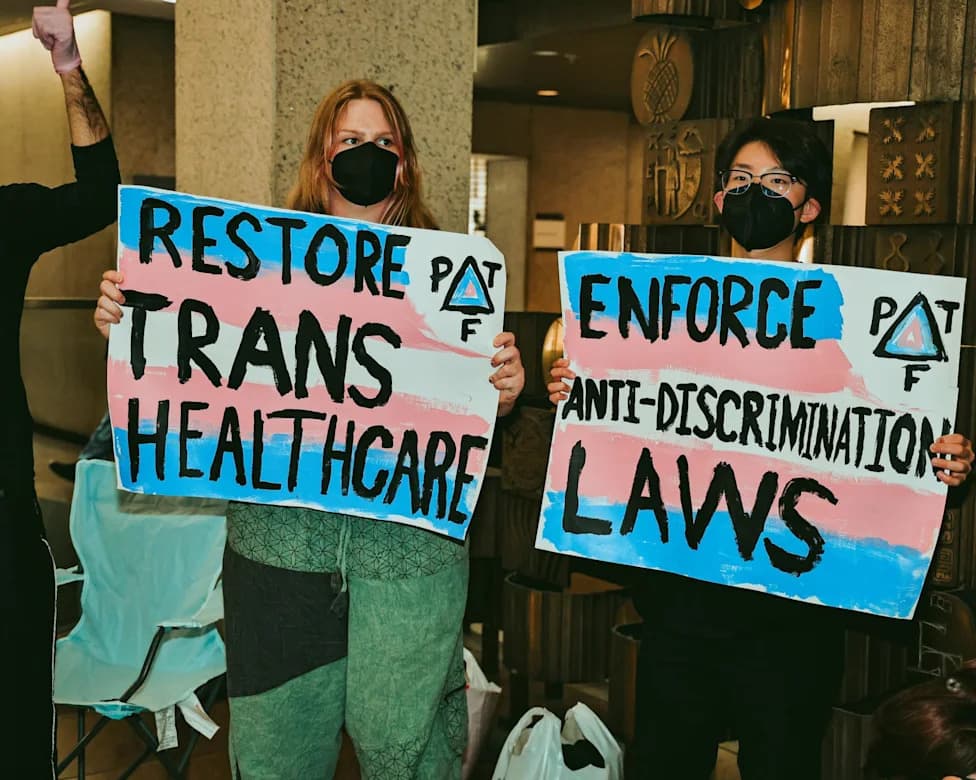
The Trump administration and many allies have signaled that transgender people are expendable to their political project. President Trump has warned — most notably on Fox News — that unless Republicans retain control of Congress, "transgender will never end," an implication that a Republican sweep could mean otherwise. Influential figures outside government, including Elon Musk, have also used dehumanizing language and framed efforts against transgender people as a moral crusade.
Project 2025, the Heritage Foundation–aligned blueprint for a potential future administration, proposes aggressively restricting speech and behavior it characterizes as "transgender ideology," even arguing that some expressions should lose First Amendment protection. Meanwhile, a string of policies and proposals have put transgender Americans in the crosshairs: bans from military service, limits on access to government-funded health care, exclusion from some public facilities, and restrictions on participation in sports — in some cases reaching into activities like chess and youth leagues.
Legal and Administrative Pressure
The Supreme Court has suggested that while "gender expression" might receive some protections, a medical diagnosis such as gender dysphoria is not categorically shielded — a distinction that creates a legal pathway for targeted discrimination. In addition, reports surfaced of a National Institutes of Health publication described as a non–peer-reviewed analysis linking support for transgender people to political violence; the September 2025 National Security Presidential Memorandum-7 (NSPM-7) even listed "radical gender ideology" among potential domestic terrorism indicators. Several House Republicans have publicly called for drastic measures, including rounding up and institutionalizing transgender people — rhetoric that raises the specter of state coercion.
Why Many Are Considering Leaving
Faced with escalating hostility, many transgender Americans are weighing emigration as a survival strategy. The Williams Institute at UCLA reported that in December 2024, about 45 percent of transgender people in the United States would leave the country if they could — and that number has likely risen as attacks have continued.
Yet leaving is not easy. Immigration systems are tightening across many Western countries amid rising xenophobia. Several states treat the United States as a "safe" country for LGBT claimants and routinely deny asylum claims from U.S. citizens. Practical, legal and diplomatic barriers — from residency rules to questions about statelessness and mutual trust between governments — complicate any large-scale exodus.
Canada As A Possible Haven
One plausible refuge often discussed is Canada. Ottawa has both geopolitical incentives — resolving trade tensions with the U.S. without appearing to accede to pressure — and economic ones, including demand for skilled workers in health care, transport and the military. At the same time, Canada faces domestic opposition to new waves of migration and would confront complex legal and administrative hurdles in any arrangement to resettle targeted populations.
Historical Parallels And The Moral Dilemma
History offers grim precedents. In the 1930s the Nazi regime at times encouraged Jewish emigration, cooperating with Jewish organizations to transfer assets and facilitating departures — while simultaneously making it harder for Jews to remain. Those who left early generally had far higher survival rates than those who stayed: historians estimate that a substantial majority of prewar emigrants survived, while many who remained perished. That stark calculus — leave and survive, or stay and risk annihilation — is the terrible arithmetic many transgender people are considering today.
Many activists and allies insist it is nobler to stay and fight. That argument rests on a judgment that the U.S. government will never resort to mass detention or other extreme measures against transgender people. But given current rhetoric, legal shifts and administrative actions, that judgement is increasingly fraught. For some, fleeing is a pragmatic choice that preserves life and capacity to resist from safety; for others, leaving would mean abandoning home, community and political struggle.
Practical Obstacles
There are concrete legal limits to mass emigration. For example, U.S. law and customary practice constrain renunciation of citizenship if it would render a person stateless. Any bilateral arrangement would require negotiations over payments, relocation logistics, and long-term residency or citizenship paths — and governments would have to overcome domestic political opposition to accepting a targeted minority at scale.
As someone who has become a Canadian permanent resident, I can attest that even straightforward family-based naturalization routes are slow and bureaucratic. Any program to help transgender Americans relocate would need extensive planning and legal safeguards to avoid creating new vulnerabilities.
Conclusion
The decision to stay or leave is deeply personal and often life-or-death. There may be moral and strategic value in resisting oppressive policies at home, but that is only meaningful if resistance does not become a death sentence. Given the current policy trajectory and public rhetoric from influential political and corporate figures, many transgender people reasonably conclude that emigration is a survival imperative rather than a political choice.
Bottom line: This is not merely a debate about tactics. It is a question of safety, survival, and whether democratic institutions will protect minority groups — or be used to persecute them.