Two residents living near Frankfurt Airport have been diagnosed with malaria and are receiving treatment. The cases follow six infections among airport staff identified in late August; two airport employees died earlier this summer. Officials suspect rare "airport malaria," likely spread by mosquitoes transported on aircraft, and say infections have been identified as Plasmodium falciparum. Investigations are ongoing and the public is advised to seek medical care for fever, chills or other unusual symptoms.
Two Residents Near Frankfurt Airport Diagnosed With Malaria; Officials Suspect Rare 'Airport Malaria'

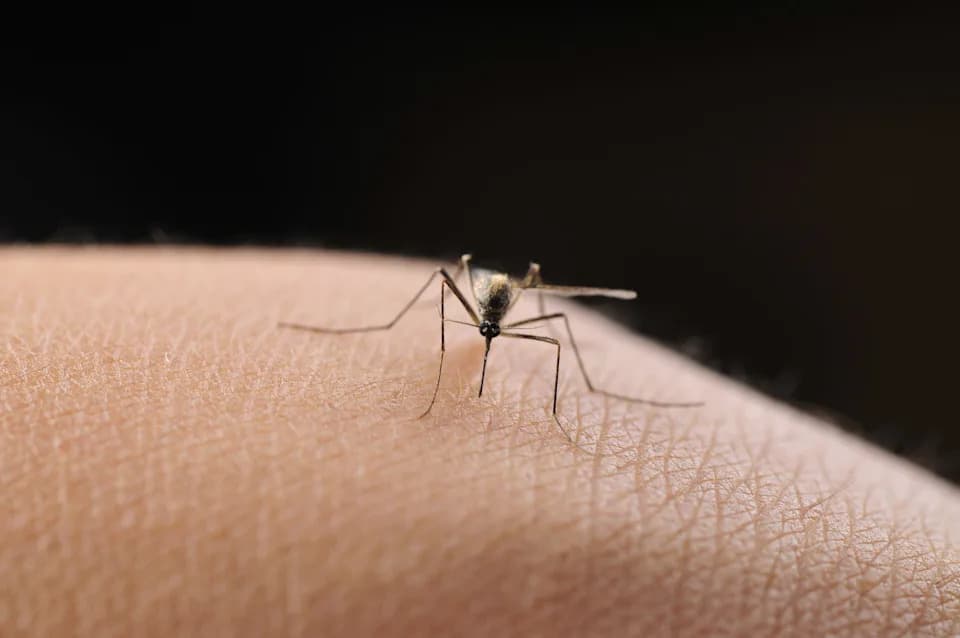
FILE PHOTO - A Mosquito sucks blood off a man's arm. Seven people have died from the West Nile virus in Greece this year, according to a report by the health authority EODY. (is associated with: «Two people living near Frankfurt Airport have contracted malaria») Patrick Pleul/dpa
Germany's Frankfurt Public Health Authority has confirmed that two people living near Frankfurt Airport have been diagnosed with malaria and are receiving medical treatment.
The announcement follows the identification of six malaria cases among airport staff in late August. Two airport employees died earlier this summer — one in early July and another in August. Authorities say those infections are believed to have been caused by mosquitoes from malaria-endemic regions that likely arrived in Germany on aircraft.
"The infected individuals have not travelled abroad," said Peter Tinnemann, head of the city's Public Health Authority. He added that neither of the new patients worked at the airport. Given the proximity of their homes to the airport, officials currently suspect these are cases of so-called airport malaria.
What Officials Are Saying
Investigators are working to determine whether the new cases are connected to the earlier infections among airport staff. According to the public health authority, the infections have been identified as Plasmodium falciparum (Malaria Tropica), the most severe form of the disease.
Germany's Robert Koch Institute (RKI) described airport malaria as "very rare," explaining that it occurs when an infectious mosquito is transported by aeroplane or in luggage and transmits the parasite on the aircraft, at the airport, or in its immediate vicinity.
Symptoms and Advice
Health officials urged calm but asked people to consult a doctor if they experience unusual symptoms. Common malaria symptoms include fever, chills, headaches, muscle aches and gastrointestinal complaints.
Public health authorities emphasize that infections among residents living near an airport have not been reported in Germany in recent decades, and they continue to monitor the situation closely.
Investigations remain ongoing to trace possible links between cases and to rule out other transmission routes. Local health services are coordinating surveillance and awareness efforts around the airport and nearby neighborhoods.
Help us improve.