Amy Westervelt's Brought To You By documents how early PR tactics and modern media ecosystems created a global problem of 'information pollution' that hides widespread public support for stronger climate policy. She links coordinated industry PR, corporate-funded research, think tanks, right-wing media and algorithmic platforms to the fragmentation of truth and the normalization of misinformation. Westervelt argues that robust, transparent journalism is the primary remedy and highlights World News Day as a call to defend trusted reporting.
The Tech Bros' War on Climate Action — How PR, Money and Algorithms Silenced Science

The Tech Bros’ War on Climate Action
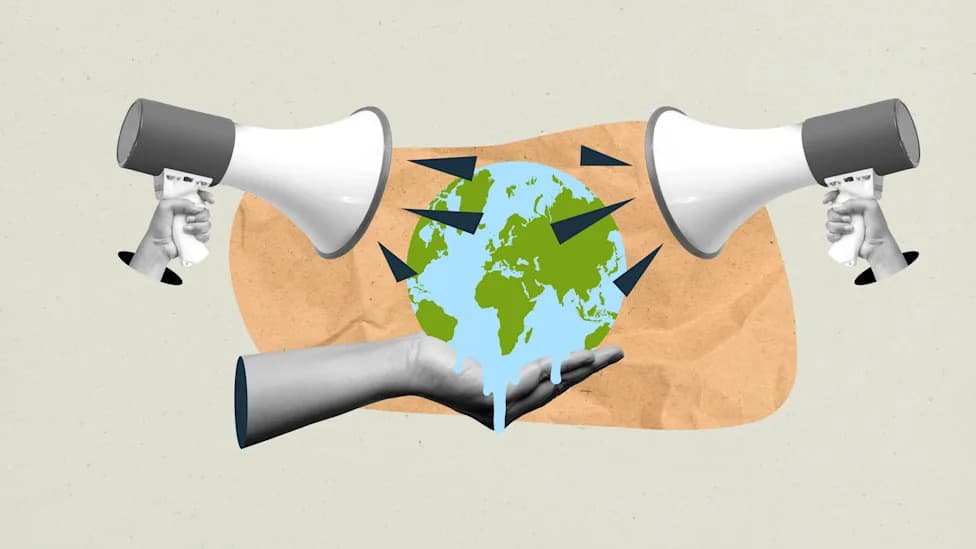
Journalist Amy Westervelt's new book, Brought To You By, traces how early public relations tactics and later waves of media innovation helped build a global information system that obscures the public's appetite for stronger climate action. Despite consistent polling that shows 80–89 percent of people worldwide want their governments to act on climate change, the noisy media environment often makes that majority feel like a powerless minority.
From Early PR to Information Pollution
Westervelt, a reporter who exposed fossil fuel industry efforts to hide the climate harms of their products, shows how World War I-era PR strategists such as Ivy Lee and Edward Bernays pioneered aggressive messaging techniques. Instead of avoiding the press, they fed journalists the narratives their clients wanted published. Over decades this offensive approach evolved into what Westervelt calls 'information pollution' — an ecosystem in which corporate-funded research, sympathetic think tanks and well-placed PR campaigns shape public debate.
Courts, Networks and Algorithms
Westervelt argues that the U.S. Supreme Court's Citizens United decision amplified the effect by equating money with speech, enabling well-funded interests to drown out other voices. Right-leaning media outlets and think tanks have normalized misleading frames, while technology platforms and algorithm-driven personalization have splintered audiences into countless information silos. A new cohort of tech entrepreneurs, derisively called 'tech bros' in the book, weaponize data and algorithms to scale fractured realities.
Westervelt invokes Justice Oliver Wendell Holmes' old distinction between the right to speak and the right to mislead to underline what has been lost in modern information politics.
Shifting Baselines and Collective Forgetting
Westervelt connects these dynamics to a broader cultural phenomenon known as shifting baseline syndrome, also explored by Jason Dove Mark. As environmental and social conditions deteriorate, newer generations accept degraded norms as normal. Examples such as the collapse of monarch butterfly migrations or summers defined by relentless heat illustrate how memory and expectation can be eroded by slow change and by the media systems that shape what people perceive as normal.
The Remedy: Trusted Journalism
Crucially, Westervelt does not blame ordinary people. She emphasizes that citizens were rarely taught how to trace information back to its origins or how to recognize the forces shaping what they see. Her remedy is a revival of rigorous, transparent journalism: careful reporting that checks sources, explains context and reconstructs coherent narratives from complex evidence. She points to World News Day on September 28 and its slogan, 'A single message: Trusted journalism matters,' as a reminder that reliable reporting is essential for democratic decision-making and for defending climate survival.
Disclosure: Westervelt serves on the steering committee of Covering Climate Now, the global journalism network co-founded by the author of this article.
Help us improve.