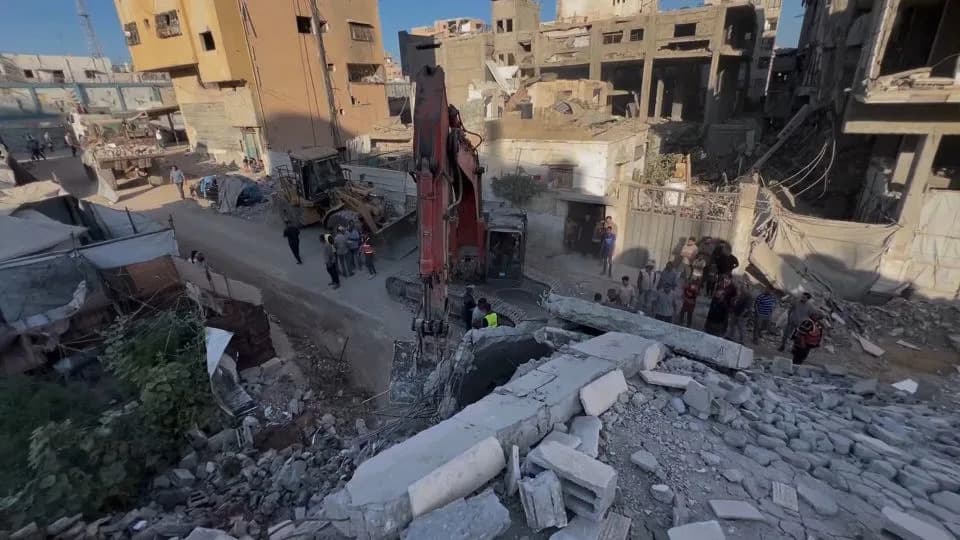
Many displaced Gazans have returned to damaged apartment blocks because few safer alternatives exist, even when structures are visibly unstable. By October 2025 the UN reported that about 84% of Gaza’s buildings were damaged or destroyed, and local authorities say roughly 2,000 buildings are at risk of collapse. Reconstruction under the October 2025 ceasefire has stalled amid security concerns and restrictions on importing heavy machinery and parts, while an assessment estimates $71.4 billion will be needed for recovery over the next decade.
Reconstruction Stalled: Gazans Shelter In Buildings At Risk Of Collapse
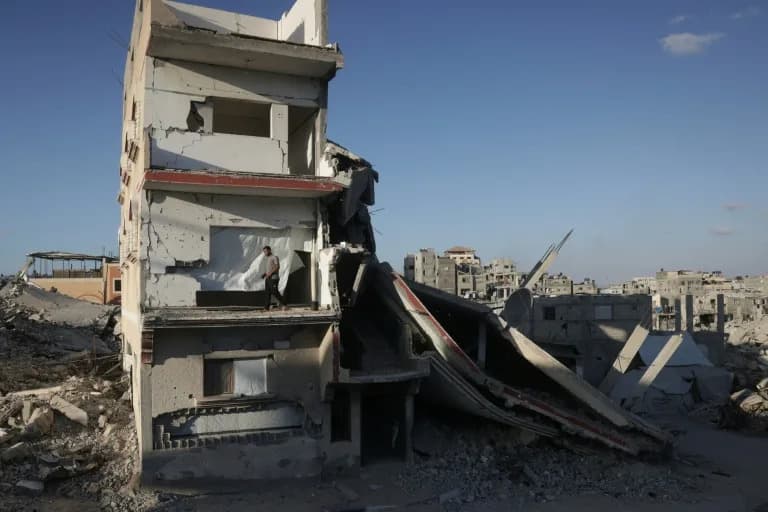
A displaced Palestinian man stands on the balcony of a heavily damaged building still used as shelter in Khan Yunis in the southern Gaza Strip on September 19, 2026 (Bashar Taleb)
Heba Arafat navigates a living room that slopes so steeply that a water bottle rolls across the floor on its own — a stark sign of how Israeli strikes and ground operations have undermined building foundations across Gaza. Like thousands of other displaced residents, Arafat, 47, returned after an October 2025 ceasefire to an older four-storey block in Gaza City's Al-Shati Refugee Camp that now houses about 30 people despite having its ground floor partially caved in.
Dangerous Choices
With whole neighbourhoods flattened and limited alternatives, many families face an impossible decision: remain in overcrowded displacement camps with poor sanitation or move into damaged, unstable apartment buildings. "We were forced to live here because we had nowhere else to go. All of our homes were destroyed, our land was razed and we have nothing left," Arafat said, describing life with her husband and six daughters in the tilted flat.
"We’re afraid a wall or the roof might fall on us, so we huddle together, afraid that one of us might get hurt," Arafat added.
Scale Of Damage
By October 2025 the United Nations estimated that roughly 84% of Gaza’s structures had been damaged or destroyed. Gaza’s civil defence reports that about 2,000 buildings are at risk of collapse across the territory. Last week a six-storey building in Gaza City collapsed, killing 21 people, including 12 children; local authorities said the building had been hit repeatedly by Israeli airstrikes, a claim Israel denied.
Local Response And Risks
Gaza City municipal teams now patrol neighbourhoods identifying unstable buildings and marking them with stencils. "These homes pose a genuine threat to the lives of the displaced persons sheltering inside them, as well as to residents in the vicinity and those in nearby displacement camps," said Gaza City spokesman Hosni Muhanna. He acknowledged, however, that many people are unlikely to relocate because few safer options exist and displacement camps offer little protection from extreme heat or cold.
Why Reconstruction Hasn’t Begun
Reconstruction planned under the October 2025 ceasefire has stalled. Israel has allowed aid into Gaza with restrictions and continued some strikes, and it has limited imports of equipment it argues could have military uses. Humanitarian officials, including UN spokesman Stephane Dujarric, say those restrictions block vital heavy machinery, spare parts and lubricants needed to clear rubble and maintain tools required for large-scale rebuilding.
A joint assessment by the United Nations, the World Bank and the European Union published in April estimated Gaza will need $71.4 billion in recovery and reconstruction over the next decade — a figure that highlights the scale of the challenge as political and security obstacles delay work.
Public-Health Pressures
Overcrowding and poor waste disposal in displacement camps have contributed to outbreaks of communicable conditions such as impetigo, prompting some displaced families to judge returning to damaged buildings the lesser risk. Municipal officials and aid workers warn the situation remains precarious while reconstruction and safe shelter options are limited.
Help us improve.