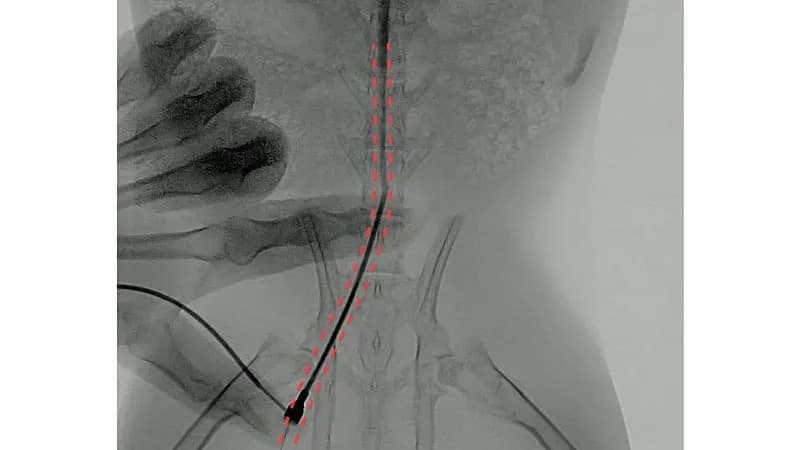
XCath Robotics' Iris remote thrombectomy platform has received FDA Breakthrough Device designation after performing the world's first live telerobotic mechanical thrombectomy in March 2026. The procedure—part of Operation Robo Angel—was conducted from Santiago to a clinic in Panama City more than 120 miles away. XCath says Iris could help reduce geographic barriers to specialist stroke care amid low global access to thrombectomy (estimated median 2.8%). The company will continue working with regulators as it expands clinical evaluation.
XCath’s Iris Wins FDA Breakthrough Designation After World’s First Live Remote Thrombectomy

XCath secures FDA breakthrough designation for remote thrombectomy robot
XCath Robotics' Iris, a remotely operated robotic platform for performing mechanical thrombectomy in patients with acute ischemic stroke, has been granted Breakthrough Device designation by the US Food and Drug Administration (FDA). The designation is intended to streamline regulatory review and accelerate the pathway to broader clinical availability.
The recognition follows Iris' role in the world's first live telerobotic mechanical thrombectomy, conducted in March 2026 as part of the clinical investigation called Operation Robo Angel. During that procedure, clinicians operated the Iris system from a control station in Santiago, Panama to treat a patient more than 120 miles away at a clinic in Panama City.
By enabling stroke specialists to perform procedures remotely, XCath says Iris could reduce geographic disparities in access to expert care—an urgent problem given the narrow time window for effective thrombectomy.
Clinical Context And Access Challenges
Mechanical thrombectomy is widely regarded as the gold-standard intervention for large vessel occlusion (LVO), the most severe form of ischemic ischemic stroke. Yet access is uneven: research from the World Stroke Organization (WSO) estimates that one in four adults will suffer a stroke in their lifetime, while the global median rate of access to mechanical thrombectomy is only about 2.8%.
Eduardo Fonseca, CEO of XCath: "We look forward to continued collaboration with the FDA as we advance the development and evaluation of the Iris system. The real-world learnings from our investigational cases are helping us shape the system to expand access to life-saving stroke care for the millions of patients we ultimately hope to serve."
Market Outlook And Competition
Analysis from GlobalData projects the global robotic surgical systems market to grow at a compound annual growth rate (CAGR) of 12.1%, reaching roughly $15 billion by 2035 (up from about $4.8 billion in 2025). Robotic telesurgery—where a clinician performs a procedure from a remote location—remains nascent but rapidly evolving.
Other companies working in remote endovascular robotics include Sovato and Sentante. Sentante, based in Lithuania, previously received FDA Breakthrough Device designation for its remote endovascular robotic platform in September 2025 and obtained a European CE mark for that platform in May 2026.
Next Steps
XCath says it will continue close engagement with regulators as it expands clinical evaluation, refines system performance, and gathers real-world data to support broader availability. Ongoing safety, connectivity, and workflow testing will be essential as the technology moves from investigational use toward routine clinical practice.
Help us improve.