Researchers at Yale report that semaglutide’s sustained weight-loss effect in female mice requires functional AgRP 'hunger' neurons. Mice with disrupted AgRP signaling still ate less on semaglutide but regained weight within 15 days because they mobilized less fat. The preclinical study (PNAS) shows prolonged semaglutide alters AgRP cellular activity, but human relevance remains unconfirmed.
New Mouse Study Suggests Semaglutide’s Lasting Weight Loss May Rely on ‘Hunger’ (AgRP) Neurons

(SweetBunFactory/iStock/Getty Images)
New preclinical research from Yale, published in PNAS, suggests that the long-term weight-loss effects of semaglutide (marketed as Ozempic and Wegovy) may depend on brain cells commonly called 'hunger neurons' (AgRP neurons) in ways beyond simple appetite suppression.

Drugs such as Ozempic and Wegovy may work in a more complex way than we realized. (imyskin/Canva)
Key Findings
In experiments on female mice, researchers used several independent methods — including interfering with Sirt1 signaling — to disrupt AgRP neuron function and then treated the animals with semaglutide. Although the drug continued to suppress food intake in these mice, the animals failed to sustain weight loss: they regained the weight they had initially lost within about 15 days. By contrast, female mice with intact AgRP neurons maintained reduced weight over the same period.
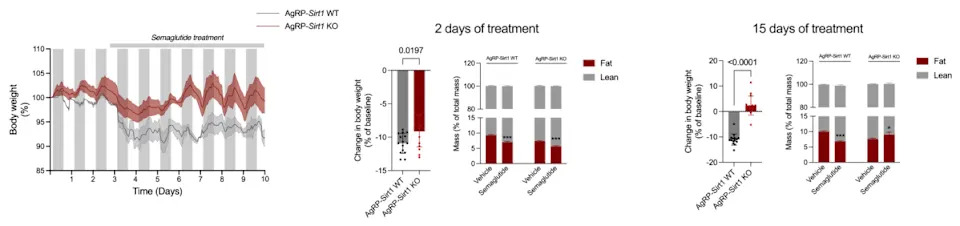
Female mice with normally functioning AgRP neurons maintained semaglutide-induced weight loss, while mice with disrupted Sirt1 signaling in these neurons regained the weight they had lost. The graphs also show differences in fat mass after 2 and 15 days of treatment. (d'Ávila et al.,PNAS, 2026)
Strikingly, weight regain occurred despite continued reduced food intake. Follow-up experiments indicated that disrupting AgRP neurons, or blocking a pathway required for mobilizing stored fat, reduced the drug’s ability to promote fat mobilization. The team also found that prolonged semaglutide exposure changed markers of cellular activity, energy usage, and synaptic connectivity in AgRP neurons — suggesting adaptive changes during extended treatment.

Subscribe to ScienceAlert's free fact-checked newsletter
Why This Is Surprising
AgRP neurons are often labeled simply as 'hunger neurons' because their activity rises when the body needs energy, promoting food-seeking behavior. Prior short-term studies showed that GLP-1 drugs quickly inhibit AgRP activity and that stronger inhibition correlates with immediate reductions in food intake. The new work does not contradict those acute effects; rather, it points to an additional, longer-term role for normally functioning AgRP neurons in enabling the body to mobilize stored energy and maintain weight loss during prolonged semaglutide treatment — at least in female mice.
Limitations
Important caveats apply: this is preclinical work in mice, and the most robust effects were observed in females — male mice did not show the same response under the tested conditions. Results were sensitive to diet and to the specific methods used to disrupt AgRP function. The authors caution that these findings should not be used to guide clinical use of semaglutide or other GLP-1 drugs at this stage.
Implications
If a similar mechanism operates in humans, it could help explain variability in patient responses to GLP-1 therapies and point to strategies for improving long-term outcomes — for example, by targeting pathways that support fat mobilization or neuronal resilience during extended treatment. Further studies in animals and humans will be needed to evaluate clinical relevance.
Reference: d'Ávila et al., PNAS (2026). Reported in ScienceAlert.
Help us improve.