A study in Environment & Health chemically analyzed 113 consumer personal care and cleaning products sold at major US retailers and found that 98% contained at least one unlabeled chemical and 85% contained at least one unlabeled chemical known or suspected to be hazardous. Researchers used non-targeted analysis to inventory chemicals in finished products and flagged the presence of endocrine-disrupting compounds. The study did not measure exposure levels or direct health effects; authors call for tighter regulation, independent testing and greater ingredient transparency.
Hidden Hazards: 85% Of Everyday Personal Care And Cleaning Products Contain Undisclosed Potentially Harmful Chemicals
(d3sign/Moment/Getty Images)
A recent laboratory analysis published in Environment & Health examined 113 personal care and household cleaning products sold at major US retailers and found widespread discrepancies between ingredient labels and chemical content.
The research team, led by Schultz et al. (2026), tested products across 12 categories — including laundry detergents, sunscreen, baby lotion, shampoo, deodorant and toothpaste — purchased from Target, Amazon, Walmart and Dollar Tree. Brands were not disclosed.
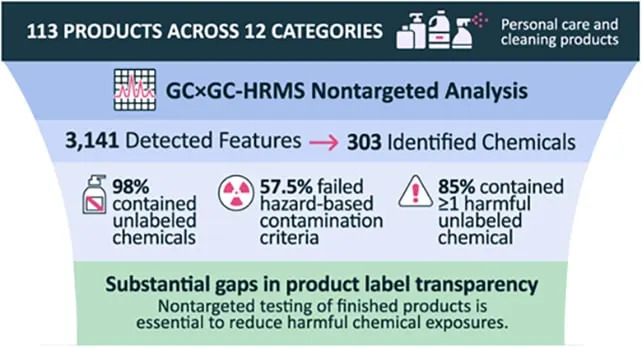
Almost all products contained unlabeled chemicals. (Schultz et al.,Environ. Health, 2026)
Key Findings
Nearly all tested products contained unlabeled chemicals: 98% had at least one chemical not listed on the product label. More concerning, 85% contained at least one unlabeled chemical known or suspected to be hazardous to human health (Schultz et al., Environ. Health, 2026).
"We found undisclosed harmful chemicals in products claiming to be free of them," says environmental health scientist Jenna Hua of the Million Marker Research Institute. "That means someone can carefully read ingredient lists, choose 'clean' products, and still end up exposed to the very chemicals they were trying to avoid. The label can't protect you when it doesn't show what's really in the bottle."
More than one in four products contained chemicals that contradicted explicit marketing claims such as "100 percent natural" or "hypoallergenic." The authors note these undeclared compounds are not necessarily intentional additives; contamination during manufacturing, storage, or unexpected chemical reactions between ingredients may also explain some findings.
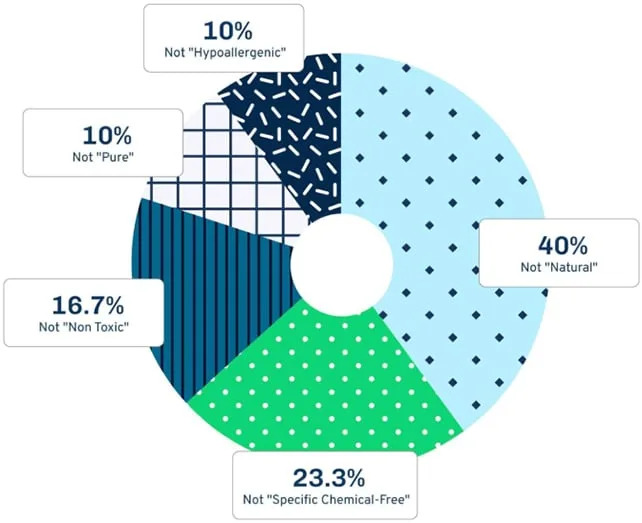
More than 1 in 4 products had chemicals that contradicted selling points. (Schultz et al.,Environ. Health, 2026)
What They Tested And How
The team used non-targeted analysis, a comprehensive technique that inventories chemical features in finished products without starting from a predefined list of compounds. This approach can reveal unexpected or previously unreported chemicals, but identification confidence for some unknown features can be limited.
One focus was endocrine-disrupting chemicals (EDCs), which can mimic or block natural hormones. EDC exposure has been linked in prior studies to health outcomes including certain cancers and metabolic disorders, raising concern that consumers trying to avoid these risks may still be exposed unknowingly.

Subscribe to ScienceAlert's free fact-checked newsletter
Limitations And Next Steps
The study documents presence but not exposure levels or direct health effects: it did not measure concentrations in products, actual consumer exposures, or dose–response harms. Determining whether detected chemicals pose a real health risk requires follow-up studies measuring quantities, exposure routes and toxicological effects.
The researchers call for stronger oversight and independent testing of finished, packaged products on store shelves. They also highlight regulatory gaps that allow manufacturers to withhold specific ingredients under umbrella terms such as "fragrance" or as trade secrets, and note that botanicals can contain many individual compounds that are often not disclosed despite potential hazards.
Recommendations
- Expand non-targeted analytical testing across more product categories and finished products.
- Improve methods to identify unknown chemical features and trace contamination sources through supply chains.
- Require greater ingredient transparency for fragrances and botanicals and consider limiting trade-secret exemptions when safety is at stake.
"People shouldn't need a chemistry lab to know what they're bringing into their homes or putting on their skin," Hua says. "The next generation of product safety must look beyond the label and test what is actually there."
Citation: Schultz et al., Environment & Health, 2026.
Help us improve.