The EPA has approved five pesticide ingredients that many scientists classify as PFAS, while using a narrower PFAS definition that excludes single‑fluorinated pesticide molecules. Three recent approvals were quietly posted and later publicized by nonprofits; critics warn many of these compounds break down into trifluoroacetic acid (TFA), now common in water. A 2024 review found 66 previously approved pesticides would meet the OECD’s broader PFAS definition, and the EPA flagged "suggestive evidence of carcinogenic potential" for one herbicide, trifludimoxazin.
EPA Approves Five Pesticides Many Scientists Call PFAS — Experts Raise 'Forever Chemical' Alarm
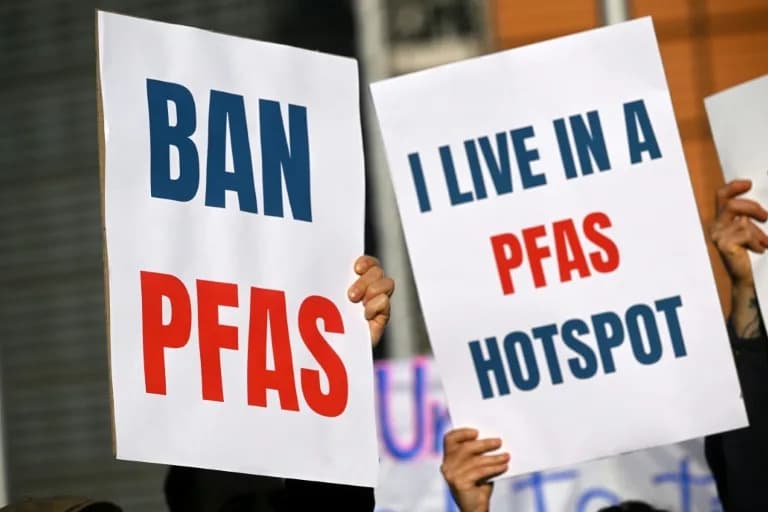
Environmental activists hold placards during a demonstration against PFAS chemicals next to the EU Commission headquarters in Brussels in March 2026 (Nicolas TUCAT)
Since returning to office, President Donald Trump’s administration has approved five pesticide ingredients that many scientists and environmental advocates classify as PFAS — the persistent so‑called "forever chemicals" regulators and researchers are working to phase out worldwide.
What the EPA says and why critics disagree
The Environmental Protection Agency (EPA) under the current administration uses a narrower technical definition of per‑ and polyfluoroalkyl substances (PFAS) that excludes these single‑fluorinated pesticide molecules and maintains they do not pose a human‑health threat. The agency argues each pesticide undergoes review, that pesticides are essential to food production, and that some single‑fluorinated chemicals can be less toxic than available alternatives. It also notes that some of the ingredients are registered or proposed for use in the European Union, Canada and Australia.
But many scientists and advocacy groups say that narrower definition is inconsistent with broader international and scientific practice and risks leaving significant hazards unaddressed. Critics point out that many of the approved compounds can degrade into trifluoroacetic acid (TFA), a persistent breakdown product now widely detected in drinking water and increasingly linked in studies to reproductive and fetal harms.
Approvals, secrecy and scrutiny
The most recent three approvals were published without the customary public press statements and only became widely known when nonprofit groups publicized the agency actions. That has increased concerns about transparency in the regulatory process.
"If we want to do something about this class of chemicals, then you need to draw boundaries," said Cindy Hu, an environmental scientist at George Washington University.
Definitions and the bigger picture
PFAS are commonly associated with the carbon–fluorine bond — one of the strongest in organic chemistry — a property that gives these molecules unusual persistence and useful water‑ and oil‑repellent qualities. Evidence linking PFAS to cancers, immune‑system effects and reproductive harms has prompted multibillion‑dollar settlements, regulatory changes and corporate phase‑outs.
In 2021 the Organisation for Economic Co‑operation and Development (OECD) adopted a broad definition of PFAS: any molecule containing at least one fully fluorinated carbon atom. Roughly half of U.S. states, Congress and the Pentagon have adopted that interpretation, as have many experts who signed a 2024 scientific consensus statement. In contrast, the EPA in 2023 adopted a narrower definition limited to chemicals with two or more adjacent fully fluorinated carbon atoms. Under that narrower definition the agency approved one pesticide during the Biden administration and five more under the current administration.
Health signals and retrospective findings
Some of the newly approved ingredients have raised specific health concerns. The EPA’s own assessment flagged the herbicide trifludimoxazin as having "suggestive evidence of carcinogenic potential." A 2024 retrospective analysis that re‑examined hundreds of pesticide ingredients concluded that 66 previously approved compounds would meet the OECD’s broader PFAS definition — suggesting current approvals may represent only a fraction of the overall issue.
Environmental Testing: Analyses of produce and food have detected residues consistent with these pesticide ingredients, prompting warnings from scientists about potential exposures for consumers and agricultural workers. Many of the chemicals can breakdown to TFA, and the European Food Safety Authority recently lowered the acceptable daily intake for TFA in food.
Governance concerns and industry ties
Critics have also pointed to the influence of former industry lobbyists now serving in senior EPA roles, naming individuals who previously worked for agricultural and chemical trade groups. A Freedom of Information Act (FOIA) request revealed edits made last November to the EPA’s web guidance on PFAS and pesticides that removed references to the broader, widely accepted definition. Those edits occurred the same day that CropLife America, the pesticide industry trade association, submitted a paper opposing further regulation and cited the revised EPA page; neither the EPA nor the industry group responded publicly to queries about coordination.
Outlook and precaution
Researchers and public‑health advocates urge a precautionary approach: set clear boundaries around what counts as PFAS, expand independent health and environmental testing of pesticide breakdown products, and evaluate whether some approvals should be reevaluated in light of persistence and potential harm. Critics warn the pattern echoes past substitutions of shorter‑chain fluorinated chemicals marketed as safer alternatives — some of which later proved problematic.
Bottom line: The approvals have rekindled debate over how PFAS are defined and regulated, the transparency of the approval process, and the long‑term implications for water quality, food safety and public health.
Help us improve.