The Rosebud Sioux Tribe will build the Wiconi Wakan Health and Healing Center, an 8,400-square-foot outpatient behavioral health facility adjacent to the Tribe’s detox center and the IHS emergency department. Funded by nearly $5.4 million in grants, the $4.6 million construction project also covers the first year of operations to allow services to begin right away. The center will centralize treatment rooms, therapy spaces, a call center and traditional healing areas, combining evidence-based practices with Lakota cultural teachings to expand access, strengthen suicide prevention and reduce barriers to care.
Rosebud Sioux Tribe to Open $4.6M Wiconi Wakan Behavioral Health Center
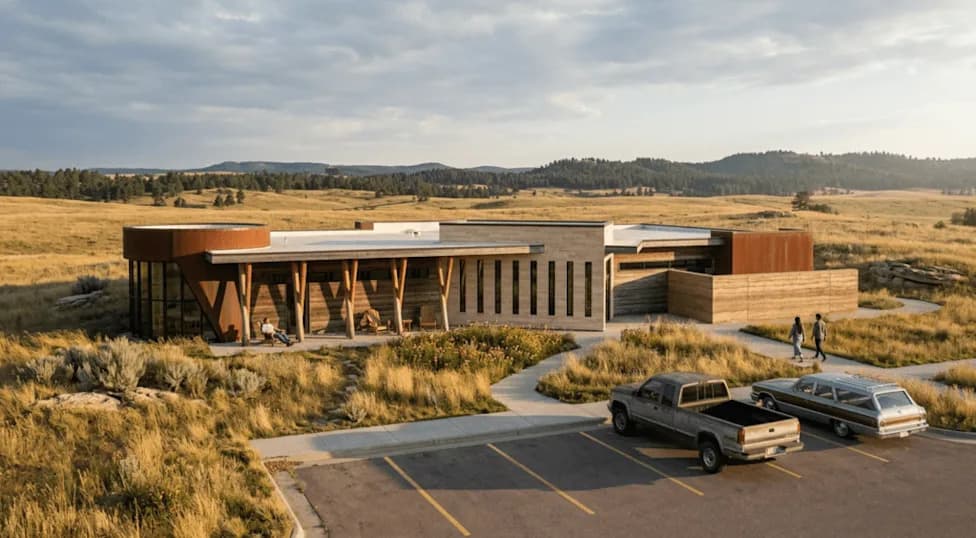
RST Behavioral Health rendering. (Photo/TSP Inc.)
The Rosebud Sioux Tribe is moving forward with construction of a new outpatient behavioral health facility—the Wiconi Wakan Health and Healing Center—a single-story, 8,400-square-foot building designed to centralize culturally grounded mental health and substance-use services on the Rosebud Reservation.
Project Overview
The center will be sited adjacent to the Tribe’s recently completed detoxification center and near the Indian Health Service emergency department, enabling a coordinated continuum of care for tribal members and nearby communities. By colocating services, tribal leaders aim to improve access, reduce barriers to treatment, and streamline referrals across detox, emergency, outpatient, and traditional healing resources.
Funding
The project is funded by two grants totaling nearly $5.4 million from the Thomas W. Haas Foundation and The Leona M. and Harry B. Helmsley Charitable Trust. Those grants will cover the facility’s construction (estimated at $4.6 million) and its first year of operations, allowing services to begin immediately once the center opens.
Design and Services
The Wiconi Wakan Center will consolidate expanded behavioral health services under one roof. Planned spaces include seven treatment rooms, three therapy rooms, a family treatment room, reception and waiting areas, a behavioral health call center, administrative offices, and a dedicated traditional healing space.
“These projects are more than buildings and programs—they are a reflection of our values, our responsibility, and our commitment to the wellbeing of the Sicangu Oyate,”
Cultural Integration and Care Model
A central feature of the center will be the integration of evidence-based behavioral health practices with Lakota cultural teachings and traditional healing methods. The Tribe emphasizes spirituality, family, language, and culture as essential components of trauma-informed, holistic care that addresses physical, emotional, mental, and spiritual wellbeing.
Expected Impact
Tribal officials say the center will expand access to outpatient treatment, strengthen suicide-prevention efforts, increase recovery supports, and reduce barriers to care within the community. The investment comes amid persistent behavioral health disparities in Native communities; public health data show Native American youth—including those in Todd County, South Dakota—experience suicide rates well above the national average, underscoring the need for accessible, culturally responsive services.
“Treatment for behavioral health and substance use issues should be as accessible as any other medical service. Bringing these services into one centralized location will ensure that Rosebud Sioux Tribe members can access a full continuum of care closer to home,”
Tribal leaders have not yet announced a groundbreaking date. Officials describe the project as a major step toward strengthening the Rosebud Sioux Tribe’s capacity to provide long-term, community-led behavioral healthcare for future generations.
Help us improve.