Doctor Kiril Apostolov, who turned 90 in May, still makes daily rounds from his surgery in Skrat and cares for over 1,500 patients across villages near the Belasitsa mountains. In 2023, 54.5% of Bulgarian doctors were aged 55 or older and the average GP is over 61, driving a shortage of rural replacements. Bulgaria recorded the EU’s lowest life expectancy in 2024 (75.8 years), and the OECD links part of the problem to underfunded primary care and delayed diagnoses. Young doctors cite bureaucracy, low pay and poor career prospects as reasons they avoid rural general practice.
At 90, Doctor Kiril Apostolov Still Makes Daily Rounds as Bulgaria’s Rural GP Shortage Worsens
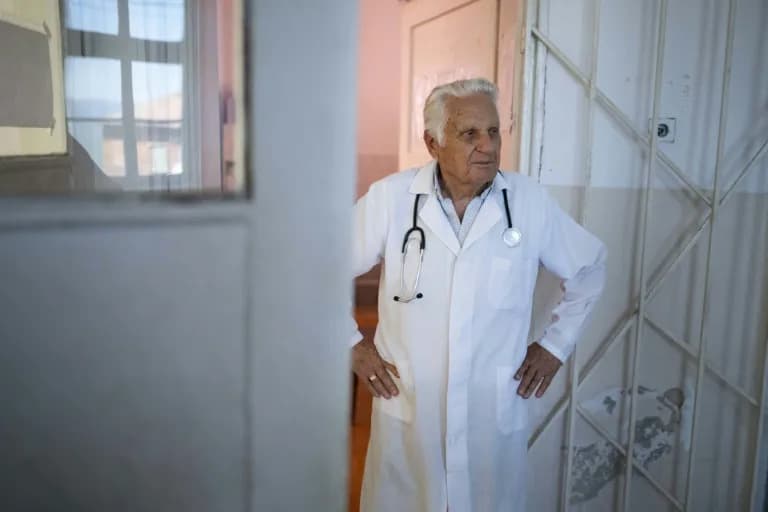
Doctor Kiril Apostolov is still serving patients in the remote Bulgarian mountains despite having recently turned 90 (Nikolay DOYCHINOV)
Doctor Kiril Apostolov, who turned 90 in May, shows little sign of slowing as he climbs the steep lane to his surgery in the mountain village of Skrat in southwestern Bulgaria, a medical case always at his side. He still walks the same hill almost every day to see patients scattered at the foot of the Belasitsa range near the borders with Greece and North Macedonia.
Apostolov’s persistence reflects a wider problem: many general practitioners in Bulgaria continue working well past retirement age because there are too few replacements, particularly in remote areas.
In 2023, 54.5% of doctors in Bulgaria were aged 55 or older — the highest share in the European Union, according to Eurostat — and the average age of general practitioners is now over 61. At the same time, Bulgaria recorded the EU’s lowest life expectancy in 2024 (75.8 years versus the bloc average of 81.5), and the country has some of the highest rates of preventable mortality, the OECD reports. Experts say shortages of primary-care doctors contribute to delayed diagnoses and weaker management of chronic diseases.
Apostolov cares for more than 1,500 patients registered across several villages. His working day begins about 7:00 a.m. when he drives roughly 16 kilometres from his home in Petrich to his office in Skrat in a 20-year-old Peugeot. Many patients are already waiting for help with conditions such as high blood pressure and diabetes.
"I'll Keep Going"
Greeting neighbors from a garden gate, he asks, "How are you today?" One regular patient, Milka Oumlenova, 88, joked about his age: "He's even older than me, but he doesn't use a walking stick. I have two. May he live a long life and keep helping us."
"For the moment, I feel fine. The work doesn't weigh me down. I'll keep going as long as I'm doing well and the patients are satisfied," Apostolov says, sitting behind a large wooden desk.
He opens his practice at 8:00 a.m., wearing a pale blue shirt and a white lab coat. Inside the old brick building, medicines and syringes sit in glass cabinets that look decades old. At midday he visits housebound patients, and in the afternoons he drives between neighboring villages to see others.
Poor Career Prospects for Young GPs
Apostolov began his medical career in 1962 as a district physician, later running a hospital department in Petrich and working in cardiology. He moved to Skrat in 2000, already in his sixties, and has remained a fixture of local care ever since. "Medicine has changed profoundly since I began, but what we have learned and our experience remain important," he says.
The OECD finds that primary care in Bulgaria is underdeveloped, underfunded and undervalued despite a comparatively high overall number of physicians. Gergana Nikolova, vice-president of the Bulgarian National Association of General Practitioners, warns: "We are the Atlas who carries everything, but this Atlas has grown old." She and others say young doctors avoid rural GP posts because of heavy bureaucracy, limited career prospects and low pay, though some mentorship links — like Nikolova training under Apostolov two decades ago — offer small rays of hope.
As Bulgaria faces demographic and structural pressures in its health system, stories like Apostolov’s underline the human consequences of an aging medical workforce: communities remain dependent on a shrinking pool of veteran doctors while younger physicians choose other paths.
Help us improve.