The Metropolitan Museum of Art houses a Bronze Age bronze helmet linked to the Elamite culture of southwestern Iran that blends martial function with religious symbolism. The dome-shaped helmet (about 8.5 inches / 21.6 cm across) once featured a nasal guard and a rear tube that may have held a plume. Three gold-coated deities (one male, two female) are mounted on the front with a diving raptor above; the male’s vessel suggests he could be a water god. Experts argue the ornate decoration indicates a high-status wearer and shows how armor could signal divine favor as well as military power.
Elamite Bronze Helmet at the Met: Gold Deities and a Swooping Raptor Reveal Power, Piety, and War
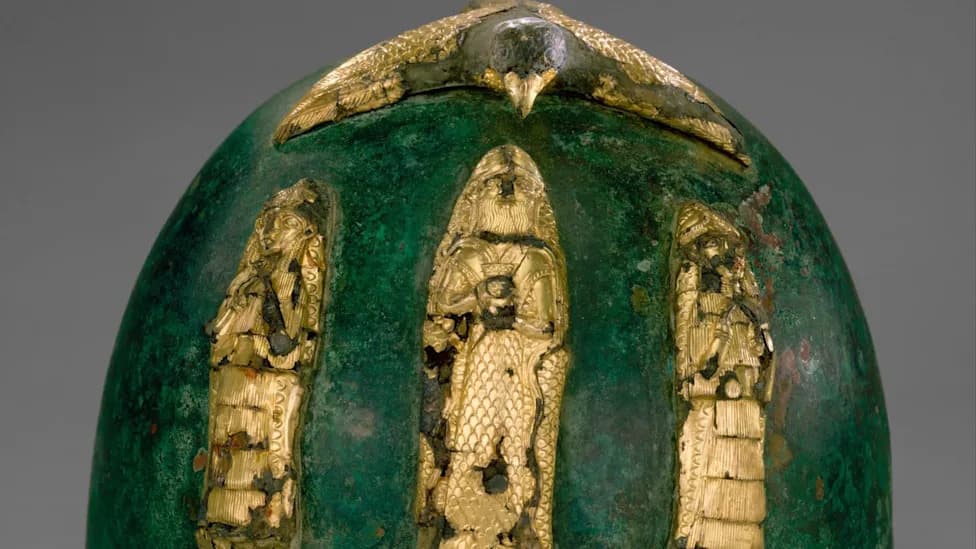
Photo Credit: The Metropolitan Museum of Art
A bronze helmet from ancient Iran, now in the Metropolitan Museum of Art, offers a vivid glimpse of how military display, political rank and religion were intertwined in the Bronze Age. Far from being merely protective gear, the helmet combines high craftsmanship, gilded figurines and dramatic bird-of-prey imagery to communicate status and sacred meaning.
Description
The dome-shaped helmet measures roughly 8.5 inches (about 21.6 cm) across. Its front is cut back so it would sit above the wearer’s eyebrows; it once included a nasal projection for added facial protection. A bronze tube at the rear may originally have held a plume of feathers or hair to increase the wearer’s height and visual impact on the battlefield.
Iconography and Interpretation
Across the helmet’s forehead are three gilt figures—one male flanked by two female deities—while a large raptor is positioned above them in a swooping pose. Because the male figure holds a vessel, researchers have suggested he may represent an Elamite water god. The combined imagery suggests the helmet served both practical and symbolic functions: physical protection, assertion of high rank (perhaps of a warrior king), and invocation of divine favor or spiritual protection.
Context and Scholarship
The helmet is associated with the Elamite culture, a civilization that endured for nearly 3,000 years in what is now southwestern Iran and frequently engaged with Mesopotamian states such as Ur and Babylon. As part of the Met’s collection, the object has been studied by curators and scholars, including Oscar White Muscarella and Charles K. Wilkinson, who have helped interpret its construction, materials and cultural meanings.
Oscar White Muscarella described the object as "a masterpiece of ancient art" that "has no parallels in either the representative art of the ancient Near East or from excavations."
Significance
Artifacts like this helmet fill gaps in our understanding of societies less familiar to many readers than ancient Egypt, Greece or Rome. They show how armor could be a medium for expressing authority, divine sanction and intended intimidation, not just functional defense. Continued conservation and study at museums like the Met allow scholars and the public to place these objects in their original social, ritual and martial contexts.
Help us improve.