A lawsuit filed in Oregon argues that a 2016 BLM land-use plan never lawfully took effect because it was not submitted to Congress under a new, expansive reading of the Congressional Review Act. If a court accepts that view, hundreds of federal land-management plans and the permits and leases they authorize could be invalidated, threatening billions in economic activity across the West. The case could trigger widespread litigation, force agencies to redraw long-standing plans, and prompt calls for Congress to clarify or amend the law.
Oregon Lawsuit Could Topple Decades Of Federal Public-Land Plans — Threatening Permits, Leases and Projects Across The West
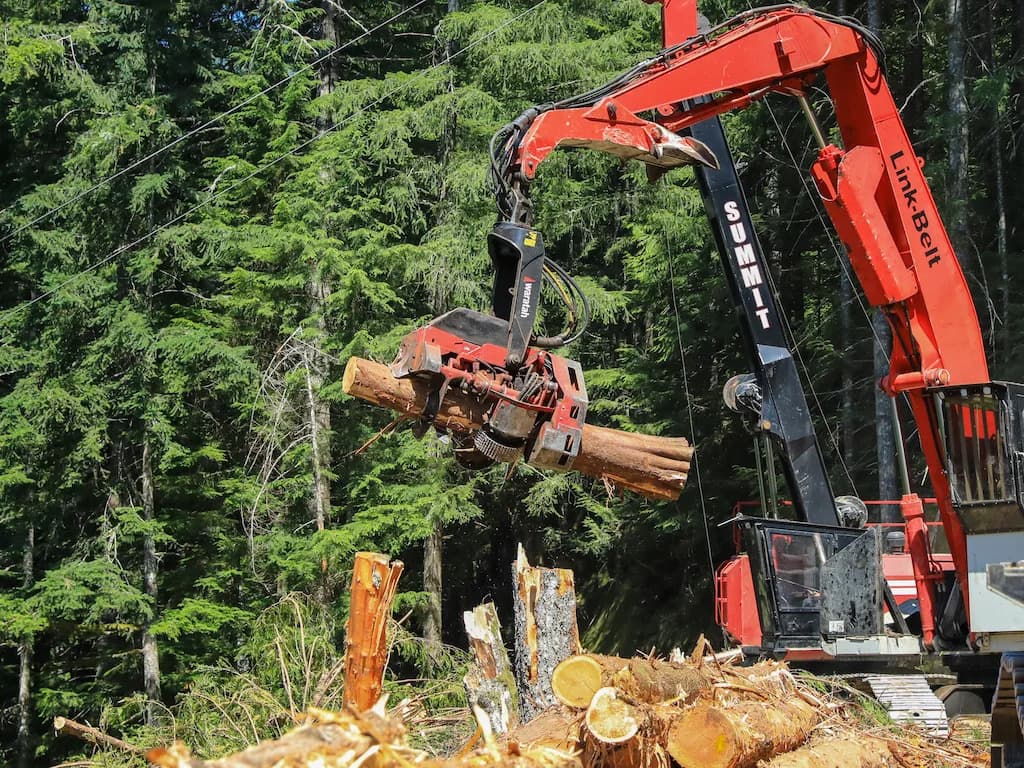
A harvester crane processes a log on a thinning project in the Mount Baker-Snoqualmie National Forest in Washington state. A new lawsuit targeting a timber harvest in Oregon could upend management of federal lands across the West. (Photo courtesy of Washington State Department of Natural Resources)
A legal challenge to a timber sale in Oregon is testing a novel legal theory that could upend how federal public lands are managed across the American West. The suit argues a 2016 Bureau of Land Management (BLM) land-use plan never lawfully took effect because it was not submitted to Congress under a broad interpretation of the Congressional Review Act (CRA). If a court accepts that theory, scores of management plans — and the permits and leases they authorize — could be invalidated, creating widespread uncertainty for industries, local communities and conservation efforts.
What The Lawsuit Claims
Cascadia Wildlands filed the challenge to a timber project on BLM land in western Oregon. The plaintiffs contend the 2016 BLM management plan authorizing the harvest never legally became effective because agencies did not submit it to Congress for the 60-working-day review required by the CRA when a rule is issued. Under that reading, actions taken under the plan would lack a lawful foundation.
“They’ve opened Pandora’s Box here,” said Susan Jane Brown, the attorney who brought the suit and principal at Silvix Resources. “When you throw that whole system into chaos, it’s a problem whether you’re the oil and gas industry or the timber industry or someone who wants to take a fall hunting trip.”
How The Congressional Review Act Is Now Being Used
The CRA, enacted in 1996, requires federal agencies to submit new regulations to Congress before those rules take effect and gives lawmakers a 60-working-day window to rescind them. Once seldom-invoked, the statute has been used far more aggressively in recent years: Republicans overturned multiple regulations during the Trump administration and have continued to expand CRA usage in his second term.
Last year, Republicans asked the Government Accountability Office (GAO) whether certain land-management plans could be treated as "rules" under the CRA. The GAO found that some plans "prescribed policy" and that congressional inquiries had, in those cases, triggered the 60-day review clock. Using that interpretation, Congress has rescinded plans that restricted mining and oil production in several states, including Alaska, Minnesota, Montana, North Dakota and Wyoming.
Broader Implications And Risks
Experts warn the ripple effects could be enormous. Agencies have issued more than 100 comprehensive land-management plans since 1996 without submitting them to Congress — plans that determine where drilling, mining, grazing, logging, recreation and conservation occur. If courts accept the challengers’ interpretation, hundreds of plans covering millions of acres could be deemed invalid.
Potential consequences include legal challenges to thousands of permits and leases tied to billions of dollars in economic activity — from oil and gas and mining to wind and solar projects, ski resorts, timber sales, grazing permits and recreation access. Under-resourced federal agencies might be forced to revise long-standing plans that normally take years to develop.
Stakeholders Respond
Conservation groups say the legal theory could be used to block projects they oppose; industry groups and local economies warn of unpredictable disruption. Nick Cady, legal director at Cascadia Wildlands, said the litigation could give activists leverage to challenge projects authorized under the 2016 plan. Others, including former agency officials and land-use experts, call the change destabilizing for every stakeholder who relies on predictable land management.
What’s Next
The Oregon case is likely the first of several legal tests. Plaintiffs hope a favorable decision will compel Congress to revise the CRA to exempt land-management plans explicitly. Conversely, a judicial rejection of the theory would preserve decades of planning practice. Either outcome could prompt legislative or administrative responses to clarify when — if ever — comprehensive land-use plans must be submitted to Congress.
Contact: Stateline reporter Alex Brown at [email protected].
Help us improve.