Colossal Biosciences and the U.S. Fish and Wildlife Service will collect, sequence and cryopreserve cell and tissue samples from every species on the U.S. Endangered Species List to build a genomic "digital twin" for each listed species. Samples will be sequenced, some converted to induced pluripotent stem cells, and the resulting biobank will be open-source for researchers worldwide. The effort complements on-the-ground conservation by preserving genetic information that could inform future interventions—though scientific, ethical and logistical challenges remain.
Colossal and U.S. Fish & Wildlife to Biobank DNA From Every Species on the Endangered List
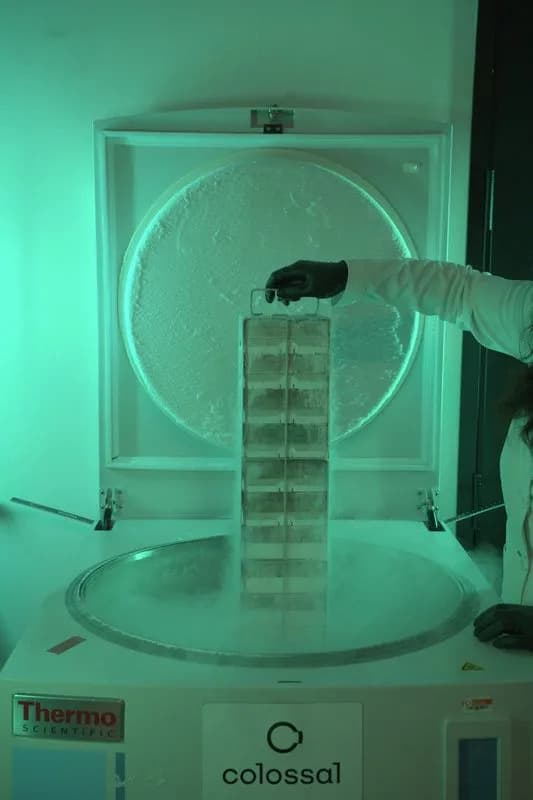
Life on ice: Cryopreserved genetic material in the Colossal labs —Colossal Biosciences
Colossal Biosciences and the U.S. Fish and Wildlife Service have launched an ambitious partnership to collect, sequence and cryopreserve cell and tissue samples from every species on the U.S. Endangered Species List—roughly 2,100 animals and plants. The project aims to create a searchable genomic "digital twin" for each listed species to support future conservation interventions, research, and, potentially, de‑extinction efforts.
What the Initiative Will Do
The organizations will gather minimally invasive field samples (blood draws and skin biopsies), coordinate necropsies when carcasses are found or animals die in collaborating zoos, and accept tissues and gametes when available. All samples will be fully sequenced to produce complete genomic records, and select cells will be converted into induced pluripotent stem cells (iPSCs) that can theoretically be reprogrammed into many tissue types, including gametes.
Existing Capacity and Global Links
Colossal already operates a private biobank at its Dallas headquarters containing about 200 species preserved in liquid nitrogen at roughly -274°F (≈ -170°C). The new public partnership will expand efforts to prioritize federally listed species. Colossal also announced a separate collaboration with Dubai’s Museum of the Future to cryopreserve samples from 10,000+ species in a public-facing facility that combines lab work with educational exhibits.
Access, Goals, and Limits
Colossal says the biobank will be open-source and available to labs and universities worldwide to accelerate conservation science. Proponents highlight two main conservation applications: (1) using whole-genome data to identify genes linked to disease resistance, drought tolerance and other adaptive traits, and (2) restoring lost genetic diversity in vulnerable populations through assisted breeding or gene-editing techniques.
"We want a digital twin of nature," said Colossal co-founder and CEO Ben Lamm. Fish and Wildlife Director Brian Nesvik added that the collaboration could help biobanking and genomics complement existing conservation tools.
Challenges and Ethical Considerations
Collecting samples from rare species poses logistical and ethical challenges: teams must minimize disturbance, obtain permits, and work with partners to handle remains responsibly. Scientific hurdles remain, too—sequencing and iPSC conversion are powerful tools but do not guarantee successful restoration in the wild. The initiative raises governance and ethical questions about prioritization, potential genetic interventions, and long‑term stewardship that scientists, policy makers and the public will need to address.
Why It Matters
While the U.S. list includes about 2,100 species, the IUCN estimates roughly 48,600 species as threatened or endangered worldwide. Organizations such as the Center for Biological Diversity warn that up to 30% of the planet’s genetic diversity could be lost by 2050 due to climate change, habitat loss and pollution. Proponents argue that an accessible, well-curated genomic archive could be a critical insurance policy for biodiversity, informing both near-term conservation and longer-term scientific options.
This partnership is positioned as a pragmatic, precautionary measure: collecting and sequencing now preserves options for the future, even as conventional conservation tools remain essential to keep species alive in their natural habitats.
Help us improve.