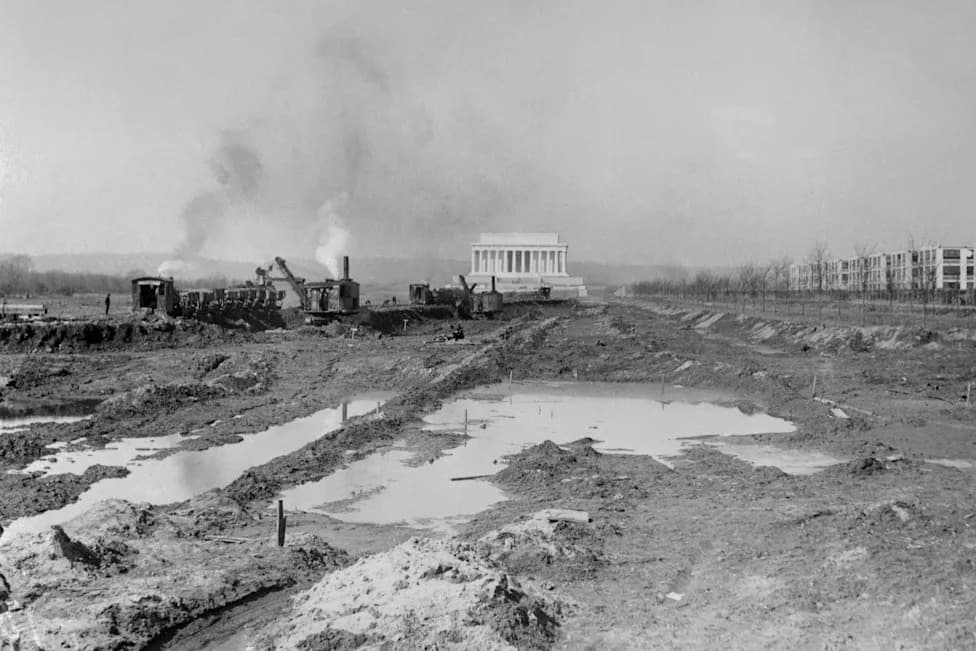
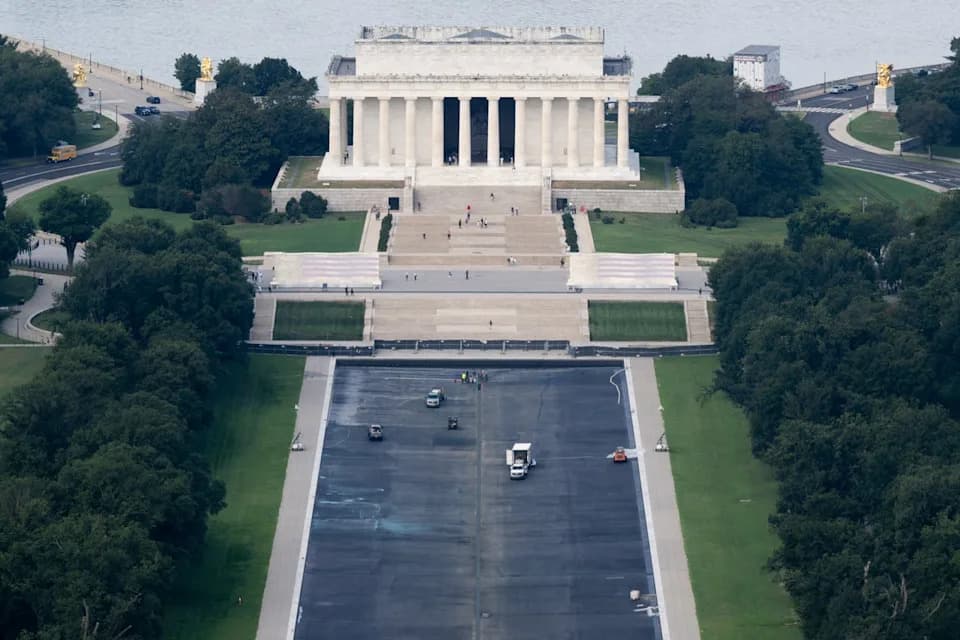
The Lincoln Memorial Reflecting Pool turned green shortly after reopening when a rapid algal bloom developed. Officials say they are treating the roughly 6.5 million-gallon basin using hydrogen peroxide together with filtration and nanobubble ozone systems. Experts caution peroxide provides only short-term control—dosing a pool this size requires careful calibration and may be logistically challenging—and that long-term fixes will depend on nutrient and circulation management. The situation highlights a trade-off between preserving the pool’s reflective appearance and maintaining ecological balance.
Workers Pour Hydrogen Peroxide Into Lincoln Memorial Reflecting Pool After Rapid Algae Bloom Turns Water Green
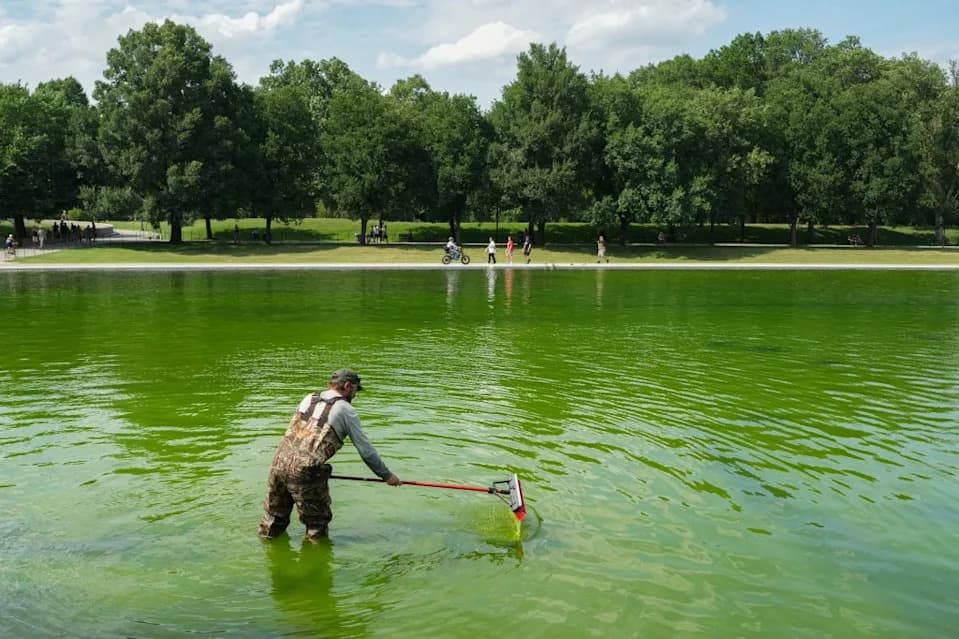
National Park Service workers push algae towards an aeration area in the center of the Lincoln Memorial Reflecting Pool on June 14, 2026.
The Lincoln Memorial Reflecting Pool turned an unexpected shade of green days after it reopened, and online video shows workers pouring what appears to be hydrogen peroxide into the water to combat a rapidly spreading algal bloom. Officials say the chemical is being used alongside filtration and a so-called nanobubble ozone system to restore clarity.
What Happened
The high-profile cleanup follows a multimillion-dollar refurbishment intended to return the century-old basin to a deeper “American flag blue.” Algal growth in the shallow, slow-moving pool—which is partially fed by water linked to the nearby Tidal Basin—is not new, but the speed and extent of this bloom drew immediate attention.
Why It May Have Flared Quickly
Marine biologist Christopher Lowe of Swansea University told Newsweek that algae reproduce extremely fast: a single cell can become millions in days under favorable conditions. He and other experts suggested several contributing factors: the pool’s compressed drain-repaint-refill schedule may have left residual algae in pipes and equipment, newly warmed water during early summer raises temperatures, and a darker resurfacing could absorb more heat—all of which can accelerate growth.
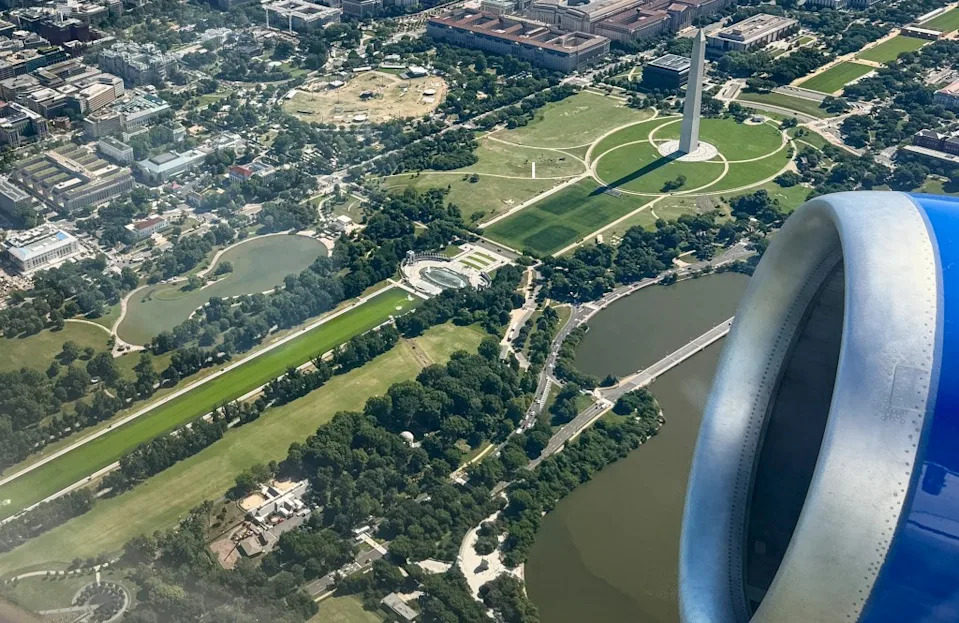
Aerial photo of water in the Lincoln Memorial Reflecting Pool from a departing flight from Ronald Reagan National Airport on June 16, 2026 in Washington, D.C.
Treatment Being Used
Park officials confirmed the use of hydrogen peroxide together with filtration and nanobubble ozone systems. Hydrogen peroxide is an oxidizing agent commonly used to break down algae and organic contaminants; it degrades quickly into water and oxygen and is often described as a milder alternative to chlorine in settings where wildlife may be present.
“Adding peroxide is, in effect, doing the same thing that the nanobubbler system does—oxidation of the organic debris. So they do not need to add enough peroxide to combat the algae entirely, just enough to help support the ozone nanobubblers,” said pool expert Steve Goodale, known online as “Swimming Pool Steve.”
Goodale and others emphasize that peroxide is most effective as part of a multi-pronged approach rather than a standalone cure.
Scale, Logistics and Concerns
The reflecting pool holds roughly 6.5 million gallons, which makes dosing and logistics complicated. Goodale offered a rough benchmark: effectively treating that volume could be on the order of 2,000 gallons of 12% hydrogen peroxide—far larger than the small jugs shown in videos of workers manually pouring the chemical from the pool edge.
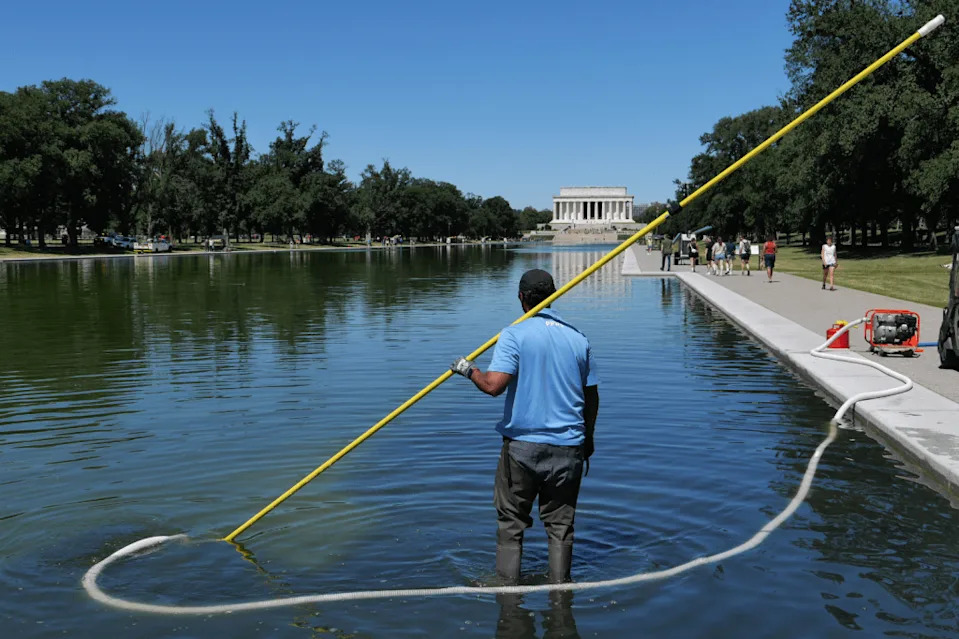
A U.S. National Park Service employee uses a vacuum pump to clean algae off the bottom of the newly repainted Lincoln Memorial Reflecting Pool on the National Mall on June 16, 2026 in Washington, D.C.
“Dosing for a system this large would normally happen in the filtration equipment area. It would definitely not be standard protocol to manually treat a body of water this large,” Goodale said. Experts add that open systems must be dosed according to concentration rather than simple volume, a task that becomes more complex at this scale.
Short-Term Fix vs. Long-Term Management
Hydrogen peroxide works quickly but is short-lived: it breaks down to oxygen and water and does not provide long-term protection against recurring blooms. That raises questions about cost-effectiveness, since repeatedly treating millions of gallons at sufficient concentrations could be expensive compared with longer-term fixes focused on nutrient control, improved circulation and design changes.
There is also a familiar trade-off at play: the mirror-like surface visitors expect depends on warm, slow-moving water—precisely the conditions that favor algal growth. Increasing circulation or aeration may suppress algae but can also disrupt the still reflections the landmark is known for, leaving managers to balance aesthetics against water quality.
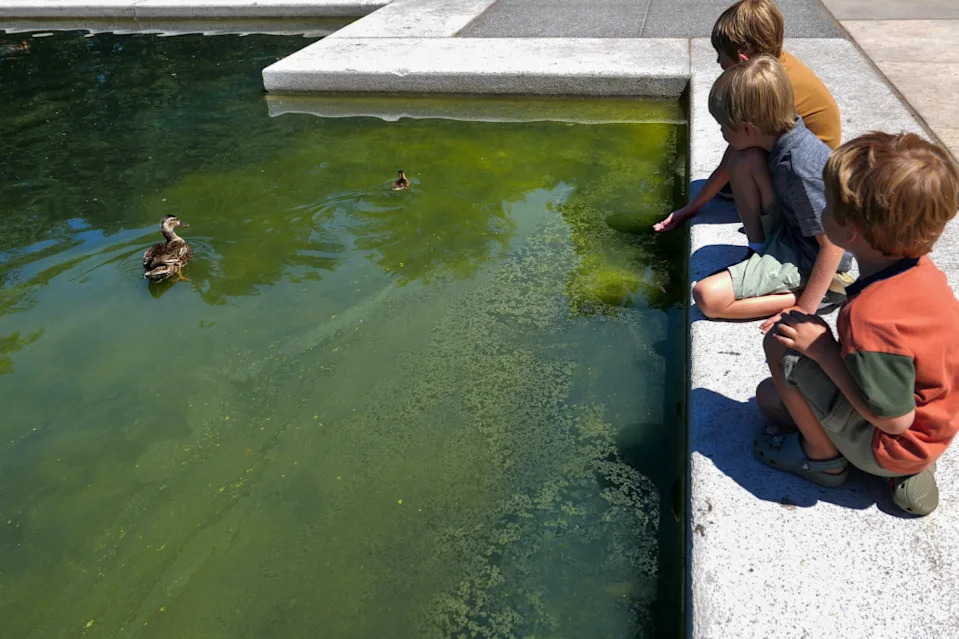
Children try to get the attention of some ducks as they swim through algae in the newly repainted Lincoln Memorial Reflecting Pool on the National Mall on June 16, 2026 in Washington, DC.
Environmental Considerations
Officials and some experts say peroxide concentrations used for the treatment should dilute rapidly in such a large volume and are unlikely to harm wildlife. However, some scientists warn that sustained chemical control could leave the basin inhospitable to many forms of aquatic life, effectively creating an ecological desert even as it preserves the visual effect for visitors.
Outlook
The peroxide and nanobubble systems may reduce the visible bloom in the short term, but the structural and ecological factors that encourage algal growth—warmer water, nutrient inputs, residual organisms in plumbing and wildlife vectors—mean algae are likely to return unless broader changes are made to pool management and nutrient control.
Update 06/17/26 08:10 a.m. ET: This story was updated with comments from Steve Goodale and a Department of the Interior spokesperson confirming the use of nanobubble ozone technology and hydrogen peroxide.
Help us improve.