South Korea has selected Hanwha Ocean to build six KDDX destroyers, a 6,000-ton class designed for multi-domain operations (ASuW, ASW, AAW). Key features under consideration include CODAG or IEP propulsion, an indigenous combat management system, an AESA radar developed with LIG Nex1, and VLS compatible with Hyunmoo cruise missiles and KAMD interceptors. Production is expected through the mid-2030s, strengthening Hanwha Ocean’s role while raising industrial-capacity and schedule-risk questions as other major naval programs proceed in parallel.
Hanwha Ocean Awarded Contract To Build Six KDDX Destroyers With AESA Radar, VLS And IEP Option
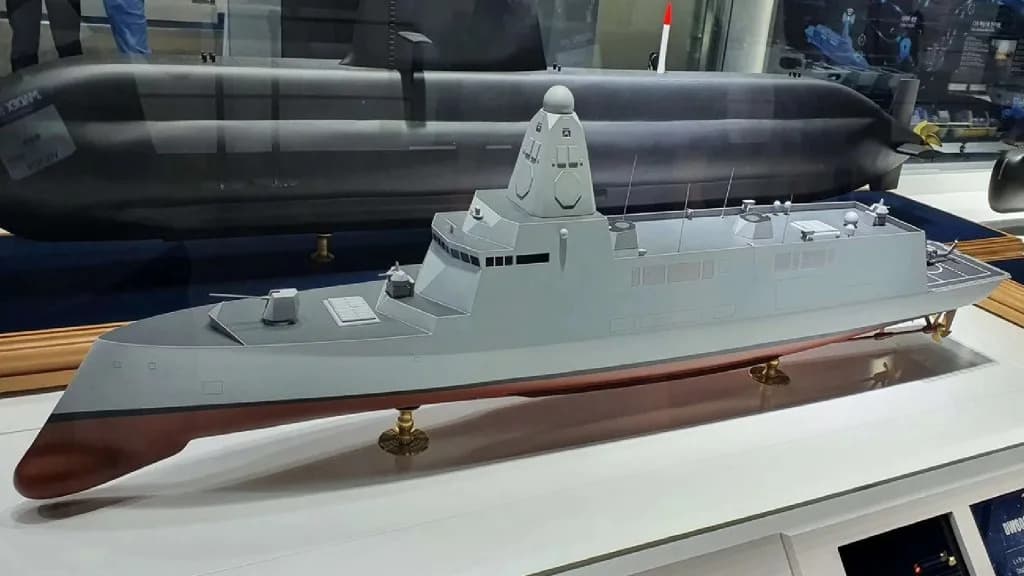
South Korea has formally advanced its Korea Destroyer eXperimental (KDDX) program by naming Hanwha Ocean as the prime contractor to build six next-generation surface combatants. The award marks a major step in Seoul’s plan to replace aging KDX-I class frigates and modernize the Republic of Korea Navy (ROKN) fleet.
Program Overview
The KDDX design targets a vessel of roughly 6,000 tonnes displacement — positioned between a conventional frigate and a full destroyer — and optimized for multi-domain operations including anti-surface (ASuW), anti-submarine (ASW) and anti-air warfare (AAW).
Shipbuilder And Industrial Context
Hanwha Ocean (the former Daewoo Shipbuilding and Marine Engineering, acquired by the Hanwha Group in 2023) will serve as lead yard for the six-ship series. The company brings experience from prior KDX-II and KDX-III construction programs. The award consolidates domestic surface combatant work at Hanwha Ocean after competition with HD Hyundai Heavy Industries.
Key Systems And Options
The KDDX will incorporate an integrated mast architecture that combines radar, electronic warfare and communications arrays into a single structure to reduce radar cross-section and simplify sensor integration. Propulsion choices under consideration include combined diesel and gas (CODAG) or integrated electric propulsion (IEP), with a final decision to follow further design refinement.
The ship’s combat management system is planned for indigenous development as part of South Korea’s broader push to reduce dependence on foreign defense electronics. The radar suite is expected to include an Active Electronically Scanned Array (AESA) developed in collaboration with LIG Nex1. A domestically produced 127mm naval gun is also under evaluation, though a supplier has not yet been finalized.
The vertical launch system (VLS) layout is expected to support the domestic Hyunmoo cruise missile family as well as Korea’s Air and Missile Defense (KAMD) interceptors, enabling layered strike and air-defense capabilities.
Schedule, Risks And Strategic Implications
South Korea’s Defense Acquisition Program Administration (DAPA) has overseen requirements definition for KDDX. Full-rate production is expected to extend into the mid-2030s, with the lead ship targeted for delivery within the current decade, subject to final contract terms and technology readiness.
Consolidating production at a single yard offers efficiency and learning-curve benefits but concentrates supply-chain risk and could create schedule vulnerability if bottlenecks emerge. These concerns are heightened because the KDDX program runs in parallel with other major ROKN efforts — including the KDX-III Batch II Aegis destroyer program and the KSS-III submarine expansion — placing pressure on budgets, skilled labor, and industrial bandwidth.
What To Watch
Key near-term technical decisions that will shape the platform’s capabilities include the final propulsion architecture (CODAG vs IEP), AESA radar configuration, integration of the domestic combat management system, and VLS loadout choices.
For naval engineers, defense analysts and regional security observers, the Hanwha Ocean KDDX contract is a procurement decision with tangible technical and strategic consequences that will influence the ROKN fleet structure and South Korea’s domestic shipbuilding posture over the next decade.
Help us improve.