The Washington, D.C., primary on Tuesday features open mayoral and congressional seats, the city’s first ranked-choice voting and heightened federal attention. Leading mayoral contenders are Janeese Lewis George and Kenyan McDuffie, with endorsements underscoring a split between progressives and the local establishment. About 481,000 people are registered to vote in D.C.; roughly 363,000 are Democrats and about 35,000 ballots had already been cast before Election Day. RCV first-choice totals are expected on election night, with further rounds reported through late June and certification on July 17.
DC Primary Day: Open Mayoral and Congressional Races, First Ranked-Choice Vote and Federal Tensions
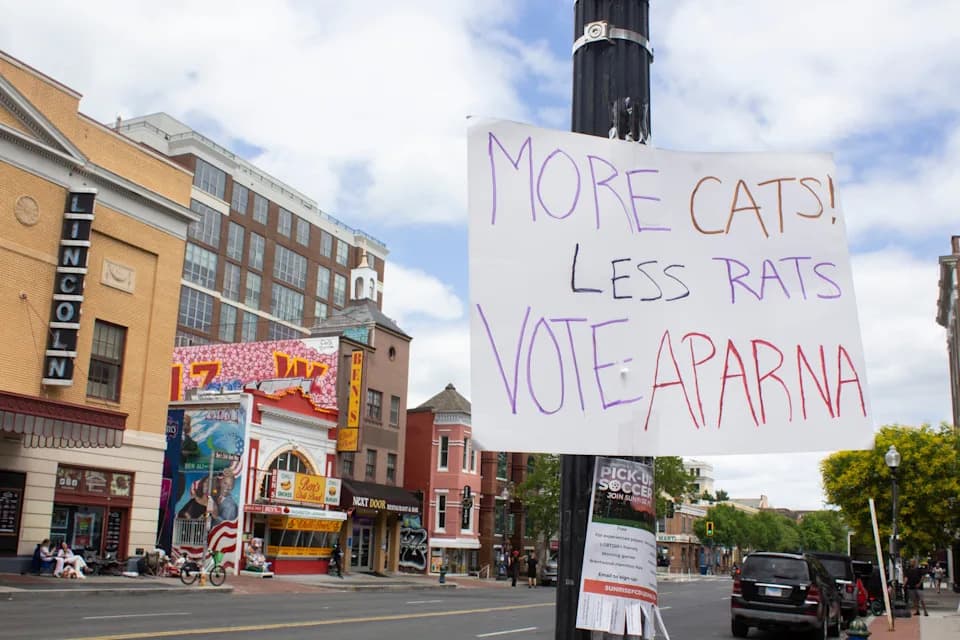
A hand-made campaign sign is posted outside the Lincoln Theatre and Ben’s Chili Bowl in the U Street Corridor of Washington, Sunday, June 7, 2026. (AP Photo/Tallulah Brown Van Zee)(AP Photo/Tallulah Brown Van Zee)
Washington, D.C., holds a citywide primary on Tuesday that will decide contests for federal and local offices against an unusually complex political backdrop: sustained federal intervention from the White House, a cascade of open top-level seats and the city’s first use of ranked-choice voting.
Key Races
Mayoral Primary. The competitive Democratic field is led by Ward 4 Councilwoman Janeese Lewis George and former At-Large Councilman Kenyatta (Kenyan) McDuffie, among six other contenders. Endorsements have highlighted a split between the city’s establishment and its progressive wing.
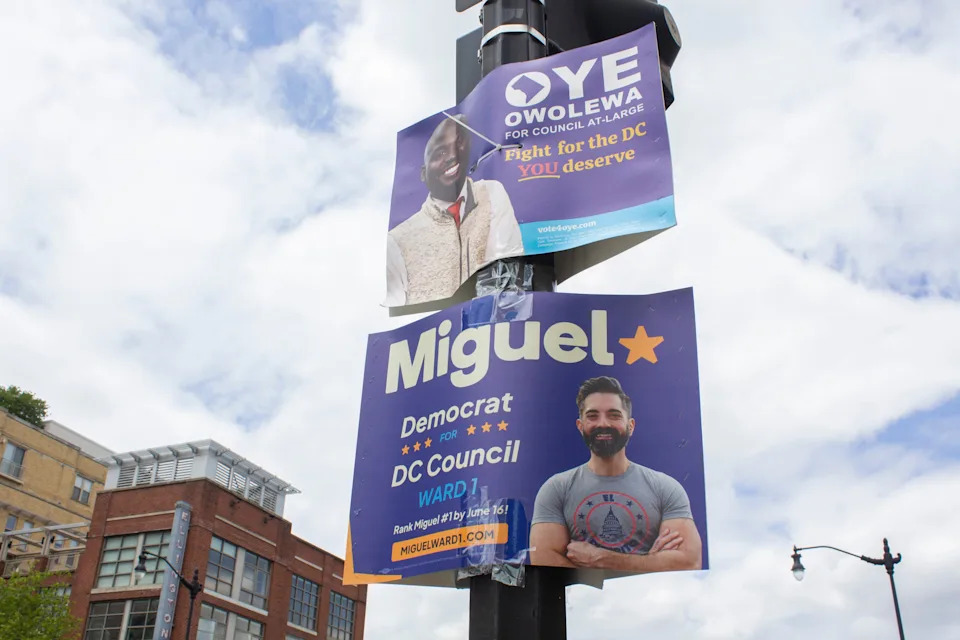
Campaign signs are posted in the U Street Corridor of Washington, Sunday, June 7, 2026. (AP Photo/Tallulah Brown Van Zee)(AP Photo/Tallulah Brown Van Zee)
Lewis George has endorsements from four fellow council members and progressive groups including the Working Families Party, Metro D.C. Democratic Socialists of America and Our Revolution. McDuffie is backed by several former mayors and senior Democratic figures, including Sharon Pratt, Anthony Williams, former U.S. Attorney General Eric Holder and former DNC chairs Tom Perez and Jaime Harrison.
Context and Local Dynamics
Three-term Mayor Muriel Bowser has not made a formal endorsement but has signaled support for McDuffie in public remarks — at one event using the name "Kenyon McDuffie" — which she later described as not an official endorsement. Bowser has sought to balance governing a heavily Democratic city with limited local authority amid heightened federal oversight, a stance that has drawn criticism from progressives.
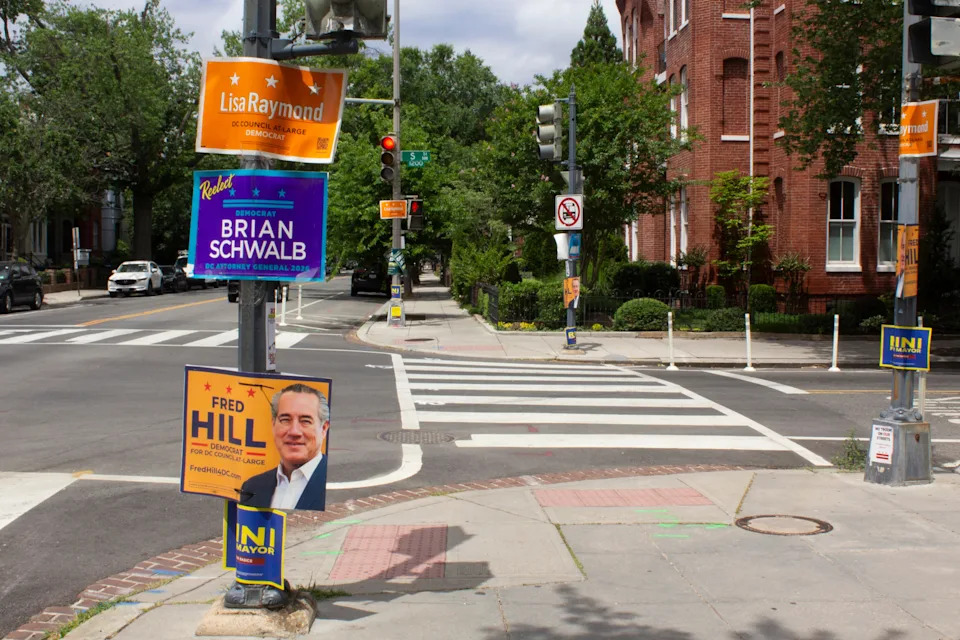
Campaign signs are posted on a lamp posts in the Logan Circle neighborhood of Washington, Sunday, June 7, 2026. (AP Photo/Tallulah Brown Van Zee)(AP Photo/Tallulah Brown Van Zee)
On the campaign trail, Lewis George has criticized unnamed leaders for "complying in advance" and for shrinking "in the face of injustice." President Donald Trump, meanwhile, warned he would consider federal intervention if Lewis George becomes mayor — a threat he has floated previously during his term.
U.S. Delegate And Chain Reaction Of Open Seats
With the retirement of 18-term U.S. Delegate Eleanor Holmes Norton and Bowser’s decision not to seek re-election, the city faces its first simultaneous open mayoral and congressional-seat cycle since 1990. That pair of retirements triggered multiple open-seat contests as council members and other officeholders pursue higher posts. Leading candidates for the non-voting U.S. Delegate seat include At-Large member Robert White and Ward 2 Councilwoman Brooke Pinto.
Ranked-Choice Voting (RCV)
This primary is the first in D.C. to use ranked-choice voting. Voters rank candidates by preference. If no candidate wins a majority of first-choice votes, the last-place candidate is eliminated and their supporters’ next preferences are redistributed; this process repeats until a candidate reaches a majority.
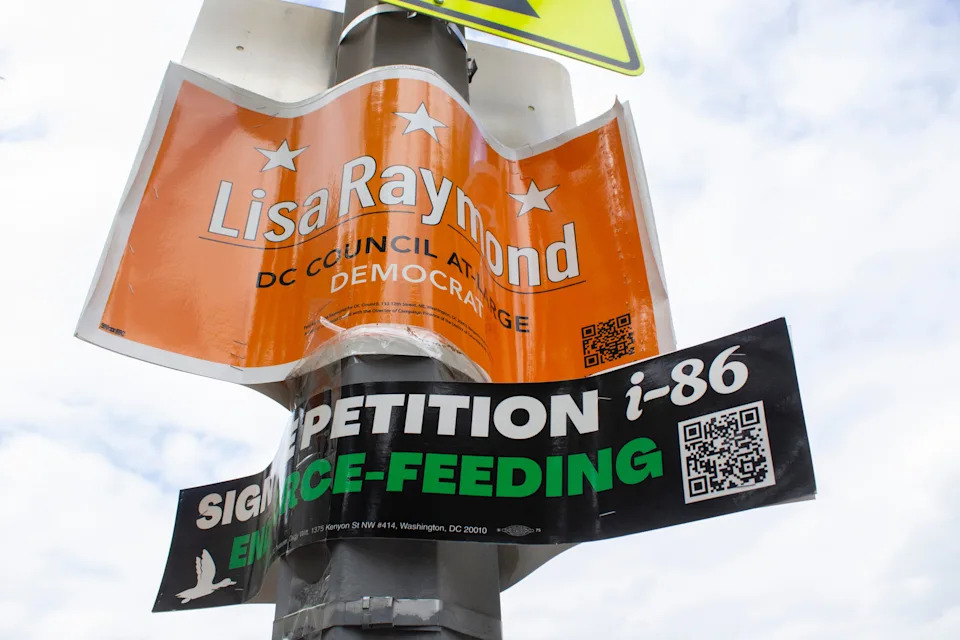
Campaign signs are posted on lamp post, Sunday, June 7, 2026, in Washington, ahead of the city’s primary election. (AP Photo/Tallulah Brown Van Zee)(AP Photo/Tallulah Brown Van Zee)
Only first-choice totals will be reported on election night for contests that trigger RCV tabulation. Subsequent rounds of redistributed votes are scheduled to be released by June 21 and June 24, with final round-by-round results available on or after June 26. Certification of the election is expected on July 17.
Practical Details And Reporting
- Polls close: 8 p.m. ET.
- Registered voters (as of May 31): about 481,000. Approximately 363,000 (more than three-quarters) are registered Democrats; roughly 25,000 (about 5%) are registered Republicans; about 86,000 (18%) are unaffiliated.
- Early ballots: As of the Wednesday before the primary, about 35,000 ballots had already been cast for this election.
- Turnout context: In 2022, roughly 127,000 Democrats voted in the mayoral primary (~26% of registered voters). In 2024, about 78% of voters used early in-person or mail voting.
- AP reporting: The Associated Press will report vote results and declare winners in contested primaries for mayor, U.S. delegate, attorney general and district council seats. The AP will call races only when no plausible scenario allows a trailing candidate to overtake the leader.
- Recounts: Automatic for federal offices, mayor, attorney general and council races if the margin is under 1% of the total vote; candidates may also request and pay for recounts regardless of margin.
Neighborhood And Electoral Geography
Washington is overwhelmingly Democratic and has not voted for a Republican presidential candidate since 1964, but sharp socio-economic divides cut across the district. Ward 3 (upper Northwest) has the highest median income and the largest white majority; Ward 8 (Southeast) has the lowest median income and the largest Black majority. Past primaries have shown an east-west voting split in many contests.
The outcome of this primary will shape local leadership as the district navigates federal scrutiny, an evolving political landscape and a new voting system that could change how campaigns build coalitions across wards.
Help us improve.