An ancient Greco‑Roman cemetery at Tel Kom Aziza in Beheira Governorate has yielded varied burial types, including painted plaster and barrel‑shaped pottery coffins typical of the Ptolemaic period. Excavations revealed diverse grave orientations and body positions and a rare find: complete wild boar burials. The cemetery overlies earlier occupation layers with artifacts ranging from the Old Kingdom through the Greek and Roman eras. Separate Luxor excavations uncovered 10 well‑preserved wooden coffins dating to the 18th Dynasty, the Ramesside period and the Late Period.
Greco‑Roman Cemetery Unearthed at Tel Kom Aziza, With Rare Wild Boar Burials and Multi‑Period Finds
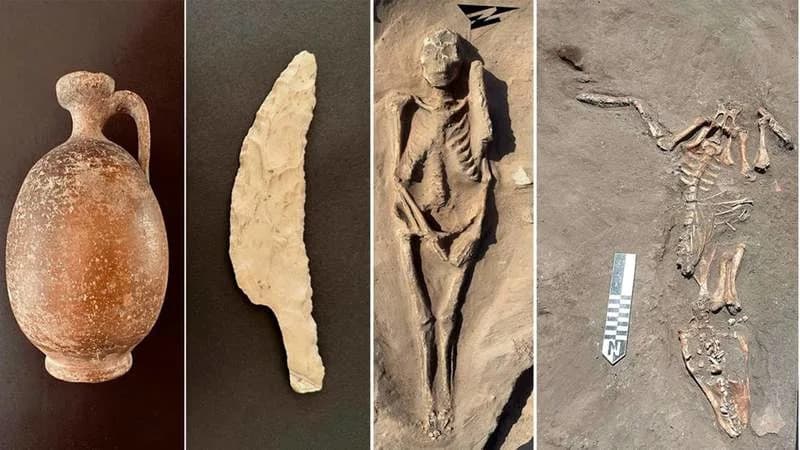
Ancient remains and artifacts discovered at Greco-Roman cemetary in northern Egypt, June 5, 2026. (photo credit: EGYPTIAN TOURISM AND ANTIQUITIES MINISTRY)
Archaeologists have uncovered an ancient Greco‑Roman cemetery at the Tel Kom Aziza site in Beheira Governorate in Egypt's Nile Delta, the Egyptian Tourism and Antiquities Ministry announced. Excavations reveal a complex site that records centuries of human activity and changing funerary customs.
Findings at Tel Kom Aziza
Excavators uncovered a variety of burial types: simple pits where individuals were laid directly into the soil, graves framed with mud bricks, and several painted plaster coffins alongside barrel‑shaped pottery coffins — forms commonly associated with the Ptolemaic period.
Dr. Hisham El‑Leithy, Secretary‑General of Egypt's Supreme Council of Antiquities, reported notable variation in grave orientation and body placement. Burials were aligned on both north–south and east–west axes. The positions of the deceased ranged from hands folded or crossed over the pelvis, to hands placed around the neck, the Osirian pose with arms crossed over the chest, and arms held straight alongside the thighs.
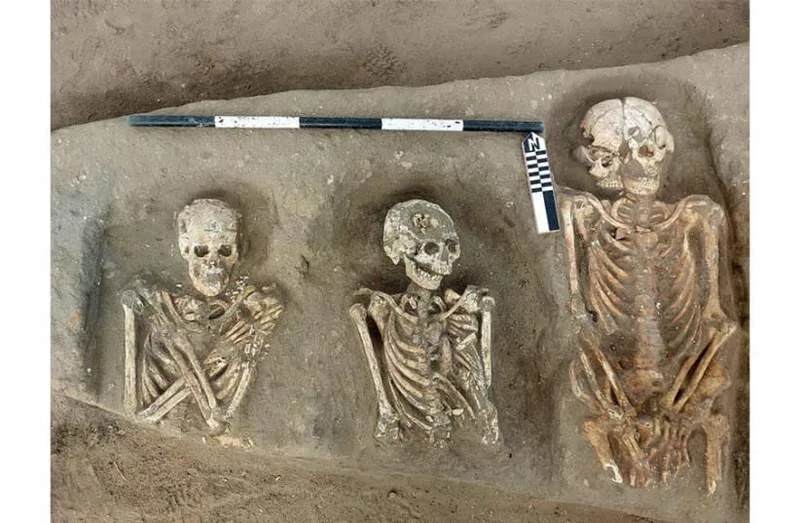
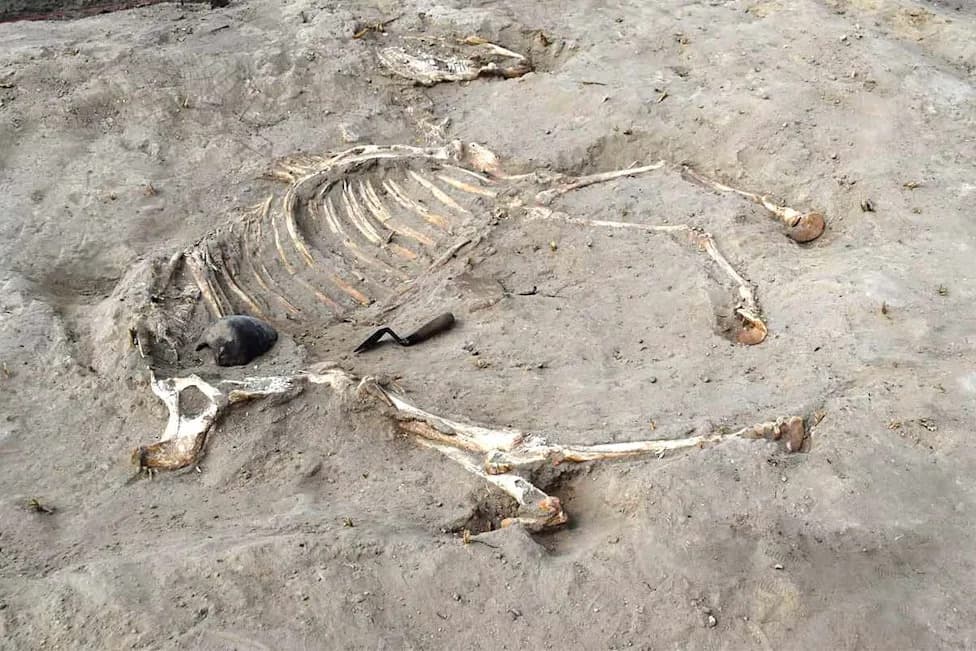
Human remains unearthed at Greco-Roman cemetary in northern Egypt, June 5, 2026. (credit: EGYPTIAN TOURISM AND ANTIQUITIES MINISTRY)
A striking and rare discovery at the site was the complete burial of wild boars. Such interments are unusual in Egyptian funerary contexts because boars are traditionally associated with the god Set, making their deliberate burial noteworthy for ritual or symbolic interpretation.
Earlier Occupation Layers
Archaeologists found that the cemetery overlies earlier settlement levels. Material remains recovered from deeper layers span a wide chronological range — from the Old Kingdom and New Kingdom through the Late Period and into the Greek and Roman eras. These earlier deposits included domestic pottery and stone vessels, bread molds, multipurpose stone tools, ovens, storage jars and large quantities of fish, bird and animal bones, indicating long‑term habitation and economic activity before the site became a concentrated funerary landscape.
Related Discoveries at Dra' Abu el‑Naga (Luxor)
In a related announcement, the ministry reported that excavations begun in November 2025 at the Dra' Abu el‑Naga necropolis on Luxor's West Bank uncovered 10 well‑preserved wooden coffins within a burial shaft in the courtyard between the tomb of Roy and the nearby tomb of Baki. Preliminary study dates four coffins to the 18th Dynasty, including one inscribed with the name Merit (likely a chantress of Amun). Another coffin is Ramesside (19th–20th Dynasties) and bears the name Padi‑Amun, identified as a priest of the Temple of Amun. The remaining coffins date to the Late Period (circa 664–332 BCE).
Significance: Mohamed Abdel‑Badie, Head of the Ancient Egyptian Antiquities Sector, described Tel Kom Aziza as a "multi‑period archaeological site" that documents a long sequence of settlement and funerary use, offering a comprehensive record of changing human‑environment interactions across millennia.
Egypt's Tourism and Antiquities Minister Sherif Fathy called the discovery evidence of Tel Kom Aziza's importance as one of the Delta's most promising archaeological locales — valuable not only for its funerary remains but for the broader picture it provides of settlement, daily life and ritual practices over thousands of years.
Help us improve.