Basketball Boosts Fractions: An experimental Danish programme that tied fraction lessons to basketball drills helped students (aged 11–13) score about 15% higher on fraction tests than a control group. The intervention involved weekly one-hour sessions for over 300 pupils and used hands-on exercises—such as making 10 shots and calculating success rates—to teach fractions and percentages. Participants also saw roughly a 5% gain in other math areas, and researchers say integrating academics into PE can improve engagement without reducing enjoyment.
Study: Basketball Drills Boost Students’ Fraction Skills by ~15%
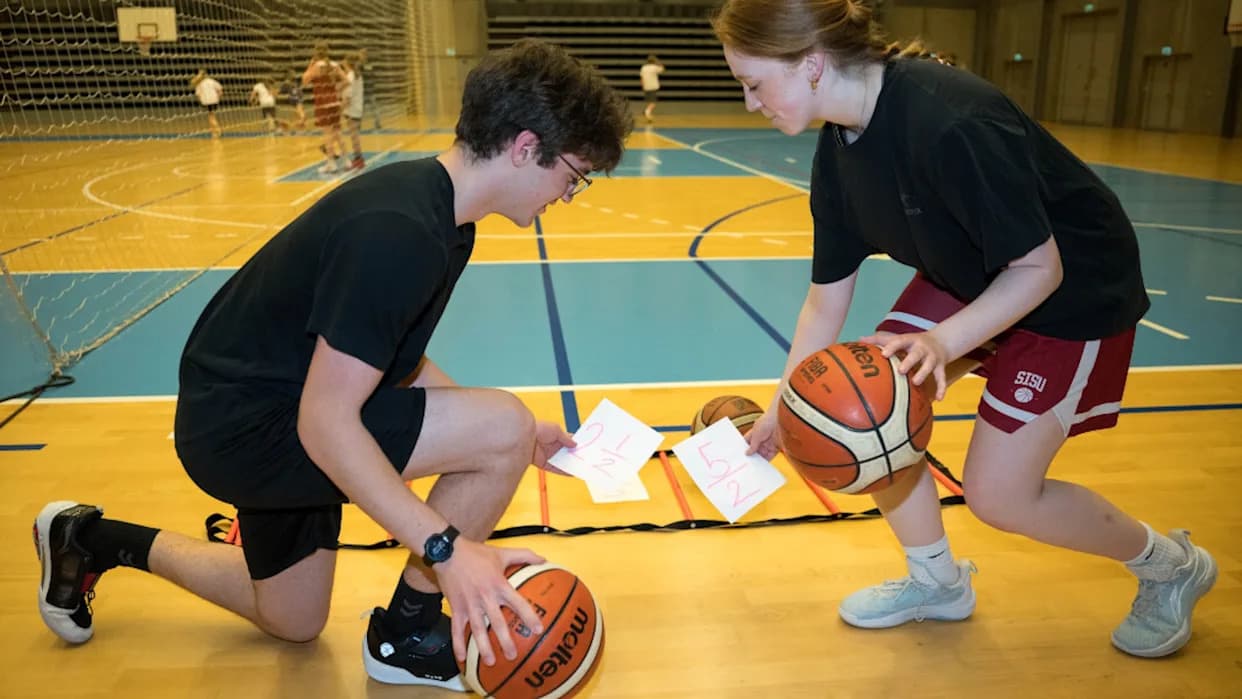
Students also saw improvement in other math areas after participating in the workshop.
A Danish experimental study found that pairing fraction lessons with basketball drills helped pupils improve their fraction test scores by about 15% compared with a control group. The project, led by researchers at the University of Copenhagen and published in Educational Psychology Review, involved practical, game-based lessons designed to make math more engaging.
How the Program Worked
More than 300 students aged 11–13 took part in a one-hour session once a week that linked fraction topics to specific basketball activities. For example, teachers asked pupils to attempt 10 shots, record how many went in, and then express the results as a fraction and a percentage. Lessons used real-world counts and conversions so students could see immediate, tangible connections between physical activity and mathematical concepts.
Results and Wider Benefits
On average, participants scored roughly 15% higher on fraction tests than the non-playing control group. The study also reported an ≈5% improvement in other math areas among the participating pupils. Beyond academics, students gained extra practice on the court and reported maintained or increased motivation for learning.
“I am convinced that sport and physical activity can open up mathematics for pupils who are not otherwise engaged by the subject,”
said Jacob Wienecke, a sports exercise researcher at the University of Copenhagen and co-author of the study.
Implications for Schools
The researchers argue that integrating academic topics into physical education is feasible and can change how children experience subjects like math—making them more motivated and engaged without reducing enjoyment. If scaled more widely, such interdisciplinary approaches could offer an effective, low-cost way to support numeracy in middle-school students.
Bottom line: Combining movement and math—simple activities linking basketball shot success to fractions and percentages—produced measurable learning gains and kept students engaged.
Help us improve.