New i‑Ready data show roughly 400 students from 27 microschools made academic gains from fall 2025 to spring 2026; over 50% exceeded expected reading growth and 47% exceeded math expectations. The sample included many students with special learning needs, mental health needs, or chronic conditions. The study is limited by its small, non‑random sample and potential self‑selection, and researchers call for larger, comparative, and longitudinal studies to better understand microschool impacts and costs.
Microschool Students Match — and Often Exceed — National Academic Growth, New i‑Ready Data Shows
New analysis of i‑Ready assessment data finds that students enrolled in microschools made academic gains comparable to national norms — and in many cases exceeded expectations — between fall 2025 and spring 2026. About 400 students across 27 microschools showed measurable growth in reading and math, even though a substantial share of the sample includes children with disabilities, mental health needs, or chronic medical conditions.
Key Findings
More than half of students in the sample exceeded expected growth in reading, and 47% surpassed expected growth in math, based on i‑Ready’s national projections. Daniel Hamlin, dean of education at the University of Texas at Austin, who conducted the analysis for the National Microschooling Center, said some microschools — particularly larger programs in the sample — were "knocking it out of the park," with many students achieving "over and above what was expected."

Daniel Hamlin
Study Sample And Limitations
The student sample included a high concentration of children with additional needs: nearly half were identified with special learning needs, 28% had mental health needs, and 14% had chronic medical conditions. i‑Ready generates individualized expected growth using national public and private school data. Within the microschool sample, gains were weaker among students experiencing poverty, elementary‑grade learners, and Black students in math.
The study has notable limitations. The sample size is small and non‑random, schools were recruited through an advocacy organization, and families who opt for microschools may differ systematically from families who remain in district schools. Researchers estimate the broader microschool sector serves roughly 1–2 million students nationally, so this sample may not be fully representative. Nevertheless, the study’s strength is that it tracks the same students’ fall and spring assessments across a school year — a data linkage other projects found difficult to assemble.
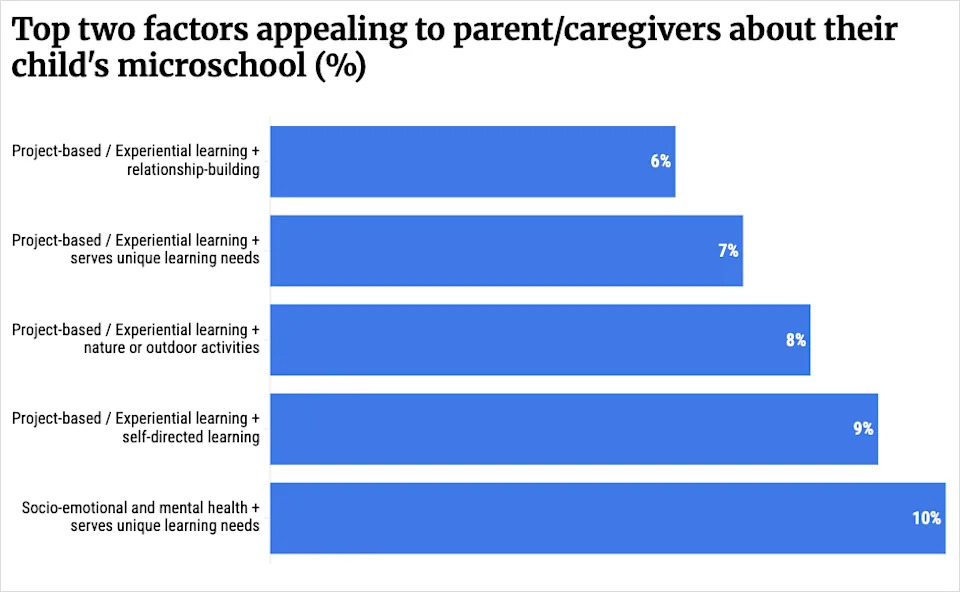
Survey data shows microschool parents appreciate the combination of learning experiences and individualization. (National Microschooling Center)
Families’ Reasons And School Practices
Survey data released alongside the assessment results show parents cite three top reasons for choosing microschools: small class sizes, individualized instruction, and a safer, more supportive environment. Parents and students reported frequent one‑on‑one time with teachers, regular small‑group lessons, and close peer relationships.
"Finding a school with well‑trained teachers who are able to recognize strengths and challenges without passing judgement is really hard," said Lara Landrum, whose daughter attends the Columbia Academy for Learning and Enrichment (CALE) in Missouri. CALE’s CEO Jill Brown noted that about 80% of the school’s 135 students previously attended public school and that students attend for varied reasons — from needing structured literacy support to seeking a calmer setting for anxiety.
Implications And Recommendations For Future Research
Researchers emphasize the need for larger, more rigorous studies that compare microschool students with demographically similar peers in district, charter, and private schools. Because microschools are diverse — including nature‑based programs, hybrid models, and schools serving specific populations — analyses should identify which models most reliably boost achievement. Hamlin also suggested longitudinal studies to determine whether gains persist over multiple years and cost‑benefit analyses that consider families using education savings accounts (ESAs). He acknowledged that recruiting through the National Microschooling Center introduces self‑selection bias but argued that early evidence is still valuable.
In short, the i‑Ready results are promising for this small sample of microschool students, particularly given the high share of students with additional needs, but broader and more rigorous research is needed to draw definitive conclusions about the sector’s academic impact and cost effectiveness.
Help us improve.