Advocates in Los Angeles are pushing a charter amendment that would allow the City Council to authorize certain noncitizen residents to vote in local elections. Councilmember Hugo Soto-Martínez filed the motion in late April, and the Council must vote by June 17 on whether to put the measure on the November ballot. If voters approve the amendment, the Council would still need to pass a separate ordinance defining eligibility and safeguards. Supporters cite fairness and representation; critics raise privacy and implementation concerns, including immigration exposure.
Could Noncitizens Vote in L.A.? Charter Measure Faces June 17 Deadline for November Ballot
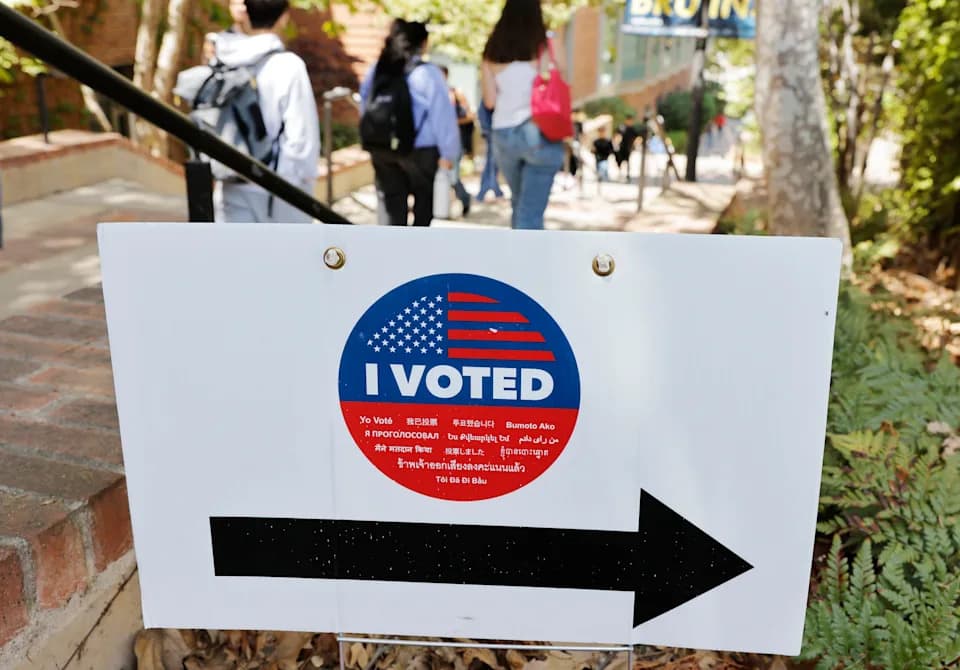
An "I Voted" sign points to a Vote Center after Democratic gubernatorial candidate Tom Steyer spoke at a Get the Youth Vote with Bruin Democrats event at UCLA's campus on June 1, 2026 in Los Angeles, California.
Just one week after Los Angeles' mayoral election, advocates renewed focus on a proposal that would expand who can vote in city contests — and the effort now faces a tight timeline to reach the November ballot.
The proposed amendment to the Los Angeles City Charter, filed in late April by Councilmember Hugo Soto-Martínez, would give the City Council authority to adopt an ordinance permitting certain noncitizen residents to vote in municipal elections. The Council must vote by June 17 on whether to place the amendment before voters in November.
The charter change itself would not immediately grant voting rights. If voters approve the amendment, the City Council would still need to draft and pass an ordinance that defines eligibility, verifies voters and sets privacy and implementation safeguards.
Who Could Be Eligible?
Advocates have discussed extending the franchise to long-term noncitizen residents, including lawful permanent residents and recipients of Deferred Action for Childhood Arrivals (DACA). Soto-Martínez framed the proposal as a fairness issue:
“If you pay your taxes, if you contribute to this wonderful city, you should have an ability to say, 'I deserve the right to vote.'”
Concerns and Precedents
Supporters say residential voting would strengthen representation for immigrant communities that contribute economically and socially to Los Angeles. Opponents and some councilmembers raise concerns about privacy, the logistics of implementation, and immigration risks. For example, San Francisco allows some noncitizens to vote in school board elections but warns applicants that information provided to its elections office may be obtained by U.S. Immigration and Customs Enforcement, underscoring potential exposure for noncitizen participants.
“People understand the reasons for doing it. But there are concerns ... Issues around privacy, how we actually implement it, who qualifies, who doesn’t — which is why we’re not moving full steam ahead,” Soto-Martínez said.
Federal law requires U.S. citizenship to vote in national elections, but some U.S. localities have allowed limited noncitizen participation in municipal contests. If Los Angeles moves forward, the debate will center on who qualifies, how voter rolls are verified, and what protections are put in place to prevent immigration enforcement access to elections data.
This version of the story is adapted from reporting by the USA TODAY Network (Paris Barraza) for clarity and context.
Help us improve.