German researchers captured mating Ecdyonurus venosus mayflies midair using long-handled nets and freezing spray, then imaged them with synchrotron X-ray microtomography to create 3D models. The study shows males have paired penial lobes that change shape during copulation; muscular deformation and penial spines stretch the female's copulatory pouch so it can store large amounts of sperm. Mating happens rapidly in midair swarms, rival males often interfere, and adults typically die soon after reproduction.
Caught Midair: How Mayflies Reshape Their Genitals During Acrobatic Mating
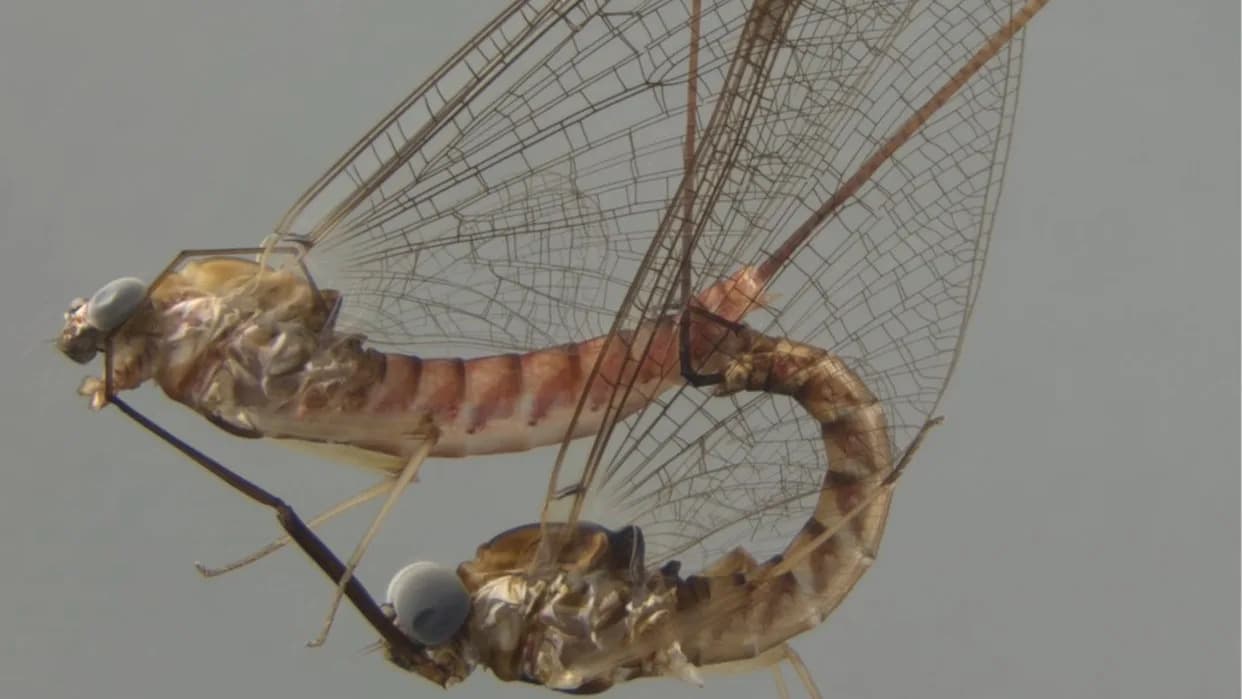
The mayfly species ‘Ecdyonurus venosus’ mating. The female is on top, the male below.
Researchers used theatrical field methods and high-tech imaging to freeze and study an extraordinary moment in insect reproduction: mayflies copulating midair. A German team netted mating pairs, arrested their movements with freezing spray, and used synchrotron X-ray microtomography to build detailed 3D models of genital interaction in Ecdyonurus venosus.
Fieldwork Worthy Of Myth
Echoing the image of Hephaestus trapping lovers with an unbreakable net, the scientists employed long-handled nets to capture copulating pairs above water in the Black Forest. Most pairs separated when disturbed, but those that remained attached were frozen in place with spray and preserved in ethanol for later imaging.

Benedict Stocker shock-freezing a copulating pair of mayflies in a net.Image: A. Staniczek / SMNS.
Revealing Genital Mechanics With µCT
At the Karlsruhe Institute of Technology, researchers used synchrotron X-ray microtomography (µCT) to produce high-resolution images and reconstruct the couples in 3D. Their paper, provocatively titled "When Mayflies Have an Erection: Functional Morphology of the Genitalia in Ecdyonurus," set out to clarify how male and female genitalia interact during the brief, aerial act of copulation.
"The aim of the present work is to clarify the function of genital interactions during copulation in the mayfly genus Ecdyonurus, and to unravel the mechanisms that lead to the change in the penis configuration during mating."
What They Found
Male Ecdyonurus possess a paired penial structure: two penial lobes flanked by claspers, with a row of spines between the lobes. During mating powerful muscles deform the penial shaft, folding the lobes over. The penial spines extend and prick the female’s thin copulatory pouch, stretching it so it can receive and store large volumes of sperm in a folded membrane at the pouch’s front.
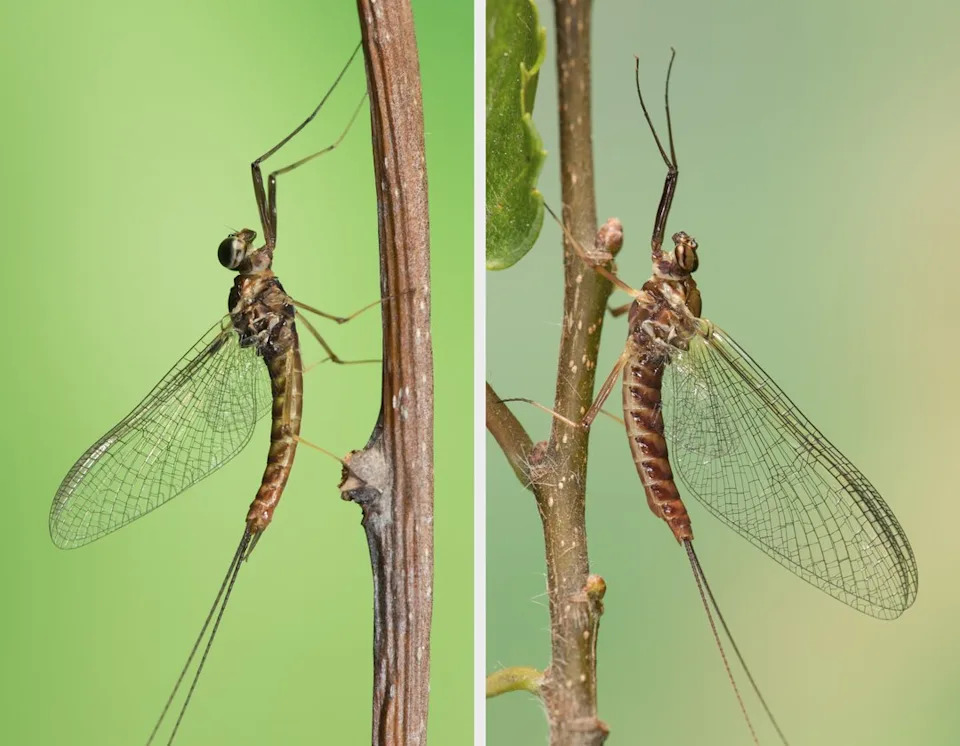
Male (left) and female (right) of the mayfly speciesEcdyonurus venosus, body length approx. 1.2 cm.Image: Copyright: A. Staniczek / SMNS.
Mayfly mating itself is a dramatic midair maneuver. Males form swarms over water to attract females; when a female flies into a swarm, a male approaches from below, grips the base of her wings with his forelegs, bends his abdomen up and over, and locks on with claspers while genital contact occurs. Rival males frequently attempt to usurp the female during this process, so a firm attachment is advantageous.
After mating the life cycle is short: males often die shortly after exhausting themselves in swarm flight, and females lay fertilized eggs on upstream water and then also perish. The study adds detailed functional insight into a fleeting but crucial reproductive moment for mayflies.
Help us improve.