Chinese researchers say an integrated platform called PADJ X modeled a B-21–type geometry from public imagery and 288 parameters, claiming about a 15% lift-to-drag improvement and reduced shock effects. The system reportedly integrates five physics domains and uses adjoint optimization to tune many parameters at once. Parts of the pipeline, such as radar cross-section computations, were cross-checked in third-party tools, but the final December 2025 package and two cited papers are not publicly verifiable. Without an independently authenticated full-system demonstration, the findings are technically interesting but remain unproven.
PADJ X Simulation Models B-21 From Public Images, Claims ~15% Aerodynamic Gain — Verification Still Lacking
Credit: Solar Atmospheres
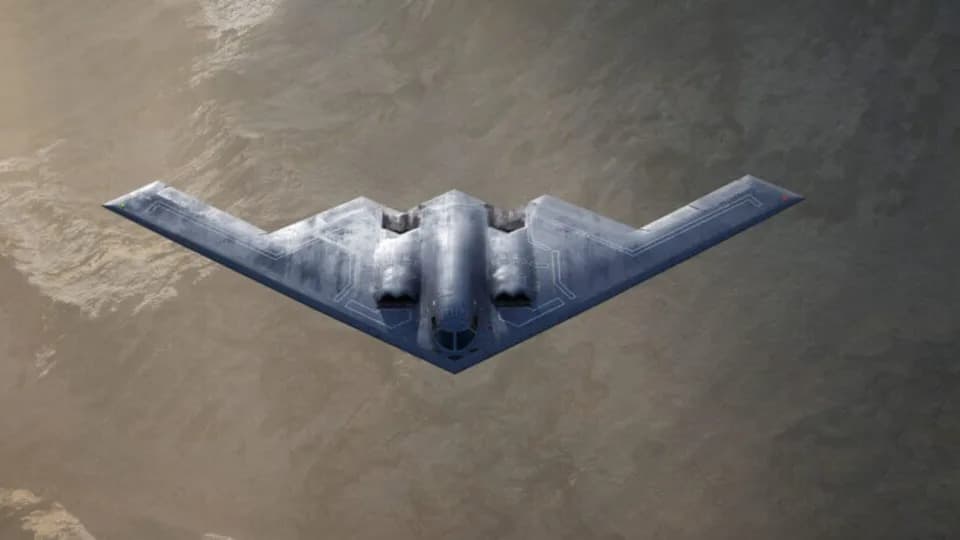
A Chinese aerospace simulation platform called PADJ X has been reported to model a B-21–type geometry using only publicly available imagery and 288 design parameters, producing claims of aerodynamic and stability limits for the United States’ next-generation stealth bomber. The work, described in leaked files and a peer-reviewed paper cited in Chinese journals, mixes promising technical detail with notable gaps in independent verification.
What PADJ X Does
PADJ X is presented as an integrated environment that combines five major physics disciplines — aerodynamics, propulsion, electromagnetics, infrared signature and sonic boom — inside a single optimization workflow. The system reportedly employs adjoint-based optimization to evaluate many design parameters simultaneously, which can dramatically reduce the computational cost of multi-parameter searches compared with sequential, trial-and-error approaches.
Key Findings Reported
According to the research summary, PADJ X modeled a B-21–type layout from open-source imagery using 288 parameters. The simulations claim that aerodynamic refinements could raise the aircraft’s lift-to-drag (L/D) ratio by roughly 15% and reduce shock-wave features that degrade both efficiency and low-observability characteristics.
Researchers argue that an "all-at-once" adjoint optimization across multiple physics domains enables faster, more holistic tuning of airframe geometry than workflows that hand off between separate discipline solvers.
Evidence, Validation, and Limits
The leak associated with PADJ X reportedly includes about 20 GB of files that document earlier projects, such as work on the Northrop Grumman X-47B drone and a Chinese benchmark model called CHN-F1. Individual components of the PADJ X pipeline — notably radar cross-section calculations — have been cross-checked in third-party tools such as Altair FEKO. This lends some credibility to parts of the workflow.

Google logo on a black background next to text reading 'Click to follow TechRadar'
However, multiple important caveats remain. The two paper identifiers cited in connection with the leak (10.7527/S1000-6893.2025.32221 and 10.7527/S1000-6893.2025.32816) are not currently discoverable in public repositories. Access to the purported December 2025 software package also appears restricted or unavailable, and there is no independently authenticated demonstration showing a complete, multi-parameter optimization from a blank start.
Practically, running a full, high-fidelity geometry optimization across 288 parameters and multiple physics domains would demand substantial compute resources and engineering effort. Observers note that the published claims may be based largely on open-source imagery, engineering inference, and benchmark models rather than recovered classified data.
Context and Interpretation
Whether PADJ X has truly "cracked" fundamental limits of the B-21 remains unresolved. The work illustrates progress in integrated, adjoint-based optimization and highlights how much can be learned from open-source reconstruction and sophisticated simulation tools. At the same time, the absence of public papers, a verified final software package, and an independently reproducible end-to-end demonstration mean these findings should be treated cautiously.
Analysts caution that the episode could serve multiple purposes: a genuine technical advance, a test of open-source reverse-engineering limits, or a narrative aimed at influencing perceptions of stealth technology and U.S. airborne capabilities. Until independent verification is available, the PADJ X claims are best seen as technically interesting but not definitively proven.
Bottom line: PADJ X appears to be a capable integrated simulation environment, and its reported results are plausible in principle. But missing documentation, unverifiable papers, and the lack of a publicly demonstrated full-system run mean the claimed 15% lift-to-drag improvement and broader implications for the B-21 should be treated with healthy skepticism.
Help us improve.