The field trial found that small inocula (290 cm3) of Amazonian dark earth (ADE) dramatically improved early growth of two native tree species on degraded land: pink trumpet tree seedlings grew up to 55% taller with stems 88% thicker, while Brazilian firetree seedlings increased ~20% in height and ~15% in stem diameter after 180 days. Microbial analysis implicates shifts in the rhizosphere—especially fungal communities—rather than a simple nutrient boost. Results are promising but preliminary: the trial covered one site, two species and 72 plants, and longer‑term effects and nutrient–microbe interactions remain unresolved.
Ancient Amazonian Soil Boosts Early Tree Growth — Up to 88% Thicker Stems

Ancient Amazonian dark earth boosted young tree growth and reshaped root microbes in a Brazil field study. (CREDIT: Shutterstock)
A small field trial in Amazonas found that tiny inocula of Amazonian dark earth (ADE or terra preta) significantly accelerated early growth of native trees on degraded land, apparently by reshaping root-zone microbial communities rather than simply adding nutrients.
What the researchers did
Teams from the Center for Nuclear Energy in Agriculture at the University of São Paulo (CENA‑USP), Embrapa Eastern Amazon and the National Institute for Amazonian Research conducted the experiment on a 1.2‑hectare former cassava plot in Itacoatiara, Amazonas. Seeds of two native species were germinated in pots that contained either 290 cm3 of Amazonian dark earth or coconut fiber (control). After 15 days, size‑standardized seedlings were transplanted to the field without fertilizer or herbicide and grown with only rainfall and manual weed control to mimic realistic restoration conditions.
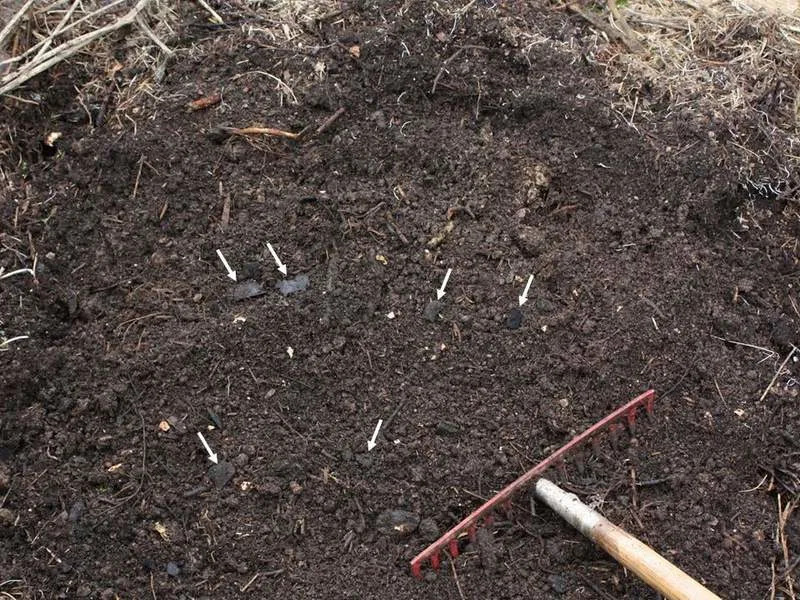
Homemade terra preta, with charcoal pieces indicated by white arrows. (CREDIT: Holger Casselmann / Wikimedia / CC BY-SA 4.0)
Key results (first 180 days)
After 180 days, survival was 100% and growth differences were striking. Pink trumpet tree (Handroanthus avellanedae) seedlings grown from ADE pots were up to 55% taller and had stems up to 88% thicker than controls. Brazilian firetree (Schizolobium amazonicum) — a fast pioneer — showed more modest gains of about 20% greater height and 15% larger stem diameter, reaching roughly 1.5 m by day 180.
Why nutrients alone don’t explain it
Each pot held only a small ADE inoculum, seedlings were normalized for size before field transfer, and any ADE nutrients would be rapidly diluted into the surrounding Oxisol (highly weathered tropical soil). The ADE used also contained far less available nutrients than commercial fertilizers. These facts led the team to look beyond a simple nutrient boost.
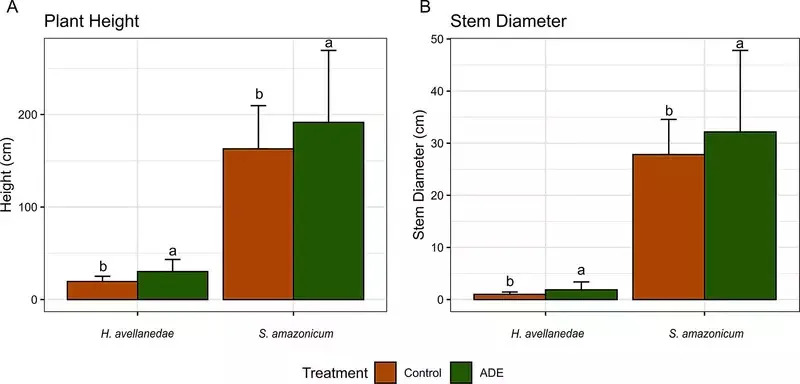
Growth of Handroanthus avellaneade and Schizolobium amazonicum after 180 days of experiment in control and ADE treatments. (CREDIT: BMC Ecology and Evolution)
Microbial mechanisms — fungi in the lead
Researchers analyzed rhizosphere DNA for bacterial, archaeal and fungal markers and compared diversity, abundance and network structure between ADE‑treated and control plants. The largest and most consistent shifts were in fungal communities. In H. avellanedae, ADE substantially increased fungal diversity and produced the most distinct microbial community composition among treatments.
"The key factor was not the amount of nutrients per se... but rather the microorganisms, which were quite different, especially the fungi," said Anderson Santos de Freitas, the study’s first author.
In the firetree, ADE increased recruitment of Mortierellomycota — fungi associated with nutrient‑rich, early‑establishment soils — while reducing groups linked to stressed conditions. In the pink trumpet tree, ADE reduced several opportunistic or pathogenic fungal genera (e.g., Lasiodiplodia, Diaporthe) and increased genera tied to growth promotion, biocontrol and decomposition (e.g., Metarhizium, Tomentella, Humicola).
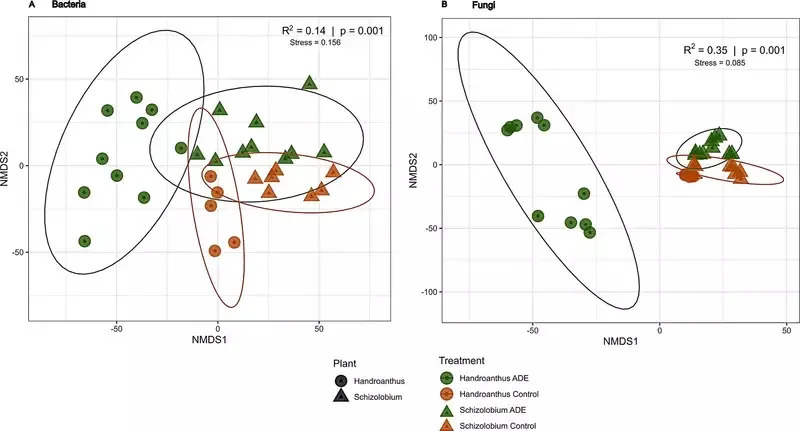
Beta diversity calculated by Euclidean distance and plotted in a non-metric multidimensional scaling. (A) Prokaryotes. (B) Fungi. R-squared and p-values were calculated by PERMANOVA with 999 permutations. (CREDIT: BMC Ecology and Evolution)
Bacterial responses and trade-offs
Bacterial shifts were more mixed. In H. avellanedae some bacterial genera — including taxa with potential nitrogen‑fixing roles — declined under ADE treatment. The authors suggest that a richer local environment may make certain microbial partnerships less necessary initially, creating trade‑offs even as seedling growth improves.
Limitations and open questions
- The reported growth effects cover only the first 180 days; the experiment continued for three years and full results are still being analyzed.
- Study scope was limited: one site, two species and 72 plants, so generality across climates, forest types and broader restoration contexts is untested.
- The trial did not measure total nitrogen or definitively partition the relative roles of added nutrients versus introduced microbes in driving growth gains.
Implications for restoration
The study offers one of the first field demonstrations that a small‑volume ADE inoculum can help native trees establish faster on degraded tropical land without fertilizers or herbicides. If researchers can identify the organisms, interactions or processes that make ADE effective, it may be possible to develop legal, scalable bio‑based restoration tools that reproduce ADE’s benefits without harvesting protected soils.
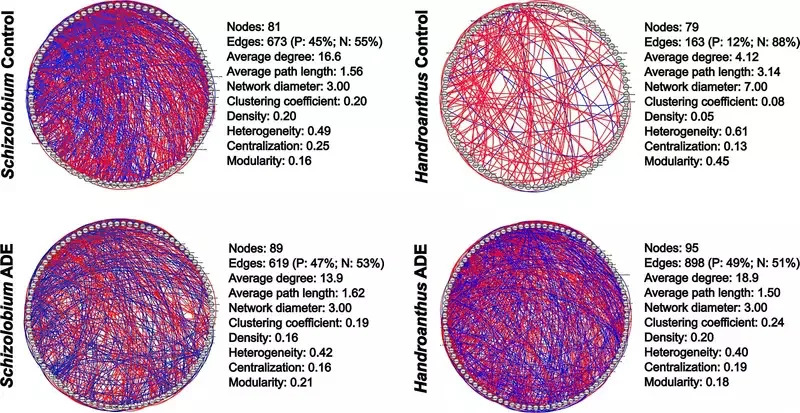
Co-occurrence network analysis of microbial communities in Schizolobium amazonicum and Handroanthus avellanedae soils under control and ADE treatments. (CREDIT: BMC Ecology and Evolution)
Publication: Findings are published in BMC Ecology and Evolution. The work was supported by FAPESP.
Note: ADE (Amazonian dark earth or terra preta) is a legally protected, human‑made soil formed over centuries by past human occupation. The authors emphasize they do not advocate mining ADE for restoration; the goal is to understand and replicate its biological functions.
Help us improve.