New research led by the College of the Atlantic finds Tyrannosaurus rex likely walked on the front part of its feet in a toe-first, bird-like gait. Models combining measurements from four specimens and fossil trackways show a distal-foot strike increases estimated top speeds by ~20% on average (up to ~42% in some cases) and raises stride frequency modestly. Adult T. rex speeds remain broadly within prior estimates (~5–11 m/s or 11–25 mph), but the results suggest improved stability and agility. Authors recommend future 3D models that add musculature, joint motion and tail dynamics for more precise reconstructions.
T. rex Walked On Its Toes: New Study Shows a Bird-Like, Toe-First Gait
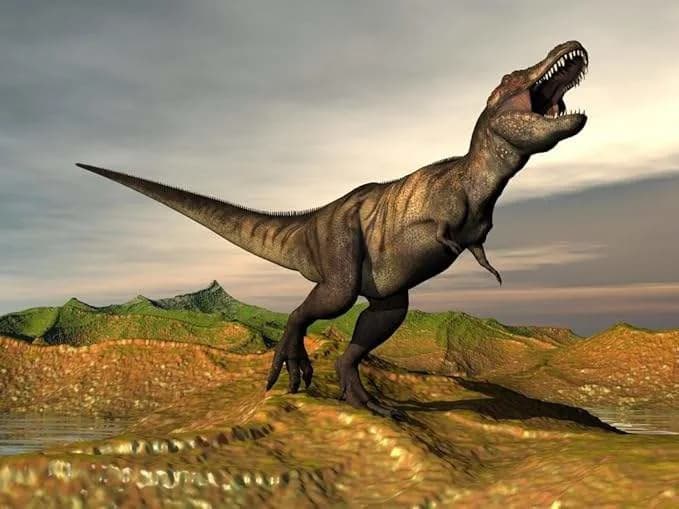
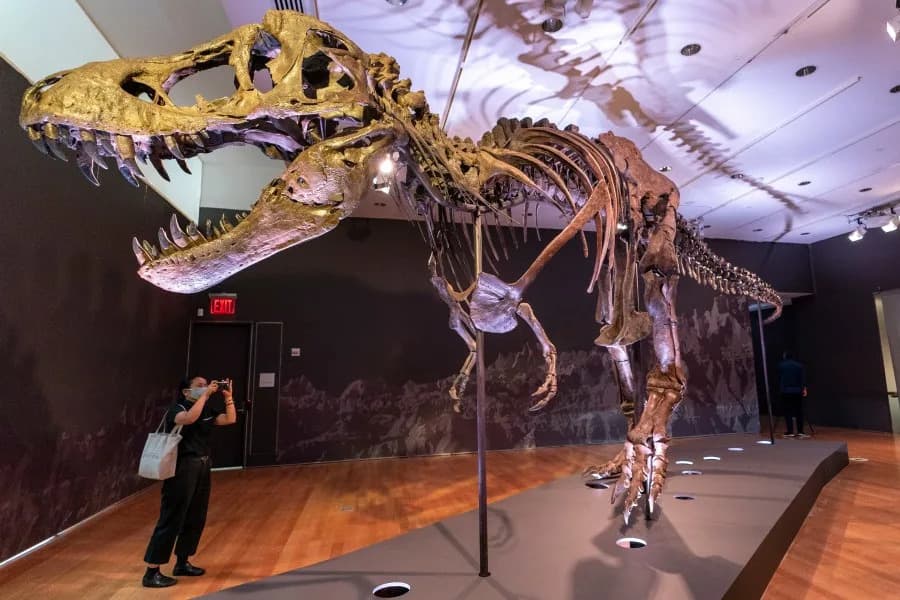
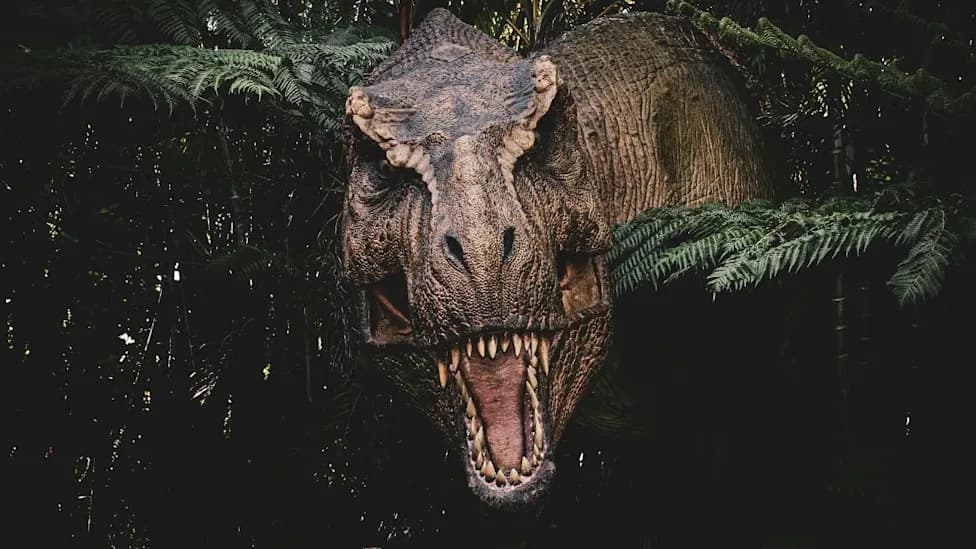
New research suggests T. rex moved on tiptoes, using a bird-like gait that may have boosted speed and stability. (CREDIT: Wikimedia / CC BY-SA 4.0)
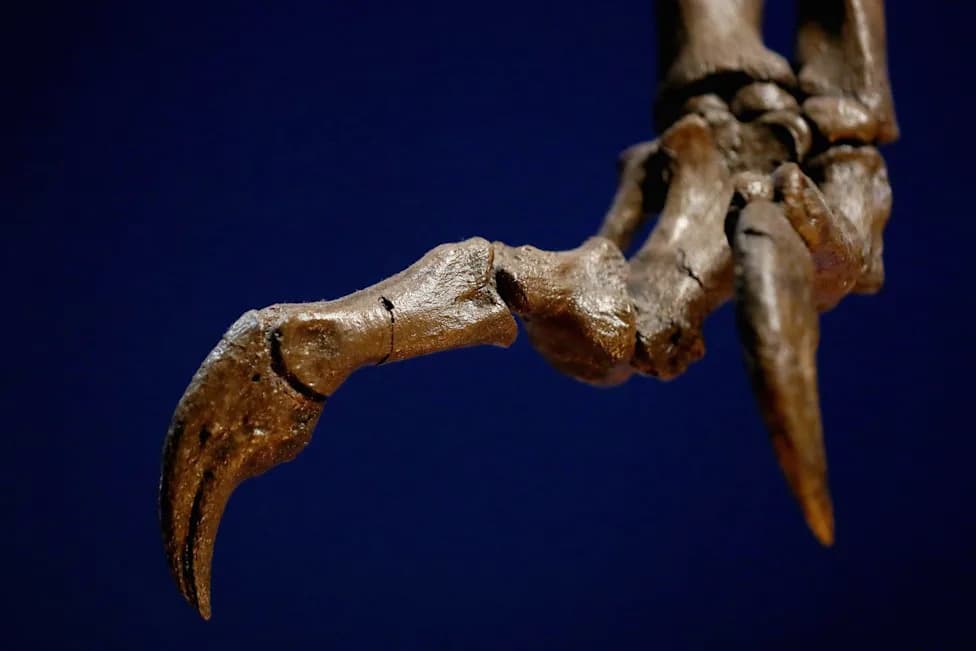
New biomechanical research indicates that Tyrannosaurus rex likely placed weight on the front portion of its feet and moved in a bird-like, toe-first (distal) gait rather than walking flat-footed. Published in Royal Society Open Science and led by researchers at the College of the Atlantic, the study combines measurements from fossil bones with trackway evidence to refine estimates of speed, stride frequency and stability for this iconic predator.
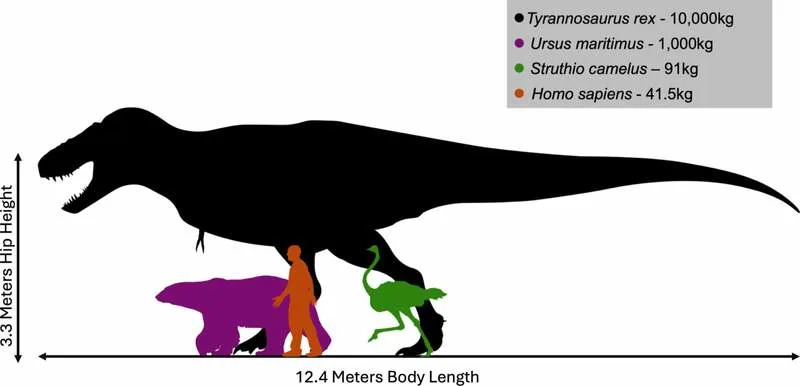
Size comparison between T. rex and several extant terrestrial vertebrates. (CREDIT: Royal Society Open Science)
How the Study Was Done
The team analyzed leg and foot measurements from four well-preserved T. rex specimens (MOR 555, FMNH PR 2081, the former BHI 3033, and LACM 23845), estimated hip height, and ran those inputs through three commonly used locomotion equations for bipeds. They modeled three foot-strike patterns—rear-foot (heel-first), mid-foot, and distal-foot (toe-first)—and incorporated fossil trackway data showing the deepest impressions under the toes.
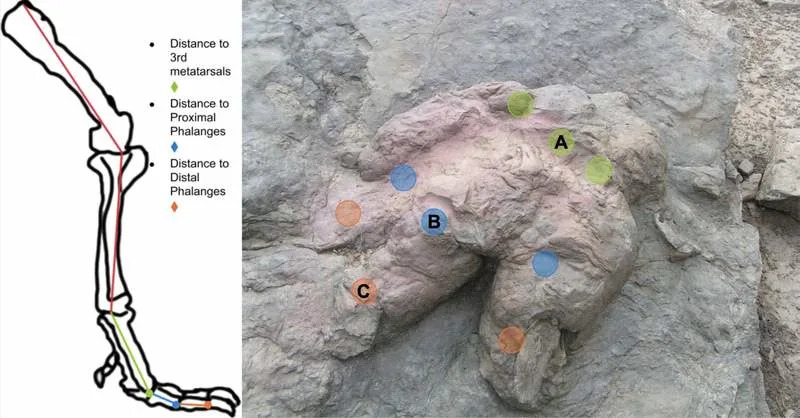
Measurements of a T. rex leg including leg length remaining in articulation with the acetabulum, distance to the third metatarsals, proximal phalanges and distal phalanges of digits I, II and III. (CREDIT: Royal Society Open Science)
Key Findings
When the models used a distal (toe-first) foot strike, estimated top speeds increased across the dataset by about 20% on average (with some lower-end cases showing increases up to ~42%). Stride frequency also rose, on average by ~6% (up to ~8% in some comparisons). The authors emphasize this does not make T. rex an elite sprinter—constraints from body mass, bone stress and muscular power still apply—but it suggests a more stable and agile gait than many flat-footed reconstructions imply.
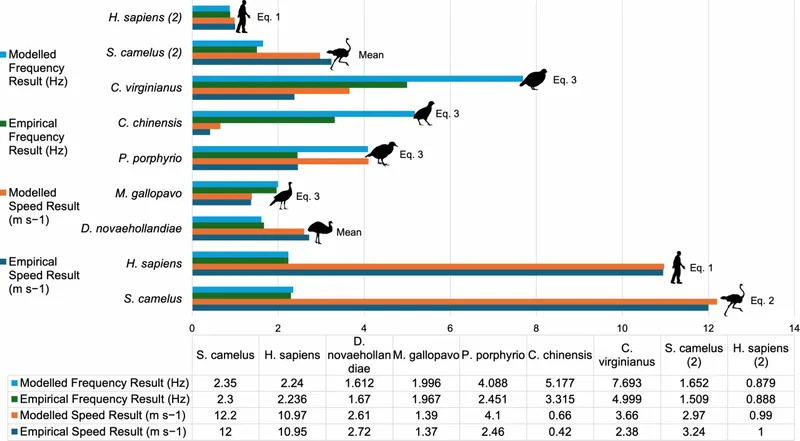
Comparison of empirical observed results and modelled for speed and stride frequency to test the models’ ability to produce accurate results. (CREDIT: Royal Society Open Science)
Biomechanical Interpretation
The researchers contrast human spring-like running (which relies on stiff limbs and elastic energy storage) with the locomotor style inferred for large ground birds. They propose that T. rex likely used shorter relative strides and faster step cycles with more compliant limbs, a pattern that would help stabilize the trunk and control head motion across uneven terrain. The paper argues the pes (foot) of T. rex functioned in a manner similar to bird feet, even while the animal retained major differences—such as a massive tail and different hip-femur mechanics.
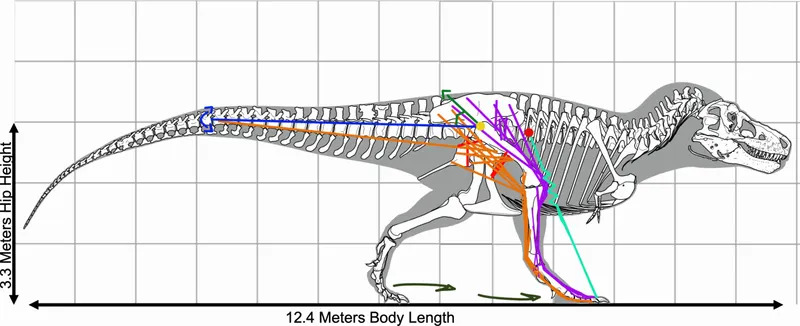
Visual representation of some of the key aspects of future models of Tyrannosaurus locomotion, including an oscillating, dynamic tail, alongside a more bird-like foot function and up-to-date muscle distribution. (CREDIT: Royal Society Open Science)
Ontogeny and Ecological Implications
Smaller, younger tyrannosaurs in the sample appear capable of higher relative speeds than heavier adults, supporting the idea of ontogenetic niche separation—juveniles and adults may have hunted different prey and moved differently during life stages.
Limitations and Future Directions
The authors acknowledge several sources of uncertainty: some input values came from two-dimensional reconstructions (estimated measurement error ≤ ~3%), and hip-height estimates could vary by as much as ~10% depending on posture assumptions. Their sensitivity analyses suggest realistic margins of error for the most precise results likely remain below ~6.5% (with expected uncertainties around 2.4% for speed and 4.6% for stride frequency). The paper stresses that equations calibrated on living animals are imperfect proxies for extinct taxa and calls for future three-dimensional models that integrate bird-like foot function with detailed musculature, joint mechanics and tail dynamics for higher-fidelity reconstructions.
Bottom line: T. rex was neither a sluggish giant nor a cheetah-like sprinter. Instead, evidence points to a 10-ton hunter that stepped toe-first—more balanced, agile and bird-like in foot function than many classic portrayals suggest.
Research Source: Royal Society Open Science. Original public write-up appeared in The Brighter Side of News.
Help us improve.