A University at Buffalo team shows that doping a chiral perovskite with 1% F4TCNQ produces a hybrid that absorbs visible light from ~550–750 nm while retaining chiral optical responses. Spectroscopy reveals ultrafast charge transfer (faster than 1 ps) and new features at 416 nm and ~510 nm, and electrical tests find dark conductivity improved by over two orders of magnitude with activation energy dropping from 480 meV to 350 meV. Photodetectors made from the doped films distinguish circular polarization (gph = 0.18 at 405 nm and 0.12 at 635 nm), though responsivity and quantum efficiency remain low pending device optimization.
Non‑Chiral Dopant Enables Chiral Perovskites To Detect Visible Light While Preserving Chirality
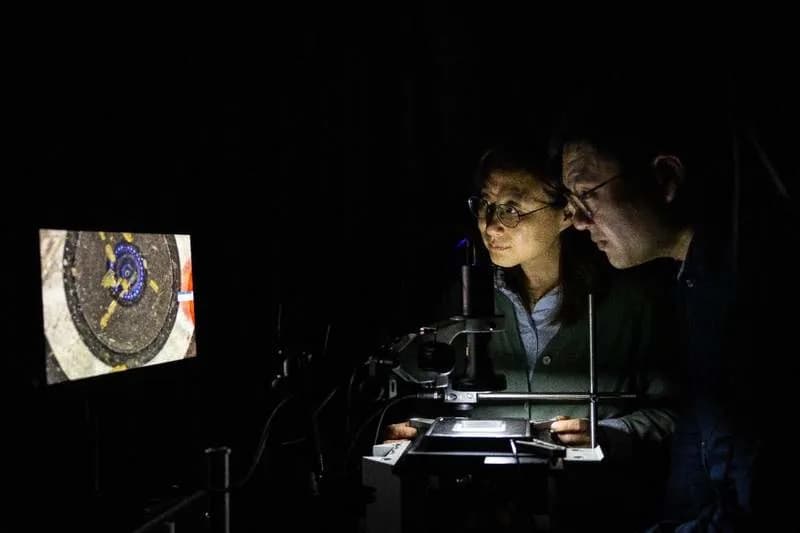
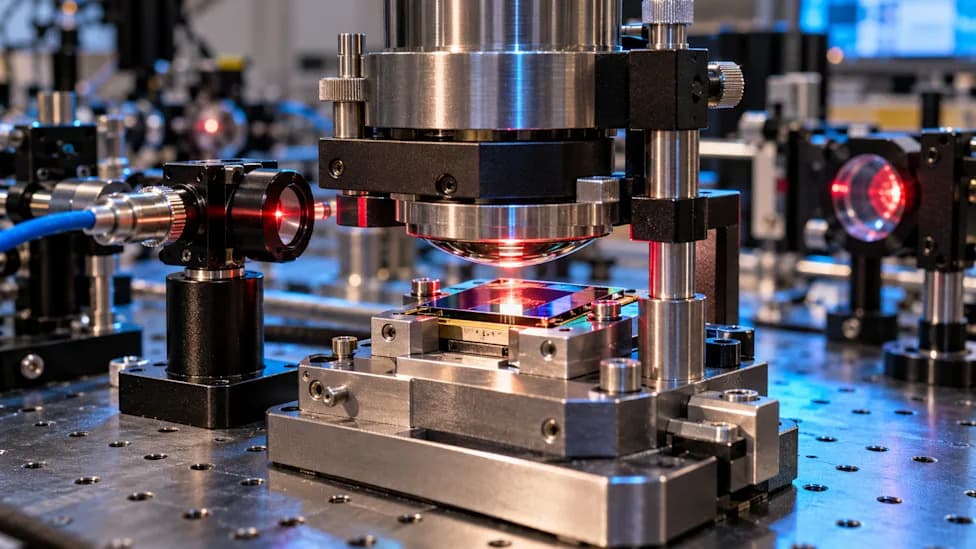
Wanyi Nie, associate professor of physics, and Dave Tsai, assistant professor of chemical and biological engineering, use a home-built optical microscope to probe the chiral properties of chiral perovskite crystals. (CREDIT: Meredith Forrest Kulwicki/University at Buffalo)
A longstanding limitation of chiral semiconductors — materials that distinguish left- from right‑handed circularly polarized light — has been weak response across the visible spectrum. A team led by the University at Buffalo reports a simple molecular workaround: adding 1% of the non‑chiral organic dopant F4TCNQ to a chiral perovskite produces a hybrid that absorbs visible light from roughly 550 to 750 nm while retaining the host's chiral optical signature.
Background
Chiral perovskites exist in left‑ and right‑handed structural forms and can interact differently with left‑ and right‑circularly polarized light. That property makes them attractive for polarized‑light detection, optical communications and other optoelectronic applications. However, many organic and hybrid chiral semiconductors have limited absorption in the visible range (typically cutting off between ~400 and 550 nm) and can suffer from low conductivity — both of which limit device performance.

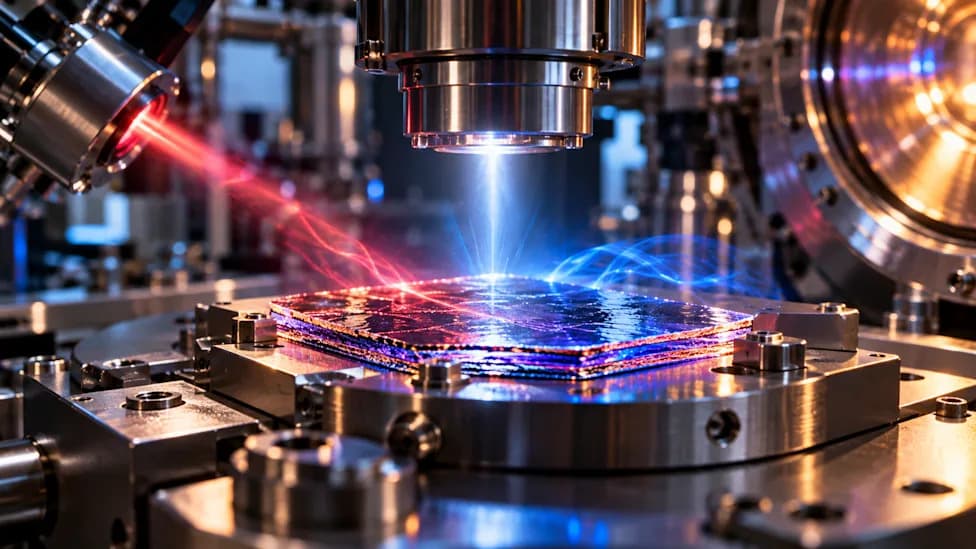
Sai and Nie chemically combined a chiral semiconducting material with a non-chiral molecule that more readily absorbs visible light. (CREDIT: Meredith Forrest Kulwicki/University at Buffalo)
What The Team Did
Instead of redesigning the semiconductor, the researchers doped a chiral perovskite with the electron‑accepting molecule F4TCNQ. The resulting guest–host assembly developed a new, broad absorption band from about 550 to 750 nm. The authors attribute this visible‑range band to optically active charge‑transfer states formed when electrons move from the chiral host into higher‑energy states associated with the dopant.
Key Measurements And Findings
Spectroscopy: Transient absorption measurements revealed new spectral features at 416 nm and near 510 nm that were absent in the undoped material, consistent with charge transfer and recombination at the host–guest interface. Timing data indicate ultrafast charge transfer, faster than 1 picosecond.
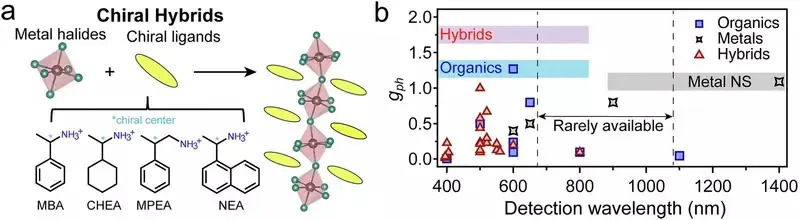
Structural assembly and wavelength-dependent chiroptical response of reported chiral metal halide hybrids. (CREDIT: Nature Communications)
Carrier Dynamics: Decay components shifted on doping: in pristine films one component was 9.01 ps and another 416.67 ps, while in doped films they became ~16.13 ps and ~303.03 ps, indicating modified recombination dynamics driven by the dopant.
Electrical Transport: Room‑temperature dark conductivity of the doped film improved by more than two orders of magnitude compared with the undoped film. Activation energy dropped from 480 meV to 350 meV with 1% F4TCNQ, suggesting the dopant facilitates more favorable charge‑transport pathways.
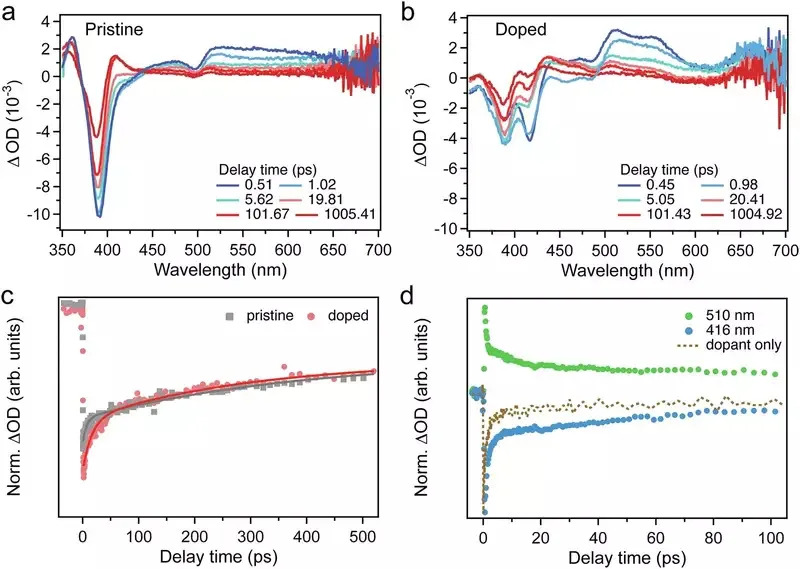
Time-resolved transient absorbance of chiral perovskite hybrids. (CREDIT: Nature Communications)
Device Performance: Photodetectors fabricated from the doped films discriminated left‑ and right‑circularly polarized light at both 405 nm (blue) and 635 nm (red). The photo‑anisotropy (gph) reached 0.18 at 405 nm and 0.12 at 635 nm, demonstrating preserved chiral selectivity even in the visible range introduced by the charge‑transfer absorption. The authors note that responsivity and external quantum efficiency were low, attributed to unoptimized device architecture and measurement conditions; detectors were tested without applied bias to avoid masking the polarization signal with large injected currents.
Modeling And Limitations
The team modeled plausible dopant placements in the perovskite lattice and found one configuration ("model‑2") produced roughly a 20‑fold stronger calculated oscillator strength than an alternative geometry. However, those atomistic models were not directly derived from experimental X‑ray diffraction data and should be considered plausible rather than definitive. The theoretical absorption onset was also blue‑shifted relative to experiment, an expected artifact of finite crystal fragments used in simulations and uncertainties in exact molecular orientations.
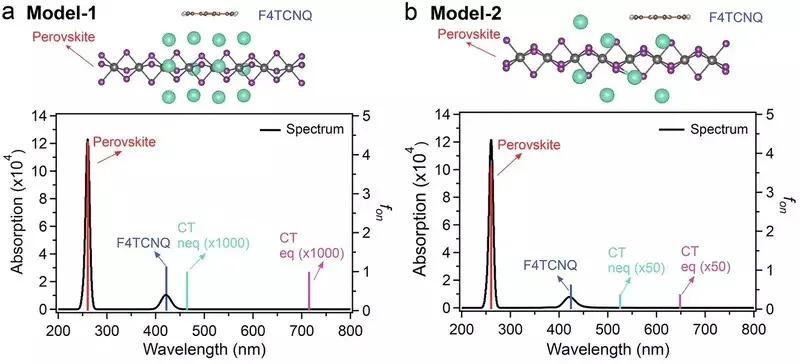
Electronic structure modeling and crystalline structure analysis. (CREDIT: Nature Communications)
Implications
Overall, the evidence suggests the dopant diffuses into the lattice to form a closely packed host–guest assembly and creates optically active charge‑transfer states that extend absorption well into the visible. This host‑to‑guest chirality transfer could be a general strategy for improving other chiral semiconductors that currently struggle with narrow optical ranges or weak electrical performance.
"We see that the ability to tell left‑ from right‑handed light is being passed from one material to another, but we don’t yet fully understand how electrons carry that information across, and what governs this process," said Wanyi Nie, corresponding author.
The study is published in Nature Communications.
Help us improve.