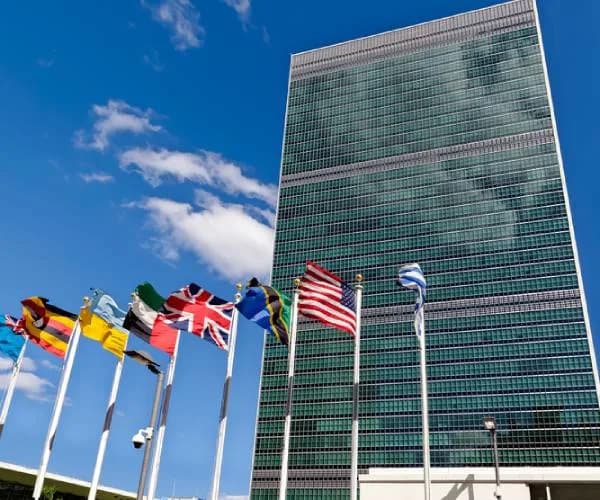
The NPT review conference opened at the UN amid sharp exchanges after Iran was elected one of 34 vice presidents despite U.S. objections. U.S. officials accused Tehran of violating treaty obligations by enriching uranium near weapons-grade levels and restricting IAEA access to sites reportedly bombed last June; Iran denied the charges and called U.S. claims politically motivated. The row highlights broader regional tensions, including Iran’s offer to reopen the Strait of Hormuz in exchange for lifting a blockade, while U.N. Secretary-General António Guterres warned that nuclear arsenals are rising and urged renewed commitments to disarmament.
U.S. and Iran Clash as NPT Review Opens at UN Over Iran’s Nuclear Role
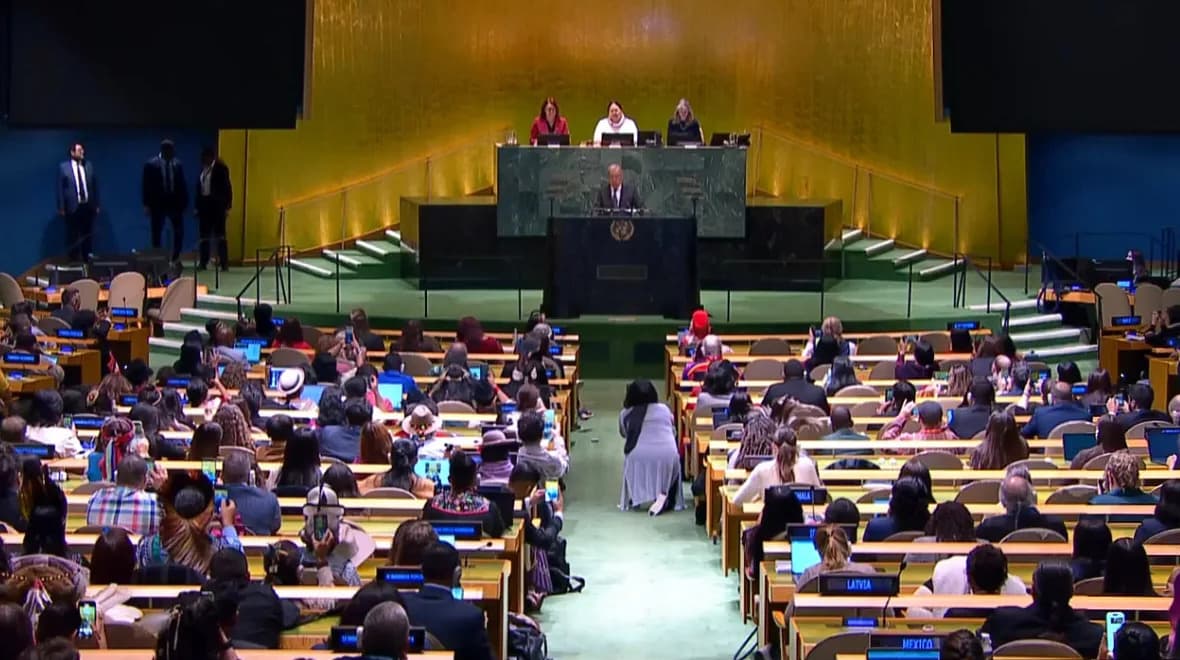
This image taken from UNTV video shows United Nations Secretary-General António Guterres speaking at the UN Permanent Forum on Indigenous Issues in New York, Monday, April 20, 2026. (UNTV via AP)
The United States and Iran confronted each other sharply Monday as the Nuclear Nonproliferation Treaty (NPT) review conference opened at the United Nations, a dispute likely to reverberate across the monthlong meeting.
Contested Vice-Presidency
The row centered on Iran’s election as one of the conference’s 34 vice presidents. The review brings together 191 parties to the NPT every five years to assess implementation of the treaty, which entered into force in 1970. Iran was nominated by the Non-Aligned Movement, a bloc of mostly developing countries.
Accusations and Defenses
U.S. delegation officials objected to Iran’s selection. Christopher Yeaw, U.S. assistant secretary of state for arms control and nonproliferation, accused Tehran of showing “contempt” for its treaty commitments and said electing Iran to a leadership role damaged the review conference’s credibility.
“Rather than choosing to use this review conference to defend the integrity of the NPT and call Iran to account, we instead elect Iran a vice president. It is beyond shameful and an embarrassment to the credibility of this conference.” — Christopher Yeaw
Iran’s U.N. ambassador in Vienna, Reza Najafi, rejected U.S. accusations as “baseless and politically motivated,” accusing Washington of hypocrisy — citing the U.S. as the only country to have used nuclear weapons and asserting that the United States has expanded its arsenal. Najafi also condemned what he described as U.S. and Israeli strikes on Iran’s nuclear facilities in the past year, calling them violations of international law.
Nuclear Tensions and Inspectors
The confrontation reflects wider concerns over Iran’s nuclear activities. U.S. and other officials say Iran has enriched uranium to levels approaching weapons grade and has denied International Atomic Energy Agency (IAEA) inspectors access to sites reportedly bombed last June. Iran maintains its nuclear program is for peaceful, civilian purposes.
Wider Diplomatic Context
The United States was supported in its objections by Australia and the United Arab Emirates. The United Kingdom, France and Germany — signatories of the 2015 nuclear deal from which the U.S. withdrew in 2018 — also expressed concern. Russian representatives cautioned against singling out Iran and urged the conference to avoid politicization. Separately, Iranian Foreign Minister Abbas Araghchi met with Russian President Vladimir Putin, according to Russian state media.
Strait of Hormuz Offer
On the conference’s opening day, Iran reportedly offered to reopen the Strait of Hormuz if the United States lifted a blockade on Iranian shipping and ended hostilities, while suggesting that talks about its nuclear program be delayed. The offer underscored how the nuclear review is unfolding amid broader regional tensions and military confrontations.
Past Frictions and the Stakes
The previous NPT review in 2022 ended without consensus after Russia blocked adoption of a final document amid fallout from its invasion of Ukraine and disputes over references to the Zaporizhzhia nuclear plant. U.N. Secretary-General António Guterres opened Monday’s session by warning that nuclear arsenals are growing again and that the world faces an elevated risk of nuclear use.
“For the first time in decades, the number of nuclear warheads is rising and nuclear testing is on the table,” Guterres said, urging states to recommit to disarmament and to ensure that advances in technologies such as artificial intelligence and quantum computing never cede human control over nuclear weapons.
What the NPT Requires
Under the treaty, the five original nuclear-weapon states — the United States, Russia, China, Britain and France — pledged to negotiate toward eventual disarmament. Non-nuclear states agreed not to acquire nuclear weapons in exchange for the right to pursue peaceful nuclear energy. The review conference aims to assess how well parties are meeting these promises and to find common ground amid renewed geopolitical tensions.
Help us improve.