Analysis of more than 3,000 marks on 260 Aurignacian objects from southern Germany shows deliberate, repeatable symbol sequences dating to about 43,000–34,000 years ago. Statistical tests (entropy, repetition rates and symbol diversity) reveal measurable structure and different information densities across object types. These patterned marks are not writing in the linguistic sense but likely reflect a long-lived shared symbolic system that may have prefigured later scripts.
40,000-Year-Old Carvings Show Structured Symbols That May Prefigure Writing
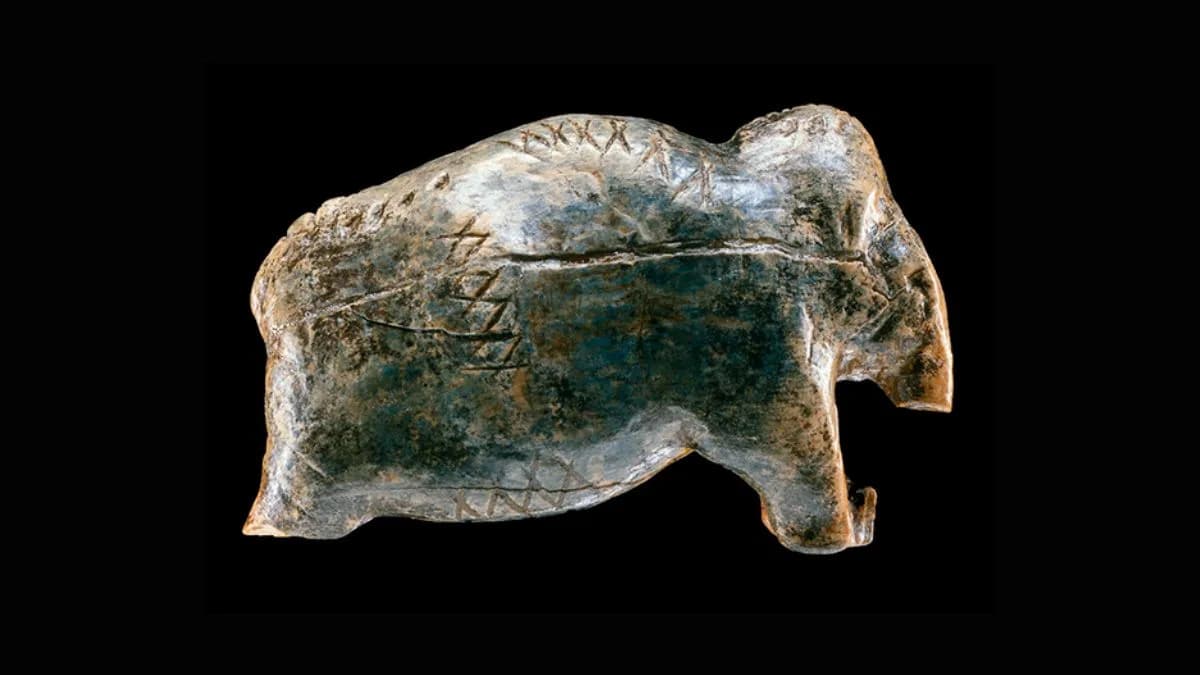
These 40,000-Year-Old Marks May Be a Precursor to Writing
Thousands of incisions on ivory, bone and antler objects from the Aurignacian culture (dated roughly 43,000–34,000 years ago) reveal deliberate, repeatable sign sequences that may represent a shared symbolic system long before true writing appeared.
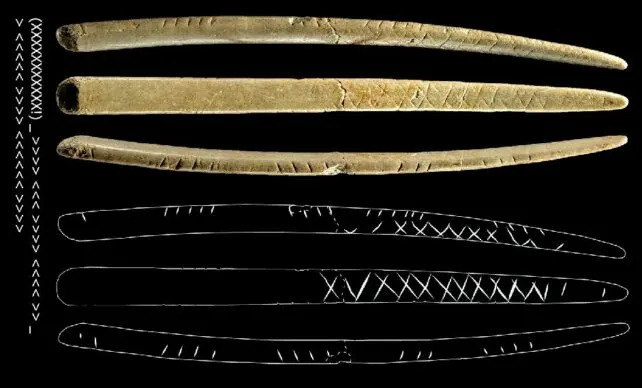
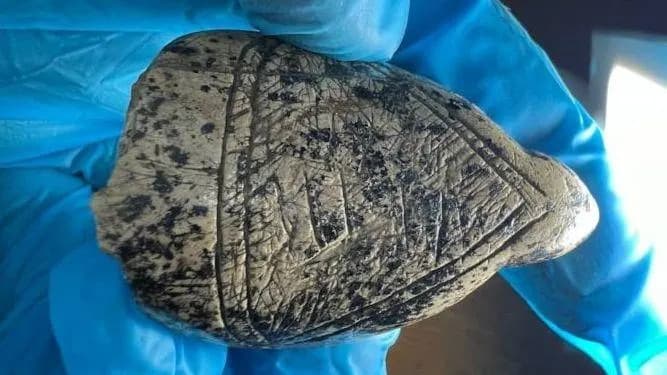
An Aurignacian bone artifact (top), an illustration of the marks carved onto it (bottom), and a catalog of those marks (left). (Bentz & Dutkiewicz,PNAS, 2026)
What the Researchers Did
Linguist Christian Bentz (Saarland University) and archaeologist Ewa Dutkiewicz (Berlin State Museums) compiled a dataset from 260 portable objects excavated in a cluster of caves in the Swabian Jura of southern Germany. They cataloged more than 3,000 individual marks — dots, lines, chevrons, crosses, zigzags, star-like motifs and hatched grids — and grouped them into distinct symbol types and object classes for analysis.
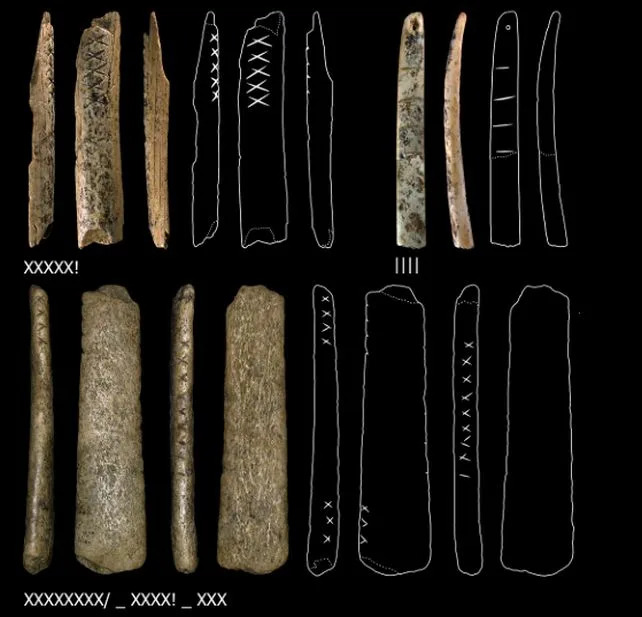
Bone and ivory artifacts with markings. (Bentz & Dutkiewicz,PNAS, 2026)
Methods
The team applied computational algorithms and information-theoretic measures, including entropy, repetition rates and symbol-type diversity, to test whether the sequences were random decorations or carried structured information. These metrics are commonly used to study language, early scripts and other symbolic systems.

Subscribe to ScienceAlert's free fact-checked newsletter
Key Findings
The analysis showed the marks were far from random. Symbols appeared in deliberate, repeatable sequences with measurable structure, and different object classes carried distinct patterns. Figurines exhibited about 15% higher information density than tools; tools showed roughly 10% higher density than tube- or flute-like objects and about 15% higher density than personal ornaments. Crucially, these patterns remained stable for an interval of roughly 10,000 years, implying a persistent, shared function rather than mere decoration.
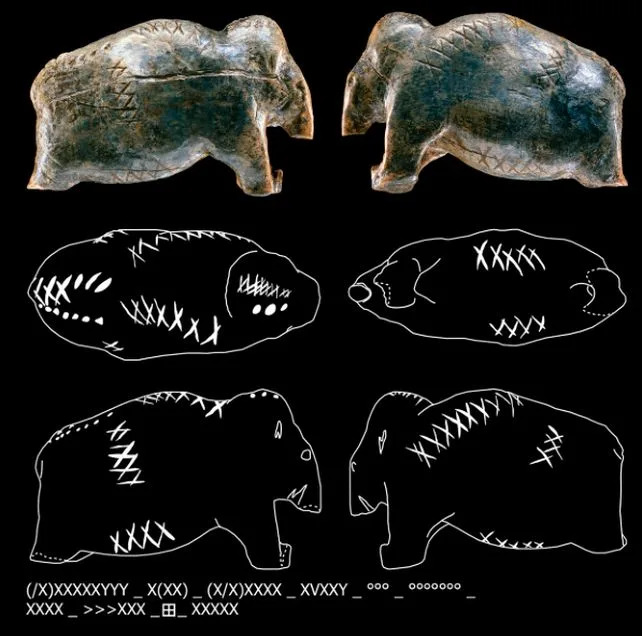
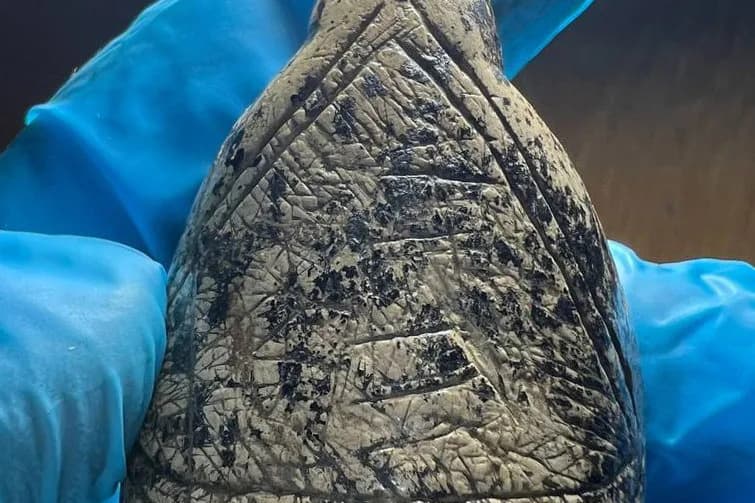
The full set of marks inscribed on the mammoth figurine. (Bentz & Dutkiewicz,PNAS, 2026)
Authors' note: 'The first hunter-gatherers arriving in Europe already applied sign sequences of comparable complexity in a deliberate, systematic, and conventional manner — several ten thousand years before the advent of genuine writing.'
The researchers emphasize that these carvings are not writing in the linguistic sense: they do not encode spoken language and lack the hallmarks of full scripts like protocuneiform. Nonetheless, the findings indicate a long-lived system of intercommunication or social convention among Aurignacian groups, offering an important glimpse into how humans began to externalize and structure information.
Publication: Proceedings of the National Academy of Sciences (PNAS).
Help us improve.