High-resolution laser scanning of the Kition Kathari temple in Cyprus uncovered 23 faint ship carvings that had remained hidden for decades. The petroglyphs—more than 3,000 years old—were etched in phases over roughly 300 years, including a repair block added about 150 years after the original wall. Stylistic analysis identifies Levantine, Minoan and hybrid vessel types, suggesting continuity of maritime imagery across the Late Bronze Age collapse. The discovery highlights how modern scanning techniques can reveal fragile archaeological traces and reshape our understanding of regional continuity.
Lost Fleet Unearthed: 23 Faint Ship Carvings Revealed in Bronze Age Temple at Kition Kathari
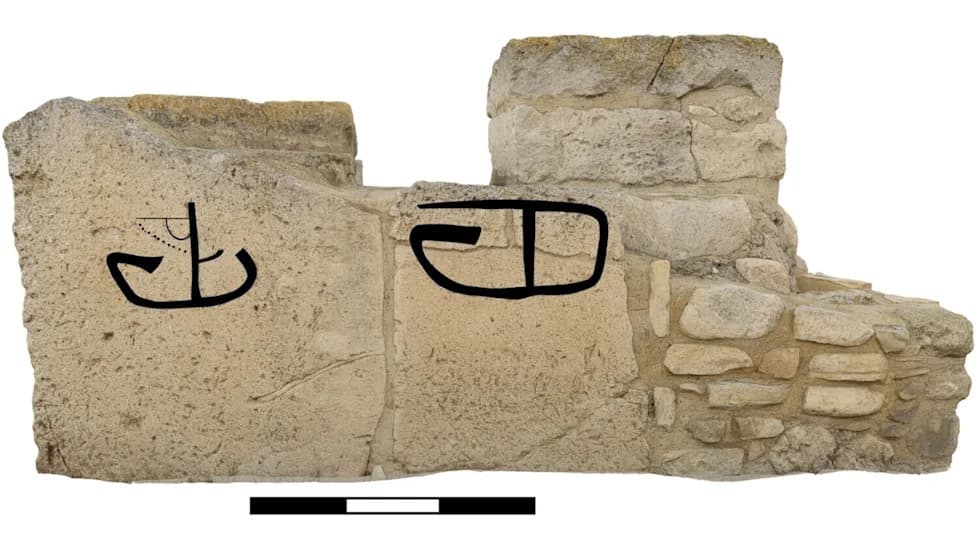
At least 40 ship images have been found throughout the temple complex.
High-resolution laser scanning has exposed a fleet of nearly invisible ship carvings hidden for more than 40 years within the stonework of a Bronze Age temple on Cyprus. The scans revealed 23 petroglyphs on blocks from the temple complex known as Kition Kathari, some of them so faint that earlier excavators overlooked them.
Founded by Phoenicians around the start of the 10th century BCE, Kition was a prominent coastal city-kingdom on Cyprus before Rome annexed it in 58 BCE. The site remained occupied until a series of earthquakes in the fourth century CE largely ended settlement. Archaeological work at Kition Kathari began in 1959 and continued intermittently; earlier fieldwork in the late 20th century documented 21 ship images, but exposure during excavation accelerated erosion of the carved surfaces.
In 2024, researchers returned to the site to document surviving Late Bronze Age masonry using high-resolution laser scanning and 3D reconstruction. Intended to study construction techniques, the surveys instead revealed previously undetected shallow incisions and low-relief ship motifs across multiple blocks and a nearby altar.
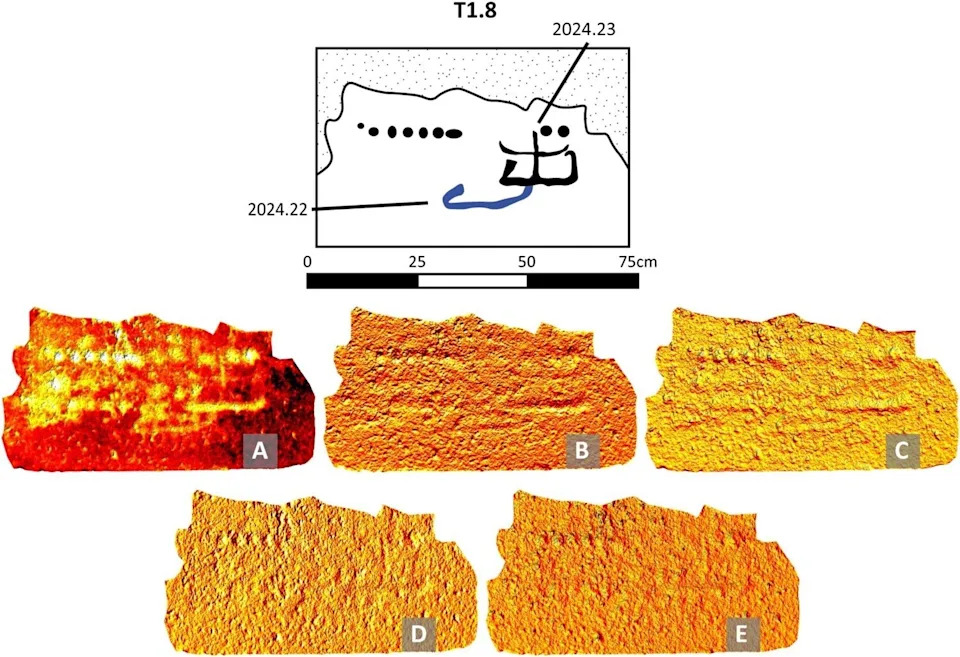
Illustration of the ship carvings on a single temple block with different laser scans. Credit:Braun et al. 2026
“When we noticed all the ships, I felt tremendously excited. We had not expected to find them,” said Caroline Barnes, an archaeologist at the University of British Columbia and a co-author of the new study.
The team identified 23 carved vessels in total. Stylistic analysis groups them into six categories that align with eastern Mediterranean ship iconography—from Levantine and Minoan types to hybrid galleys showing mixed influences, possibly from the Carmel Coast. One notable example appears on a repair stone inserted roughly 150 years after the original wall was built, indicating the imagery was added in discrete phases spanning about 300 years.
Because the motifs date from centuries bracketing the Late Bronze Age collapse, the authors argue they point to continuity of maritime imagery and related knowledge through times of cultural change rather than an abrupt loss of seafaring expertise. The precise function of the carvings remains open: they could be votive or commemorative images, builders’ marks, or emblematic displays of maritime identity.
Methodologically, the study underscores how noninvasive technologies such as high-resolution laser scanning and 3D modelling can recover faint archaeological details invisible to the naked eye, improving documentation while minimizing further damage to fragile stonework. The findings are published in the International Journal of Nautical Archaeology (Braun et al., 2026).
Significance: The rediscovered ship motifs expand our picture of long-term maritime traditions in the eastern Mediterranean and challenge simplified narratives of a total cultural break after the Late Bronze Age transitions.
Help us improve.