Prime numbers continue to fascinate because they blend deep theory with surprising cultural hooks. This article spotlights three notable primes: 73 (Sheldon Cooper’s favorite), which was proven to be uniquely special under strong bounds; 67, which surfaced in a viral "6‑7" meme and appears in combinatorial sequences; and the enormous Belphegor prime that theatrically embeds 666. Each case highlights how number theory intersects with computation and popular culture.
What ‘6‑7,’ Demons and The Big Bang Theory Reveal About Prime Numbers
Prime numbers are the elemental particles of arithmetic: indivisible integers greater than 1 that can only be divided by 1 and themselves. For millennia they have fascinated mathematicians because they hide deep mysteries — how they are distributed, how to find them, and why particular primes sometimes capture the public imagination.
73: The Sheldon Prime
In episode 73 of the sitcom The Big Bang Theory, the character Sheldon Cooper dubs 73 the "best number". His playful argument: 73 is the 21st prime, its reverse 37 is the 12th prime, and 7 × 3 = 21. This whimsical property prompted mathematician Christopher Spicer (then at Morningside College) and two students, Jessie Byrnes and Alyssa Turnquist, to search the first ten million primes for another number with the same three properties; they found none and published their search as “The Sheldon Conjecture.”
In 2019 Spicer and number theorist Carl Pomerance completed a rigorous analysis that showed 73 is uniquely special. They proved there can be no other such prime larger than 1045. Although that bound is astronomically large, it is finite: by combining analytic estimates and elimination arguments the researchers gradually ruled out all remaining families of candidates until only 73 remained. The result is a rare example where a pop-culture-inspired question received a definitive mathematical answer. Portions of that work even appeared, as an Easter egg, on a whiteboard in a 2019 episode of the show.
67: From Meme To Mathematics
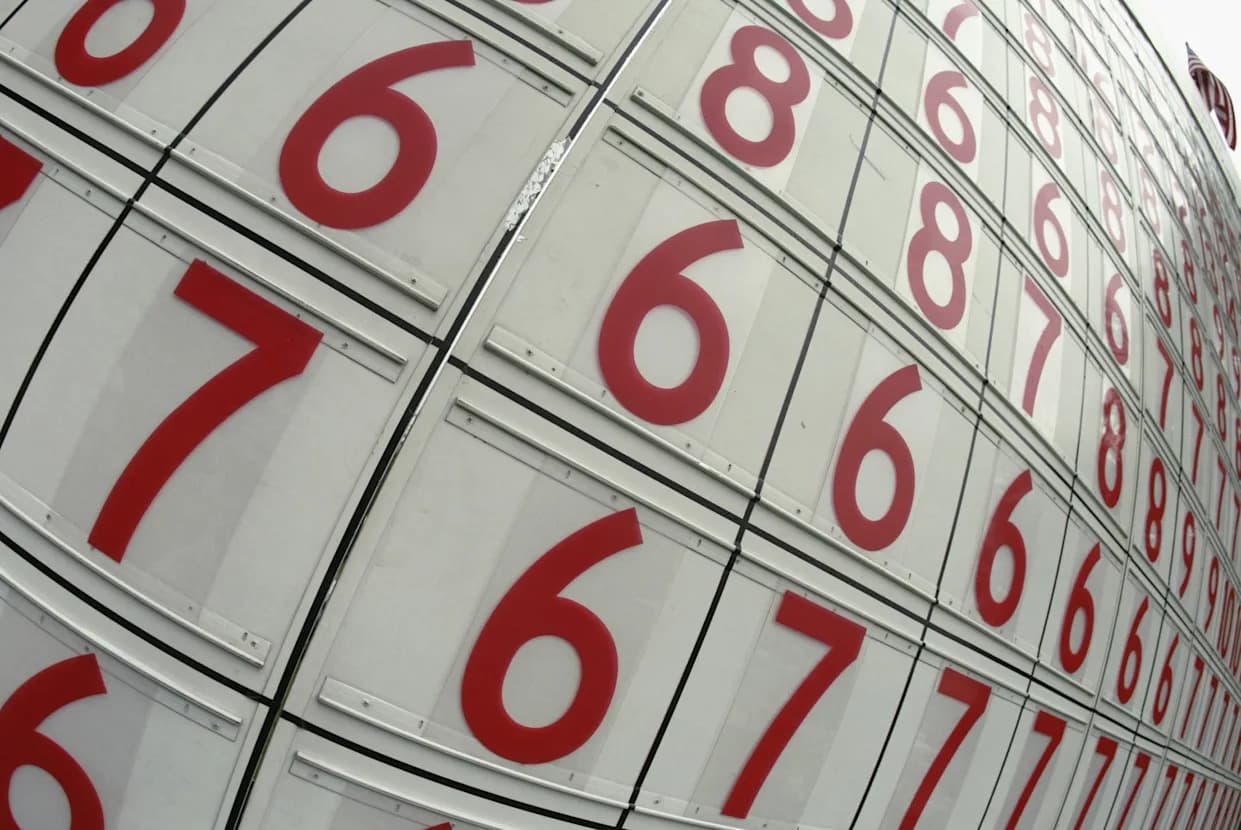
In 2025 the internet lit up with repeated "6‑7" posts: a meme pronounced "six‑seven" that spread across social feeds without an agreed meaning. Some users traced it to a boy celebrating a basketball score, others to the song "Doot Doot (6 7)" by Skrilla, or to the reported height of basketball player LaMelo Ball (six feet, seven inches). The meme itself carries no deeper shared code — it is simply 6‑7 — yet it invited fresh attention to the number 67.
Mathematically, 67 is interesting. It is prime and a super‑prime: it is the 19th prime, and 19 is itself prime. It appears in two adjacent pairs of "sexy primes" — primes that differ by six — and together with 61 and 73 it forms a sexy prime triplet. 67 also occurs in a classic combinatorial formula known as the lazy caterer’s sequence, which gives the maximum number of pieces a disk can be divided into with n straight cuts. The formula is (n2 + n + 2) / 2; with n = 11 cuts this yields 67 pieces.
The Belphegor Prime: Palindromes and the Devil’s Number
If you want a number built for theatricality, consider the Belphegor prime: 1,000,000,000,000,066,600,000,000,000,001. The late Harvey Dubner, an avid collector of remarkable primes, highlighted palindromic primes that embed the "devil’s number" 666. A smaller example he found is 16,661 — a palindrome with 666 in its center. Inserting zeros between the leading 1 and the block of sixes yields many palindromic candidates (1,066,601; 100,666,001; 10,006,660,001; and so on), most of which are composite.
The so‑called Belphegor prime becomes prime again only when there are 13 zeros between each 1 and the block 666. In compact notation it is written as 1030 + 666 × 1014 + 1. There are other palindromic primes built from similar patterns, but the Belphegor example remains one of the most dramatic. Larger patterned variants (for example with many more zeros) may be prime or composite, and some cases remain unproven.
Why These Stories Matter
These three examples — 73, 67 and the Belphegor prime — show different facets of number theory. One is a playful curiosity made rigorous by proof; another is a number that bridges internet culture and combinatorics; the third is a large, evocative example that highlights how pattern, computation and human taste intersect in the search for primes. Together they illustrate how pure mathematics, computation, and popular culture can feed each other: questions sparked by jokes, memes or aesthetics sometimes lead to lasting mathematical results.
Originally published in Spektrum der Wissenschaft; reproduced with permission.
Help us improve.