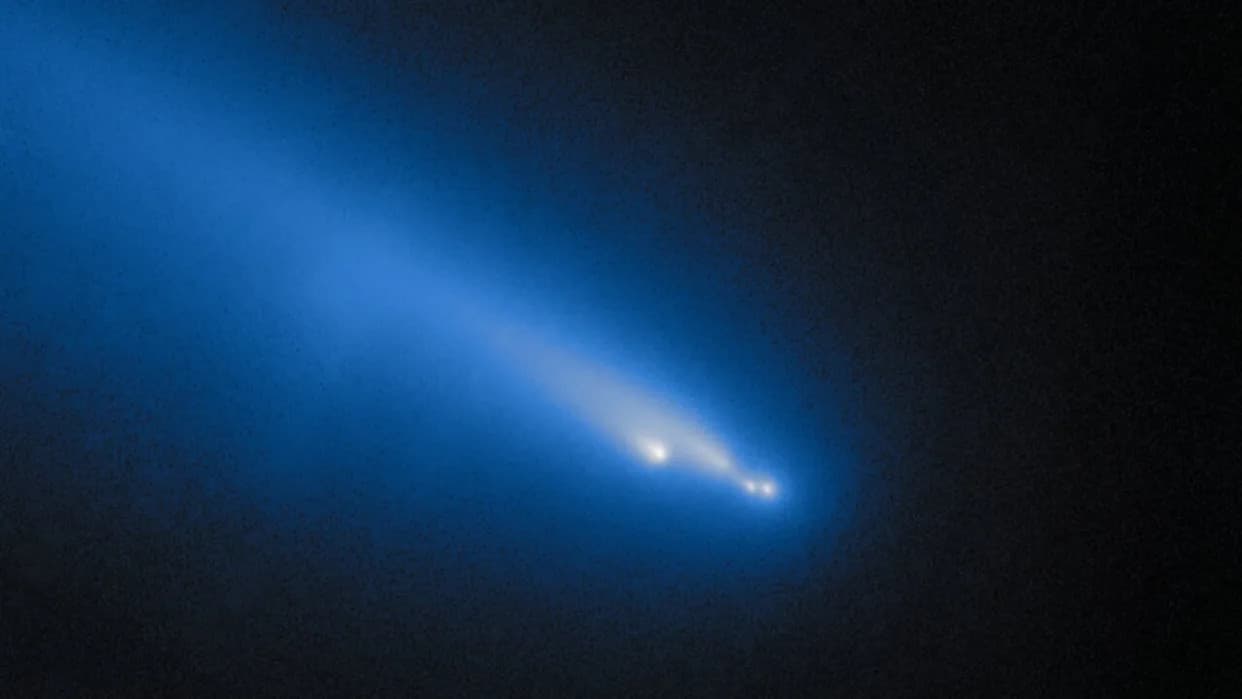
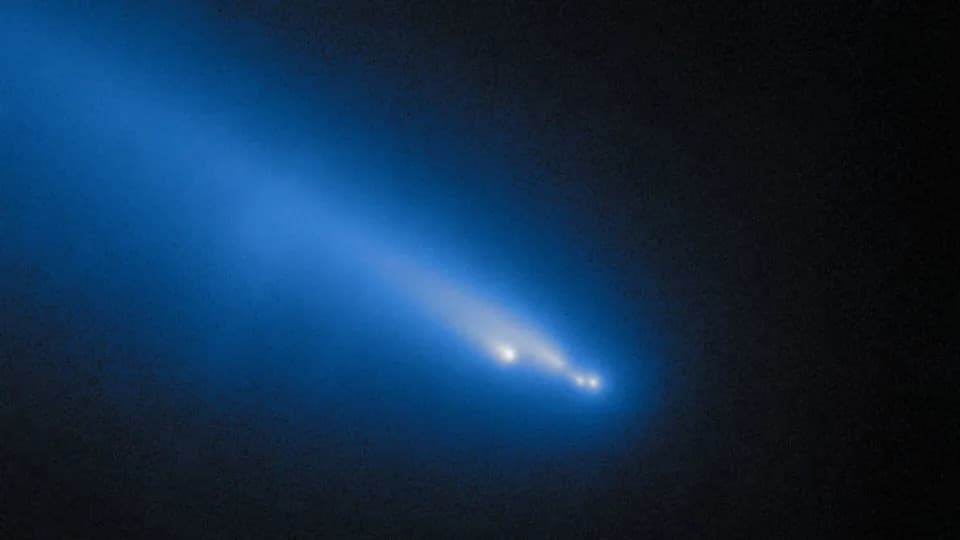
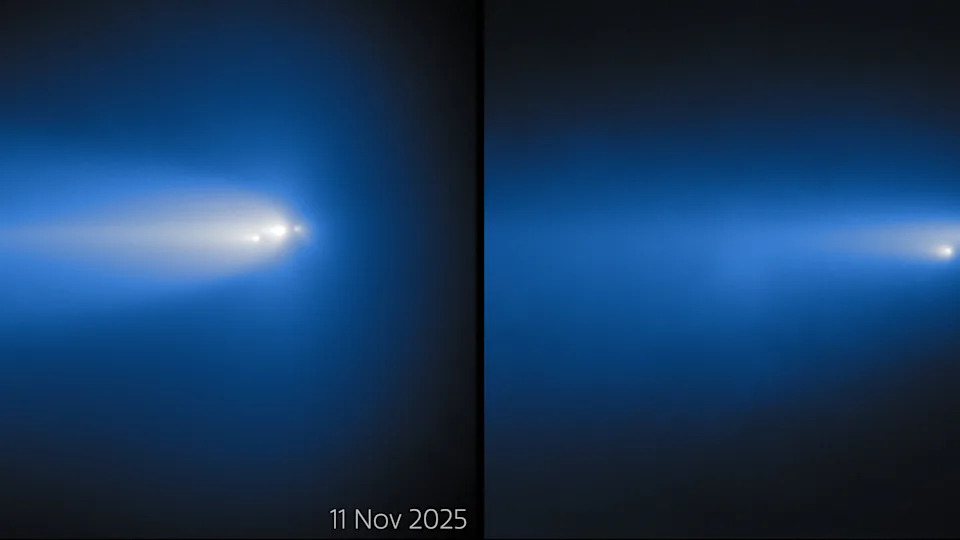
High-resolution Gemini North images released Jan. 29 reveal Comet C/2025 K1 (ATLAS) fragmenting, with exposures taken on Nov. 11 and Dec. 6 showing bright pieces separating from the nucleus. Amateur and professional observers — including Gianluca Masi and Italy’s Asiago Observatory — reported matching fragments, with Asiago measuring a separation of about 1,200 miles (2,000 km). The comet, discovered by ATLAS in May 2025 and likely from the Oort Cloud, appears to have broken up after its Oct. 8 close pass to the Sun due to intense solar forces.
Gemini North Images Capture Comet C/2025 K1 (ATLAS) Shattering After Close Solar Pass
Two images by the Gemini North telescope in Hawaii show Comet C/2025 K1 (ATLAS) breaking apart. AT left is a view on Nov. 11, 2025 and at right, another image from Dec. 6, 2025. | Credit: International Gemini Observatory/NOIRLab/NSF/AURA/B. Bolin; Image Processing: J. Miller & M. Rodriguez (International Gemini Observatory/NSF NOIRLab), T.A. Rector (University of Alaska Anchorage/NSF NOIRLab), M. Zamani (NSF NOIRLab); Acknowledgments: PI: Bryce Bolin (Eureka Scientific)
Powerful, high-resolution images from the Gemini North telescope on Mauna Kea show Comet C/2025 K1 (ATLAS) breaking apart into multiple bright fragments. The exposures — taken on Nov. 11 and Dec. 6 and released Jan. 29 — reveal pieces of the nucleus separating in stunning detail.
Observations and Who Saw It
The 8.1-meter Gemini North optical/infrared telescope, part of the International Gemini Observatory, captured the fragmentation in images produced with National Science Foundation funding. These observations complement reports from both professional and amateur astronomers recorded late last year.
Two images of Comet C/2025 K1 falling apart. | Credit: International Gemini Observatory/NOIRLab/NSF/AURA/B. BolinImage Processing: J. Miller & M. Rodriguez (International Gemini Observatory/NSF NOIRLab), T.A. Rector (University of Alaska Anchorage/NSF NOIRLab), M. Zamani (NSF NOIRLab)
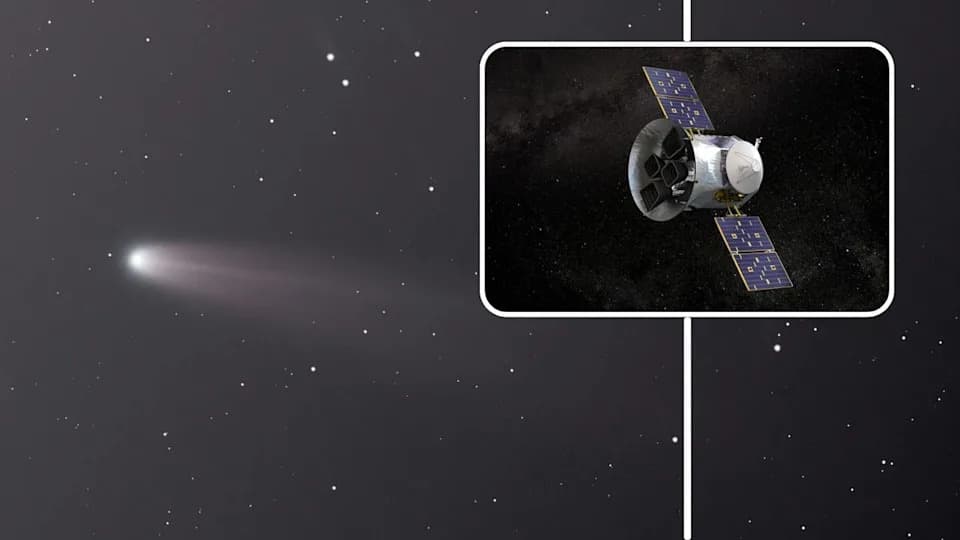
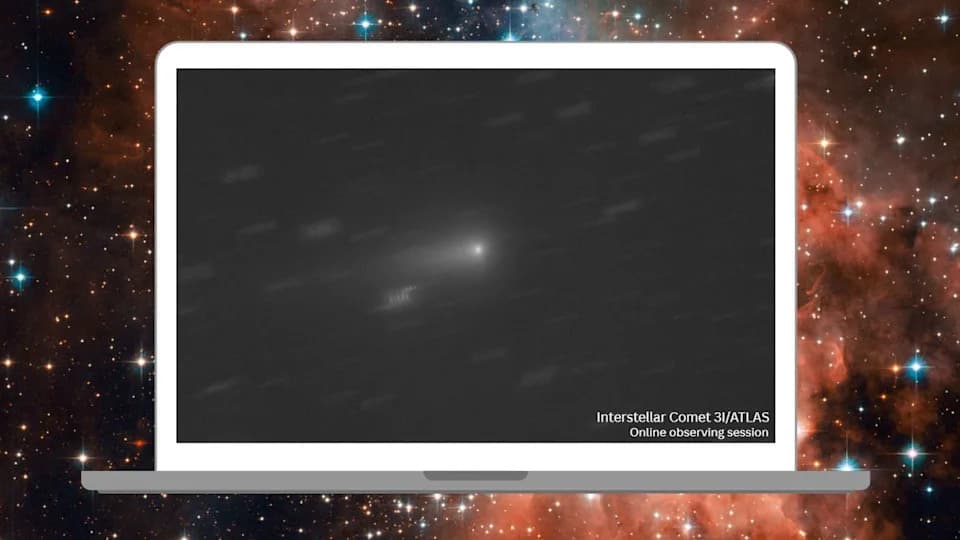
Italian astronomer Gianluca Masi of the Virtual Telescope Project recorded the breakup in early November using a Celestron C14 Schmidt–Cassegrain on a Paramount ME robotic mount. In a statement accompanying his frames, Masi reported seeing "three fragments of the original nucleus and possibly a fourth one." Observers at Italy’s Asiago Observatory also reported two main components on Nov. 11, separated by roughly 1,200 miles (2,000 km), using the observatory’s 1.82-meter Copernicus telescope.
What Likely Caused the Fragmentation
C/2025 K1 (ATLAS) made a close approach to the Sun on Oct. 8. That perihelion exposed a loosely bound mixture of ice and dust — often described as a "rubble pile" nucleus — to intense solar gravity and the persistent flow of charged particles known as the solar wind. Together, these stresses likely caused the nucleus to fracture into multiple chunks.
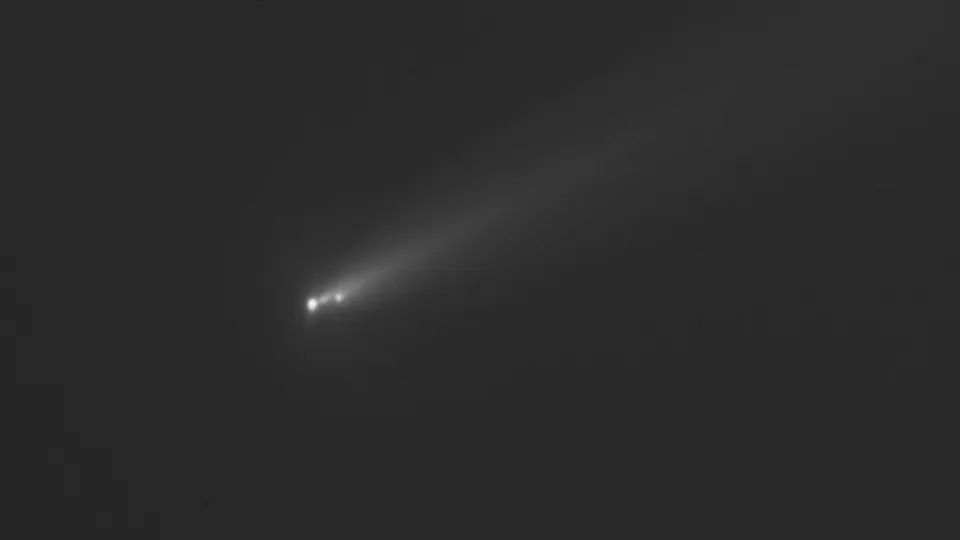
An image of C/2025 K1 (ATLAS) captured by Gianluca Masi of the Virtual Telescope Project. | Credit: Gianluca Masi, Virtual Telescope Project
Why This Matters to Astronomers
Discovered in May 2025 by the Asteroid Terrestrial-impact Last Alert System (ATLAS), C/2025 K1 likely originated in the Oort Cloud, the distant reservoir of icy bodies beyond Neptune. Long-period comets from the Oort Cloud are especially valuable to scientists because they tend to be more pristine than short-period comets and can reveal information about the early solar system’s composition and conditions.
Want to See or Photograph It?
Skywatchers and astrophotographers interested in capturing distant comets should consult up-to-date observing guides and equipment roundups for telescopes, cameras, and lenses optimized for deep-sky work. If you have images of C/2025 K1 (ATLAS) you'd like to share with the astronomy community, consider submitting them — many outlets accept photos, names, locations, and brief notes for publication (for example: spacephotos@space.com).
Note: Dates and measurements above reflect published observations from Gemini North, Gianluca Masi (Virtual Telescope Project), and Asiago Observatory. This work was made possible in part by National Science Foundation-supported facilities.
Help us improve.